New Eaton-Cummins powertrain geared for Mexico

American Trucking Associations' Safety Management Council has named Curtis Carr, of Estes Express Lines, as the winner of the 2017 National Safety Director Award. ATA also recognized Gary Plant of Walmart Transportation as the National Driver of the Year.
Carr has been with Estes since 1993, starting as an area safety supervisor. He became the company's safety director in 1993 and later rose to vice president of safety and risk management. Under Carr's supervision, Estes Express Lines implemented new individualized situational training programs, opened strong channels of communication throughout the company, and emphasized incentive awards programs and campaigns. At Estes, Carr oversees nearly 8,000 professional truck drivers who travel more than half a billion miles each year.
Since 1960, ATA's SMC National Safety Director Award has come to represent the top achievement for those responsible for safety in the trucking industry. Candidates for the award are considered experts in the field, dedicated to educating and training truck drivers and safety professionals to ensure safety is the priority for all sectors of the industry.
Nominations for the award are reviewed by past winners, and ultimately selected by representatives of the Commercial Vehicle Safety Alliance and law enforcement officials.
“Curtis is a well-respected safety expert throughout our industry and the results of his leadership speak volumes about his approach to safety and interaction with the wider trucking community,” said Chris Spear, ATA president and CEO. “One only has to look to recent successes at Estes to see evidence of Curtis' leadership. The company won six ATA SMC safety awards just last year and continues to improve safety on our nation's highways under Curtis' direction.”
Gary Plant, a truck driver for Walmart Transportation, was named the National Driver of the Year. He is in his 41st year as a driver and has driven 4.4 million safe miles in ...Read the rest of this story
Deborah Lockridge
" >Deborah Lockridge
" width="185" height="216">When Charles “Shorty” Whittington was chairman of the American Trucking Associations a decade ago, the founder of Grammar Industries called for the industry to look at paying drivers by the hour, he recalled last month during a panel discussion at the ATA's annual Management Conference & Exhibition. “And I was about tarred and feathered.” Trucking companies told him to do so would be “business suicide.”
But things are changing.
Seriously evaluating how we pay drivers is something trucking needs to do as the industry faces its worst shortage of drivers since ATA first started keeping numbers. The shortage is projected to hit 50,000 by the end of the year. One Northeast fleet manager I talked to said he's 15-18% short of where he needs to be on drivers.
Grammer Industries is one of a number of fleets — many in the tanker and bulk business — who have been quietly experimenting with hourly pay. Some of Whittington's friends in the industry who have done so, he says, have seen their driver turnover drop to 20%.
Admitting that getting customers to accept the rates they'll need to pay in order to make that happen is just one challenge in making this transition, he said, “but I think this industry has done a terrible job in communicating with the shippers.”
With the upcoming electronic logging device mandate, however, many in the industry have agreed that this kind of communication is going to be vital. And it also could mean that moving to hourly pay would make sense, at least in some situations.
It's understandable how the mileage rate became the standard and accepted pay structure for the industry. With drivers out on the road for days and even weeks at a time, with no way to know much of anything about what they were doing ...Read the rest of this story
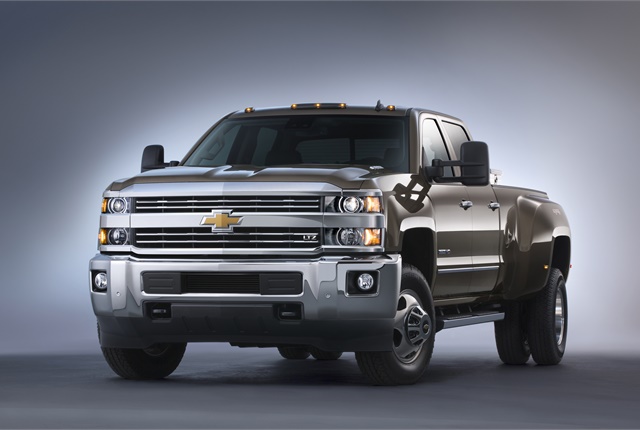
Photo of Chevrolet Silverado 3500 courtesy of Chevrolet.
">Photo of Chevrolet Silverado 3500 courtesy of Chevrolet.
">General Motors is recalling 35,292 2011-2015 Chevrolet Silverado 3500 and GMC Sierra 3500 trucks — all equipped with dual fuel tanks — because the low fuel level sensor for the front tank may stick, according to the National Highway Traffic Safety Administration.
As a result of the problem, the rear tank might overfill the front tank and create excessive pressure that causes the front tank to expand and contact the driveshaft. This could lead to a hole in the tank that would leak fuel and pose a fire risk, NHTSA said.
Dealers will replace the rear tank fuel pump or update the fuel-level sensor software to resolve the problem. The front tank will also be inspected and replaced if needed. There will be no charge for this service.
Vehicle owners will be notified of the recall beginning in mid-December. When repair parts are available at dealers, a second notice will be mailed in February.
Vehicle owners can reach Chevrolet customer service at (800) 222-1020 or GMC customer service at (800) 462-8782. GM's number for this recall is 17399.
Follow @HDTrucking on Twitter
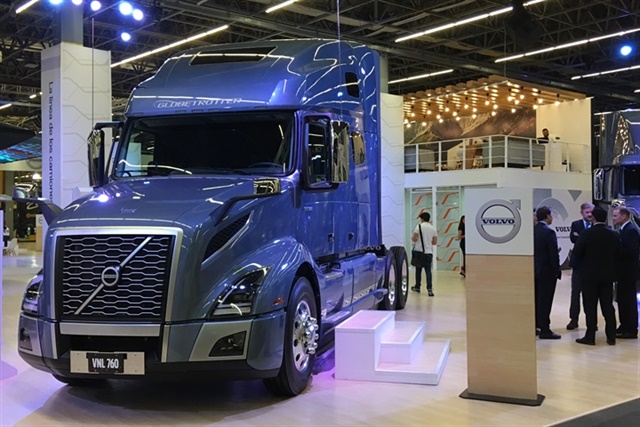
...Read the rest of this storyVolvo Trucks debuted the new VNL for the Mexican market. Photo: Jim Park
">Volvo Trucks debuted the new VNL for the Mexican market. Photo: Jim Park
">GUADALAJARA, MEXICO — The Mexican truck market has grown to 25,000 - 27,000 annual sales per year, according to Volvo, putting it on par with Canada and positioning it as one of the largest truck markets globally.
As a result, Volvo is expanding its presence in the country, officially launching the new VNL and for the first time, adding the VNR regional haul and VAH auto hauler truck models to the Mexican market.
“Expanding our product range makes Volvo Trucks even more competitive in the Mexican market,” said Göran Nyberg, president of Volvo Trucks North America, in making the announcement at the Expo Transporte commercial vehicle show. “We now have innovative, leading products for regional haul, long-haul and autohauler operations.”
The company has also worked to provide more access to truck buyers in and around Mexico City, investing 6 million to bring its trucks to the Group Alden dealership network and bringing the total number of Volvo dealer locations in Mexico to 43. The company has a presence in 140 countries with manufacturing operations on each continent.
Distinguishing it from U.S. versions, the VNL series trucks sold in Mexico will be offered with the Volvo D11 and D13 engines certified at EPA 04/ Euro 4, the country's current emissions standard. Volvo GHG 17 engines will be an available option for trucks that will operate in areas where they're permissible and ultra-low-sulfur diesel and diesel exhaust fluid are available.
For the first time, Volvo also introduced the new VNR series for regional haul operations and an expansion of the VAH auto hauler series in the country. Previously Volvo Trucks was mostly only offering the VNL in the Mexican market. The VNR and VAH will also be offered with U.S. EPA 04/ Euro 4 engines ...Read the rest of this story
Photo: Volvo Group
">Photo: Volvo Group
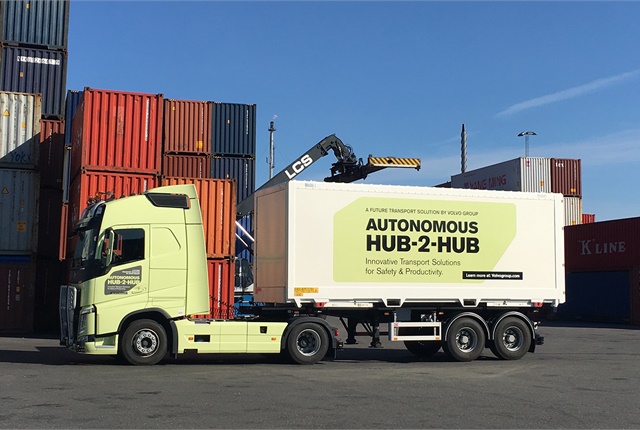
">The Volvo Group demonstrated a new self-driving truck, designed to travel autonomously from one hub to another, at the Volvo Group Innovation Summit in Beijing, China.
The latest autonomous concept truck was designed for hub-to-hub transportations in semi-confined areas such as harbors and dedicated lanes on highways. The company previously showed similar autonomous concepts for confined areas such as mines, quarries, and sugarcane fields, and this new solution takes those ideas into an over-the-road setting.
The truck is based on the company's existing FH platform and navigates completely autonomously, using lidar and GPS to continuously scan its surroundings and check its location. It can navigate around fixed and movable obstacles and gather data to optimize its route, traffic safety, and fuel consumption. The truck requires no manual supervision and is part of a total transport solution that controls the entire delivery process.
“Although this technology may be years away from production, it will undoubtedly influence our future offering and has the potential to develop smart societies for the future,” said Martin Lundstedt, president and CEO at Volvo Group. “No matter what type of solution we develop, safety is always our primary concern and this applies to all our self-driving projects.”
Related: Business Interests Spur Autonomous Vehicle Policy Moves in Wisconsin
Follow @HDTrucking on Twitter
...Read the rest of this story