Maven ELD certified, listed on the FMCSA registry
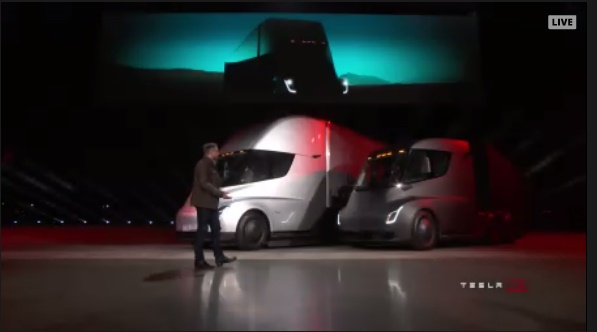
Screen shot from Tesla's live feed unveiling its electric semi.
">Screen shot from Tesla's live feed unveiling its electric semi.
">LOS ANGELES – The highly anticipated Tesla electric semi has finally arrived. And, as hinted, teased and promised these many past months, it is a potential game-changer — and quite possibly a disruptive vehicle for trucking in many ways.
Tesla chose to launch the truck at its SpaceX facility in the Los Angeles suburb of Hawthorne, with more than 1,000 journalists in attendance from around the globe. Security was incredibly tight as journalists were taken in small groups to a small hanger, where two Class 8, all-electric daycab models were on display with engineers on hand to explain various vehicle systems and features.
While the initial vehicle walk-around focused on a very high-level view of the truck, there's still a lot of information available.
For starters, the unveiled truck very closely resembles the now-familiar blacked-out teaser photos that Tesla released months ago. This includes a highly aggressive aerodynamic design dominated by a Corvette-like front end and a steeply sloped hood. Remember, there is no internal combustion engine at the front of this truck, which allowed Tesla engineers to completely rethink its configuration with an emphasis on safety and visibility. One particularly slick feature is the LED marker lights at the top of the cab, which are located behind the windshield and shine through a darkened strip at the top, keeping them completely protected from the elements.
The massive batteries that power the truck are located directly underneath the cab, while the electric motors they power are arranged between the frame rails behind the cab and running under and aft of the fifth wheel. Tesla says these are the same electric motors found in Tesla Model 3 cars. One electric motor powers each drive wheel-end. The motors are computer controlled and can deliver electrical power individually ...Read the rest of this story

If you were asked to describe a smart highway, you might say it swiftly collects tolls. You might say it speeds the flow of goods. You might say it advances safety. You might even say it glows. And you might say, how on Earth do I merge onto this ribbon of wonder?
All that's promised by myriad visions of the smart highway is nowhere near here yet, but some smart features already exist in some places. The technology is also being incorporated into the planning of major urban and suburban transportation-infrastructure projects.
Unlike the smart trucks and cars that are grabbing headlines, the smart highway seems to be slowly sneaking up on us. But that will change. As more highway users come to understand what intelligent roadways can offer trucking and society at large, more pressure will be directed at local, state, and federal government to speed their development by taking out regulatory speedbumps and spurring public and private investment.
To compare what's here and now to what's likely around the corner and what might be coming along somewhere down the road, it helps to start with a working definition of just what a smart highway is. Let's peg it as a road with one or more intelligent and/or interactive technological features bolted onto it or built into its design.
Following that line of thinking, we can see that existing roads with overhead gantries to make toll collection faster and safer, or with weigh-station bypass systems to benefit truckers, as highways boasting smart features.
Where do we go from here?Where the smart highway goes from here appears limited only by the imagination. Transportation engineers might argue that mundane but critical technical limits like bandwidths and network speeds may play a role in what smart features get rolled out first and where. But infrastructure funding, or ...Read the rest of this story
Photo: Embark
">Photo: Embark
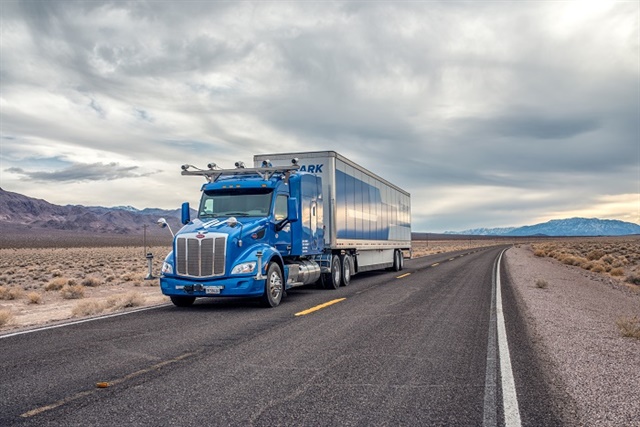
">Autonomous vehicle technology company Embark has partnered with Ryder System and household appliance maker Frigidaire, on a pilot test program to transport goods on public highways in the Southwest.
Beginning in October, the pilot has involved several trips transporting appliances through four states using Embark automated trucks, on the highway segments and Ryder tractors and drivers on surface streets. The pilot is focused on highway driving, which is more structured and allows for faster commercialization, and solves a critical challenge for the freight industry, according to the company.
“Trucking is facing a workforce problem,” said Alex Rodrigues, Embark's CEO. “More than 50% of all drivers will retire in the next two decades and there aren't nearly enough young drivers joining the industry to replace them. By allowing automation to work together with local drivers to handle less desirable long haul routes, we will be able to increase productivity to address the current 50,000 driver shortage, while also creating new local driving jobs that attract younger drivers for the industry.”
During the pilot program, Frigidaire refrigerators were successfully transported 650 miles at a time, using automated driving technology. Operating at a Level 2 system, the pilot involved trucks with a professional driver sitting at the wheel actively monitoring the road, supervising the system, and ready to take control at any time. The team worked closely with state transportation and public safety officials in Texas, New Mexico, Arizona, and California to coordinate testing activity.
Stretches as long as 306 consecutive miles were traveled in automated mode, with the driver only taking over control for a mandatory stop at a port of entry, according to Embark. After the initial pilot program, Embark, Frigidaire, and Ryder will look to increase the number of test trucks moving shipments along this freight lane in the coming months.
“Every month we're ...Read the rest of this story