Five Tips for Winterizing Heavy-Duty Diesel Engines


The U.S. housing market improved in October following some ups and downs earlier in the year, while industrial production jumped in part due to increased manufacturing. And e-commerce retail sales continued booming in the third quarter.
New home construction surged 13.7% from the month before to an annual rate of 1.29 million units, according to a Commerce Department report Friday. That's the highest level in a year and better than a consensus estimate from analysts. September's performance also was revised slightly higher.
The October increase ended three straight months of declines triggered due to shortages of land, labor and even building materials, according to Reuters, which had put a damper on both new home construction and even sales of these homes. The 2.4% increase in total housing starts from the same time a year ago also has been kept lower due to less multi-family home construction.
Construction of new single-family homes, the largest share of the market, saw a 5.3% increase in October from the month before, hitting its highest level in eight months.
Also, the number of building permits issued for all homes, an indicator of future building levels, moved 5.9% higher in October to its highest level since January.
Overall, the “report does point to momentum for new home sales,” according to analysts at Econoday, who noted the housing market started the year off strong but stumbled through the spring and had a flat summer.
Analysts at Wells Fargo Securities said the pace of building came back stronger than before two hurricanes hit the U.S. this summer. The increase in permits issued also bodes well for residential investment in coming months.
This follows another report on the housing market from Thursday that revealed builder confidence in the market for newly built single-family homes rose two points to a level of 70 in November, according to ...Read the rest of this story
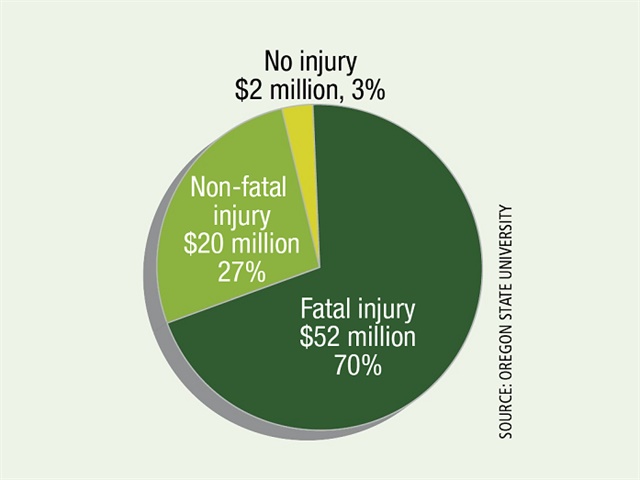
Crash harm costs in six Oregon truck crash ‘hot spots.'
">Crash harm costs in six Oregon truck crash ‘hot spots.'
">A pilot study by Oregon State University illustrates the high economic cost of having too few safe places for commercial truck drivers to park and rest — but an indirect solution may be on the horizon.
Over a seven-year period on one 290-mile stretch of highway alone, at-fault truck crashes resulted in approximately $75 million in economic costs of “crash harm,” according to research conducted by the OSU College of Engineering for the Oregon Department of Transportation.
Crash harm is defined as a “measure of the combined human and material losses from traffic crashes based on economic valuation.”
“Current crash data collection forms don't have an explicit section for truck-parking-related crashes, but we can operate under the assumption that specific types of at-fault truck crashes, such as those due to fatigue, may be the result of inadequate parking,” said the study's lead author, Salvador Hernandez, a transportation safety and logistics researcher at OSU.
Hernandez and his team analyzed Oregon's portion of U.S. Highway 97, which runs the entire north-south distance of the state along the eastern slope of the Cascade Range.
“Around the country, commercial drivers are often unable to find safe and adequate parking to meet hours-of-service regulations,” Hernandez said. “This holds true in Oregon, where rest areas and truck stops in high-use corridors have a demand for truck parking that exceeds capacity. That means an inherent safety concern for all highway users, primarily due to trucks parking in undesignated areas or drivers exceeding the rules to find a place to park.”
Researchers looked at what other states were doing in response to the parking issue, surveyed more than 200 truck drivers, assessed current and future parking demand on Highway 97, and used historical crash data to identify trends and hot spots and to estimate crash ...Read the rest of this story
The long wait is over and the all-electric Tesla Semi is here for all the world to see. Expect predictions over the next few days as to its future: Will it be a disrupter? Or a dud?
For now, it's obvious that electric trucks won't make massive inroads into North American fleet operations in the immediate future. So maybe your inclination is to dismiss the Tesla truck as a high-tech oddball that doesn't affect you or your business.
But I'm going to argue that powertrain aside, the Tesla truck is a glimpse of the future of trucking and will be a game-changer for trucks very soon.
About 10 years ago, General Motors was kind enough to supply me with a rotating fleet of editorial demonstrator vehicles to drive, evaluate and write about. This was at a time when the first GPS, infotainment centers and other real-time driver tools were coming on line. It was really stunning technology at the time, and I remember crowding friends inside the vehicles so they could see and play with the navigation screens and other features.
Over the summer, I bought myself a new-to-me car — a sweet little ride that is about a year old. This little car is also loaded with the latest suite of automotive driver aids — which are almost identical to the systems I first encountered a decade ago.
Those systems, which were mind-blowing at the time, are pretty much no big deal today. In fact, they're clunky to use, hard to see, and impossible to manipulate safely while driving the car.
Compare and contrast my newish car driver aids with the systems in the new Tesla truck, however, and you suddenly realize how woefully far behind auto makers — and yes, truck OEMs — are in terms of integrating new driver assistance technology with a ...Read the rest of this story

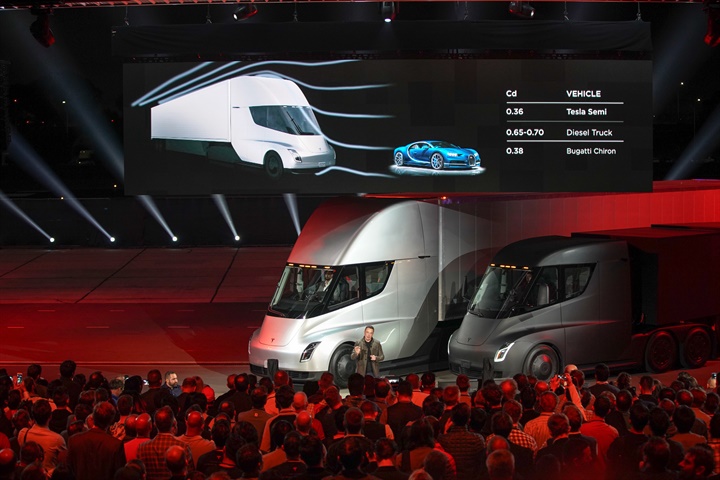
Tesla has revealed more details concerning its new, all-electric Class 8 Semi.
In a scene reminiscent of a Rolling Stones concert in the 1960s, Tesla CEO Elon Musk emerged from a silver Tesla Semi at a SpaceX hanger in Hawthorne, California, packed with raucous fans.
For starters, Musk noted that the truck will feature a 500-mile range on a single battery charge, which he said would allow fleets to “go out to the middle of nowhere and return.” Equally important, he said that a planned network of global, high-speed, Direct Current charging stations would give the truck an additional 400 miles of range — and compared that to the 15 to 20 minutes it takes to fill up a diesel-powered Class 8 truck today, adding that drivers are required to take rest breaks anyway. “Once you're done with your break,” he said, “your truck will be ready to go.”
Fleets that use solar-powered “mega-chargers” would see tremendous savings, he added, since their trucks would be “powered by sunlight,” while adding that the batteries receive additional electric energy through the truck's regenerative braking system, which Musk said was so powerful drivers would rarely need to use the brake pedal.
Musk likely raised more than one eyebrow when he claimed that thanks to its optimized traction and instantaneous torque, the new Semi would be able to go from 0 to 60 mph in five seconds without a trailer, and 0 to 60 in 20 seconds when pulling a fully loaded trailer. Equally important, Musk said the unique characteristics of an electric powertrain's torque delivery with no clutch actuation or gear shifts would allow the Tesla Semi to climb a 5% grade while maintaining a constant 65 mph.
Musk also touted the simplicity of the design and its operation, noting that there was not transmission or gears that ...Read the rest of this story