Is your trucking company prepared to confront a crisis?
Rolf Lockwood
" >Rolf Lockwood
" width="185" height="245">My mandate with this column is to write about the tools that keep our trucks rolling, the hardware and software and operational tricks that make the difference between earning a buck and going broke. But if you think about it, people are one of the most important tools you can have.
Somebody asked me the other day what draws me to another person and makes me hang around. Of all the things I value in other people, civility is the one I crave most. And it's one that I see pretty rarely these days.
I was reminded of how I found a perfect example of that sought-after quality several years ago in an odd place – the unpaved back 40 of a fleet's yard. It surprised me at the time, but I later realized it was actually typical of that particular outfit's “corporate culture,” to use a terribly worn phrase.
First off, what do I mean by civility?
It's the act of being civil. Of being polite, considerate, though not necessarily kind in a warm and fuzzy way. Of being able to relax the darn ego for a minute or two – deliberately – in favor of someone else's best interest or psychic comfort. In some people, the truly civil, it's not a deliberate act at all, rather an instinct.
So how did I find civility out in the back 40? I was visiting a fleet manager, himself a picture of civility, and he wanted to show me an interesting trailer at the back of the company's huge acreage, so we went walking through the dusty unpaved yard.
I heard a diesel cranking to life and then saw the nose of a T600 poke out of a row of trailers and turn toward us. Most of the way through its turn, and 100 ...Read the rest of this story
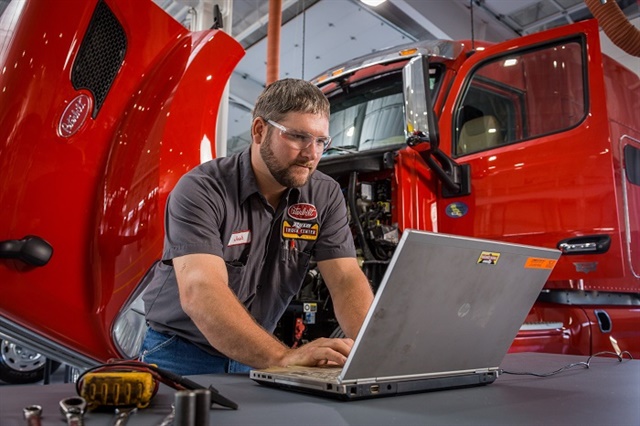
Diagnostic tools are vital for fleet maintenance procedures today. But the systems can be expensive and difficult to use across different makes and models of trucks. Photo: Rush Truck Centers
">Diagnostic tools are vital for fleet maintenance procedures today. But the systems can be expensive and difficult to use across different makes and models of trucks. Photo: Rush Truck Centers
">The diagnosis process for Class 8 vehicle repairs has come a long way, and even more capable systems will soon give fleet managers and technicians unprecedented access to data and diagnostic abilities. But, as with many new and emerging fields of technology, there are growing pains.
Handheld diagnostic devices and shop laptops today allow technicians to access vehicle systems in ways that were unimaginable a few years ago. But with that power have come concerns over both the upfront and annual costs of hardware and software associated with these tools, as well as the proliferation of products and the continuing lack of any sort of common platform to simplify matters on the fleet side of the equation.
“As Class 8 equipment continues to become more complex and sophisticated, diagnostics tools are becoming essential, and the adoption from desktop to handheld has accelerated,” says Scott Vanselous, TMW Systems executive vice president. “Fleets are changing the way they measure maintenance operations. More progressive fleets are tracking equipment downtime and utilization versus the cost to operate a truck. This is a major shift in the industry.”
Taken as a whole, Vanselous says, these changes on the diagnostic front have been transformational for fleets, which are now able to minimize and even eliminate unscheduled downtime. “Diagnostic handheld devices are just more efficient and help fleets quickly understand the health of critical components on their vehicles to take proactive action, before breakdowns occur,” he says.
“The rate of change is incredible,” adds Dick Hyatt, chief executive officer and president, Decisiv. “And we're moving into two distinct areas of operation today: One where you have telematics relaying information directly off a ...Read the rest of this story
Rolf Lockwood
" >Rolf Lockwood
" width="185" height="246">Disrupt, disruption, disruptive. I like these words, even though they've already become over-used in the business and technology worlds to describe developments that have the potential to force a change in direction. To obliterate expectations. Or simply to make us think very hard.
The first time I heard the word “disruptive” expressed in this way, the governor of Nevada used it during his remarks on the launch of the semi-autonomous Freightliner Inspiration Truck in Las Vegas. He was right to use it in that instance, because the technology involved did challenge assumptions and point us toward next steps.
So what's the next disruptor? Well, your guess is as good as mine, and the thing is we probably can't guess – the nature of a truly game-changing idea is that it sneaks up on normal folks like you and me. Or at least the implications do.
For me, that's the case with 3D printing, and I believe it's about as big a disruptor as you'll find in the freight-hauling world. It has the potential to wipe a lot of freight right off the map. Really.
It will revolutionize shopping too, and eventually it will render present distribution systems obsolete. At some point in the future just about everything, except some foods and conventional fuels, I suppose, could be made locally. Freight re-defined.
Need an obscure part for your not-quite-current truck? No need to order it from a warehouse days away, because your local dealer can make it for you on the spot. Some companies have even developed ways to 3D print a house.
How about a 3D-printed jawbone made to fit you exactly – jagged edges and all – in the event of some traumatic accident and the need for facial reconstruction? The medical possibilities are endless.
Lest you think this is some futuristic vision, ...Read the rest of this story
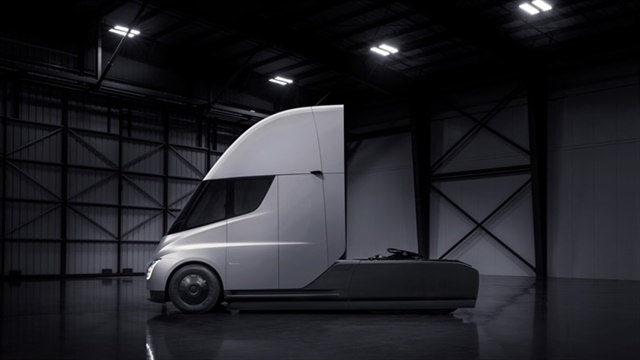
Photo: Tesla
">Photo: Tesla
">J.B. Hunt Transportation announced that it placed a reservation to purchase multiple Tesla Semi electric tractors that was unveiled on Nov. 16.
The Tesla Semi is slated for launch in 2019 but companies can reserve a truck now for $5,000. J.B. Hunt plans to deploy the electric trucks to its intermodal and dedicated contract services divisions to support operations on the West Coast.
“Reserving Tesla trucks marks an important step in our efforts to implement industry-changing technology,” said John Roberts, president and chief executive officer at J.B. Hunt. “We believe electric trucks will be most beneficial on local and dray routes, and we look forward to utilizing this new, sustainable technology.”
In April, J.B. Hunt announced a five-year, $500 million commitment to enhancing operating systems, developing cloud infrastructure, and creating innovative and disruptive technologies, as the company commits to meeting the needs of an evolving supply chain and introduces new technology for customers and employees.
In addition to its investment in electric trucks, J.B. Hunt is supporting sustainable initiatives such as reducing engine idle time, governing top speed limits, converting over-the-roads shipments to intermodal, optimizing routes for better efficiency, and using biodiesel fuels when possible.
Related: Tesla Unveils All-Electric Class 8 Semi Truck
Follow @HDTrucking on Twitter
...Read the rest of this story