ATA: Tonnage surged in November

ATA: Tonnage surged in November

Truck freight up 2.8% year-to-date, the trade group added.

The American Trucking Associations (ATA) said its for-hire truck tonnage index jumped 8.2% in November after dropping 0.3% in October.

Year-to-date, compared with the same period in 2015, tonnage is up 2.8%, the trade group noted.

Bob Costello, ATA's chief economist, noted in a statement that 2016 “has been an interesting year” with monthly gains and decreases in truck tonnage “as large as I can remember,” which he said suggests freight seasonality is “different” this year.

read more

...Read the rest of this story

Truck Tonnage Index Shows Significant Increase

<img width="150" src="http://www.automotive-fleet.com/fc_images/news/m-truck-tonnage-index-3-1.jpg" border="0" alt="

Source: ATA

">

Source: ATA

">

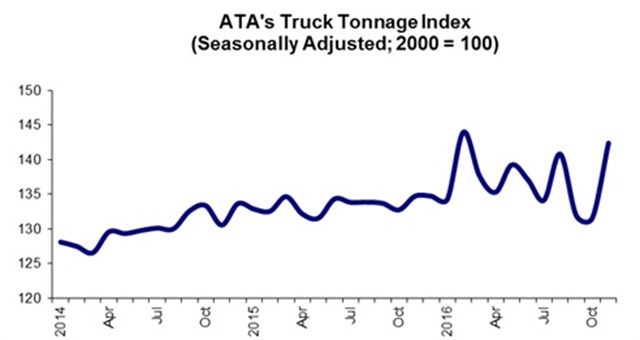
The American Truck Associations' advanced seasonally adjusted For-Hire Truck Tonnage Index spiked 8.2% in November, recovering from a slight 0.3% dip in the month before.

The Truck Tonnage Index equaled 142.4, up from 131.6 in October and only slightly down from the all-time high reading of 144 from February of this year.

Compared to last November, the index is up 5.7% - the first year-over-year gain since August. Year-to-date, compared with the same period in 2015, tonnage was up 2.8%.

“2016 has been an interesting year for truck tonnage, with monthly gains and decreases as large as I can remember, which suggests seasonality is different this year,” said Bob Costello, ATA chief economist. “November's substantial increase continued with the seesaw pattern that has persisted for much of the year.”

The not seasonally adjusted index, which represents the change in tonnage actually hauled by the fleets before any seasonal adjustment, equaled 135.9 in November, which was 1.7% below the previous month.

“While I think the November gain overstates the strength in the freight market, I do believe we are seeing some improvement that will continue into 2017,” said Costello. “Retail sales are good, the housing market is solid, and the inventory overhang throughout the supply chain is coming down, all of which will help support truck freight volumes in 2017.”

Related: Overall Freight Shipping Levels, Rates Better than They First Look

Follow @HDTrucking on Twitter
...Read the rest of this story

Navistar Ends Fiscal Year with $97 Million Loss

Truck and engine maker Navistar International Corp. (NYSE:NAV) on Tuesday reported losses for both its fiscal fourth quarter and full year. But it's optimistic about the future with its pending strategic alliance with Volkswagen Truck & Bus, which has received U.S. antitrust approval.

The Illinois manufacturer had a net loss of $34 million for the quarter ending on Oct. 31, or 42 cents per share, compared will a fourth quarter 2015 net loss of $50 million or 61 cents per share.

This was short of expectations. The average estimate of seven analysts surveyed by Zacks Investment Research had forecast net income of 24 cents per share.

Revenue in the most recent quarter fell 17% from a year earlier to $2.06 billion, also missing analysts' expectations. The drop was largely driven by an 18% decline for charge-outs (typically trucks that have been invoiced to customers with units held in dealer inventory) in the company's Class 6-8 trucks and buses in the United States and Canada. Those charge-outs totaled 13,000 units, and largely reflected continued softening of Class 8 industry volumes in the U.S. and Canadian markets, according to the company.

Fourth quarter 2016 earnings before interest, taxes, depreciation and amortization (EBITDA) was $95 million versus $86 million in the same period a year ago. This year's fourth quarter included $9 million in net charges for asset impairments and restructurings, and $8 million in pre-existing warranty adjustments. As a result, adjusted fourth quarter 2016 EBITDA was $112 million.

For all of fiscal 2016, Navistar reported a net loss of $97 million, or $1.19 per share, versus a net loss of $184 million, or $2.25 per share, for fiscal year 2015. Revenue for fiscal 2016 was $8.1 billion compared to $10.1 billion in fiscal year 2015.

Fiscal year 2016 adjusted EBITDA was $508 million, versus $494 million adjusted EBITDA ...Read the rest of this story

How Navistar’s SuperTruck Exceeded Goals

<img width="150" src="http://www.automotive-fleet.com/fc_images/articles/m-navst-1.jpg" border="0" alt="

Photos: Jim Park

">

Photos: Jim Park

">

The unveiling of Navistar's SuperTruck in late September completes the first round of the Department of Energy's fuel efficiency improvement demonstration project. Like the three others before it, Navistar's truck, dubbed CatalIST, exceeded the DOE's goals and provides possibilities for actual operations. CatalIST achieved a freight efficiency improvement of 104% compared to the baseline vehicle (a 2009 ProStar-powered rig). Its engine achieved brake thermal efficiency of 50.5%, and 13 mpg in real-world over-the-road and urban duty-cycle test runs.

Aerodynamics played a huge role, while advanced technology such as kinetic energy recovery, off-engine accessory drives, variable-speed compressors, and lightweighting shared the rest of the glory. Navistar also brought some clever solutions to traditional problems that seem unique among the four SuperTruck projects.

“We engineered the aerodynamic design back to front,” says Dean Oppermann, chief engineer for advanced vehicles and the SuperTruck group at Navistar. “We are pretty well tapped today on what we can do with the tractor alone until we clean up the trailer. Once we did the trailer, speaking in relative numbers, a 2-3% improvement on the tractor became an 8-10% improvement because of the overall reduction in drag on the rear of the trailer.”

Engineers got closer to the highly desirable teardrop shape by lowering the ride height of the the trailer suspension and the Hendrickson air-over-spring steer axle suspension, giving the vehicle an airfoil-like top profile.

“At speeds above 50 mph, we drop the front and rear suspension by 1.5 to 2 inches,” says Oppermann. “The boat tail at the rear helps to reduce the low pressure area at the base of the trailer, too. That relatively small shape change is very good for air flow.”

The trailer features nose treatment and Wabash's Ventix Drag Reduction system, essentially vented side skirts. There is also a fairing in front of ...Read the rest of this story