Calandrino steps up as new Fastfrate president
As far as terror weapons go, a semi-truck is a pretty good choice – assuming you're the sort of ill-adjusted fanatic who spends his day trying to dream up ways to kill other human beings, that is. Trucks are big. They're heavy. They're hard to stop once they get going. And they're everywhere. Getting hold of one and deploying it against the millions of "soft targets" around the world is a relatively simple affair: Once you've got it, all you have to do is decide whether you want to pack it full of explosives like right-wing terrorist Timothy McVeigh did in his Oklahoma City attack in 1995, or plow through a packed Christmas marketplace as the attacker in Berlin, Germany, did earlier this week, leaving at least 12 people dead.
Reports are sketchy at the time, but the latest news reports indicate the truck was owned by a Polish fleet and apparently hijacked. The driver was reportedly dead in the passenger seat next to the terrorist driver. The fleet reported it had lost contact with the truck prior to the attack.
Terror attacks should never be considered "routine." But in today's world they are a fact of life – and one that seems unlikely to get better any time soon. And while I certainly don't want to side-step the horror still unfolding in Germany (a country I've visited many times as a trucking journalist and come to love immensely), nonetheless, if you're a fleet manager, at some point thinking about the potential for a terrorist attack and coming up with ways to guard against such an attack has to be a high priority.
At this point, I think it's safe to say the trucks-as-terror-weapons problem isn't one that can be solved by more regulations, background checks, law enforcement initiatives or even stricter immigration ...Read the rest of this story
Source: EIA
" >Source: EIA
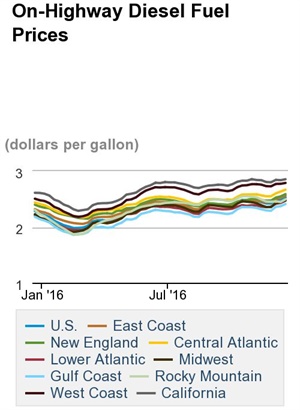
" width="250" height="342">The price of diesel fuel saw significant increases for the third straight week, according to the latest numbers from the Energy Department.
The average price of on-highway diesel fuel jumped 3.4 cents last week, hitting $2.527 per gallon at the pump. As 2016 comes to a close, the price of diesel fuel is now more than 24 cents higher than it was in the same week of 2015.
Prices were up in all regions of the U.S., with the largest increase coming to the Rocky Mountain region with a 4.8 cent spike for the week. Prices saw the least change on the West Coast, where the average rose only 1.6 cents for the week.
The average price of regular gasoline was also up last week, increasing 2.8 cents to $2.264 per gallon at the pump. The price is 23.8 cents more expensive than it was in the same week a year ago.
The largest increase was on the Gulf Coast, where gas prices rose by 4.5 cents per gallon. The smallest increase was on the West Coast, where prices notched up 0.7 cents.
An instance of political uncertainty caused crude oil prices to increase slightly on Dec. 19, as the assassination of the Russian ambassador to Turkey caused the market to trend higher, according to a MarketWatch report.
With a deal between oil producing countries to reduce or freeze production already on the books, new tensions between Russia and Turkey could cause oil supplies to tighten further-- which can have the effect of increasing prices.
Related: Breaking the 10 MPG Barrier
Follow @HDTrucking on Twitter
...Read the rest of this story
Great Dane has received accreditation from the National Institute for Automotive Service Excellence for its service technician training program.
Great Dane said that it is the first semi-trailer original equipment manufacturer to receive ASE accreditation for a technician training program. Other major companies in the automotive services industry that have ASE accreditation include Toyota, General Motors and Penske Truck Leasing. The ASE accreditation is through the ASE Continuing Automotive Service Education program.
“Training is a key part of our emphasis on safety, and we are proud that our training program has received this accreditation,” said Dave Durand, Great Dane vice president of aftermarket parts and service. “ASE accreditation assures our customers that our training processes are held to a national standard.”
The rollout of the training program is ongoing and is designed to support Great Dane's effort to ensure the safe and efficient delivery of goods.
The ASE accreditation program is administered by the Automotive Training Managers Council (ATMC), a nonprofit organization that has been a member of ASE's Industry Education Alliance since 2009. Earlier this year, ATMC evaluated Great Dane's process for developing and delivering training and then recommended accreditation by ASE.
“When you see the Great Dane Certified Technician insignia, you know the technicians working on your trailer have proven their skills through theoretical and practical tests in their specialties,” said Durand.
Related: Great Dane Dealer Opens Full-Service Facility in Fresno
Follow @HDTrucking on Twitter
...Read the rest of this story
Advertisements are like time capsules. They mirror the concerns of the age in which they were written by describing products and services available to help people carry on their lives. Ads we see today in newspapers, magazines and now on internet websites might some day be viewed that way, though most are more brief than those run in foregone times, when narratives were part of established formats.
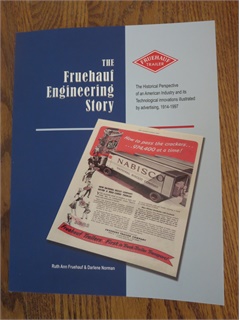
Vintage ads help Ruth Ann Fruehauf, granddaughter of the founder of Fruehauf Trailer Corp., tell how the company designed and built trailers for many uses. Her book, “The Fruehauf Engineering Story,” runs 84 pages (with soft covers) and shows scores of ads describing how customers employed semitrailers during war and peace.
Led by Harvey Fruehauf, one of August's sons and an accountant, the company created and ran ads in monthly periodicals aimed at general readership, like the Saturday Evening Post, and those in our industry, including Heavy Duty Trucking. Executives credited advertising for part of their success.
Fruehauf was once a dominant name in the trailer-building business. The company grew as the concept introduced in 1914 by its founder, blacksmith August Fruehauf, caught on with freight carriers. High capacity and great versatility were the reasons trailers made immense sense in the transport world.
“A truck is like a horse. It can pull more than it can carry,” was the slogan of Fruehauf and his company, and that appeared as part of the firm's advertising for years. He put some numbers to it by explaining that while an early 20th century horse could carry 300 pounds, it could pull a wagon weighing 2 tons; and while a truck of that time could carry 3 tons, it could easily pull a 9-ton trailer. Today we call that productivity.
Versatility lay in use of a single truck-tractor that could work continually, ...Read the rest of this story