New EU Rule Aims to Boost “Transparency” of Truck MPG

New EU Rule Aims to Boost “Transparency” of Truck MPG

<img width="150" src="http://www.automotive-fleet.com/fc_images/news/m-vectothumb-1.jpg" border="0" alt="

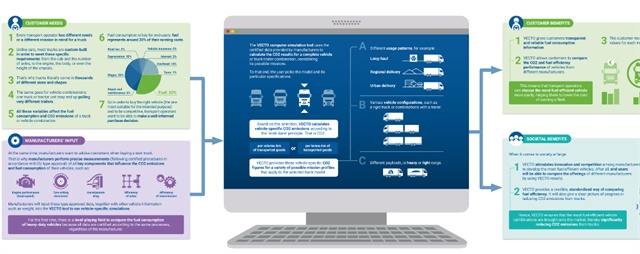
Infographic lays out how EU's Vecto computer simulation tool functions. Image: ACEA

">

Infographic lays out how EU's Vecto computer simulation tool functions. Image: ACEA

">

A new European Union procedure for determining emissions of the greenhouse gas CO2 from new trucks has won praise from a key industry group for its expected positive impact on transparency.

The European Automobile Manufacturers' Association said it “welcomes [the procedure] as an important step to introduce more transparency to the market– ultimately leading to reduced fuel consumption and lower CO2 emissions” from commercial vehicles.

The European Automobile Manufacturers' Association (ACEA) is the Brussels, Belgium-based trade association of the 15 major car, van, truck and bus producers in Europe. Its membership includes DAF Trucks, Daimler Trucks, Iveco, MAN Truck & Bus, Scania, Volkswagen Commercial Vehicles, and Volvo Group.

The new regulation, approved in May by member states in the EU's regulatory committee, will require CO2 emissions from new trucks to be calculated per “harmonized and certified procedures.” EAMA said the European Commission has developed a computer calculation tool, called Vecto, to model CO2 emissions from a wide variety of complete truck and trailer configurations using various heavy-duty vehicle cycles.

“Using Vecto data, the EU legislation on the calculation of CO2 from trucks will require a declaration of CO2 values for each vehicle produced for the EU market,” EAMA said in a statement. This will in turn provide “a credible, standardized way of comparing fuel efficiency across all brands.”

“This will be a major game-changer, as it will help transport operators choose the most fuel-efficient vehicle more easily, thereby significantly reducing CO2,” asserted ACEA Secretary General Erik Jonnaert. “It will also lead to increased transparency and competition among manufacturers to develop the most fuel-efficient vehicles, driving the market uptake of the cleanest vehicles.”

Jonnaert pointed out that the EU market is diverse and complex with “trucks usually tailor-made to customers' specific orders or are ...Read the rest of this story
595 trucks! Mercy's Sake: Talk about a convoy!

LANCASTER, PA-- For 364 days of the year, the horse-drawn Amish buggy is the vehicle most commonly associated with the city of Lancaster, Pennsylvania. But not on Mother's Day. On Mother's Day, Lancaster is all about trucks. Last Sunday, May 14, 595 trucks rolled out in the annual Make-A-Wish Mother's Day Truck Convoy. By the time the last driver had pulled out, an estimated $400,000 to $450,000 had been raised for Make-A-Wish of Philadelphia, Northern Delaware and Susquehanna Valley, with approximately $300,000 of that coming from the drivers themselves. ...Read the rest of this story

595 trucks! Mercy' Sake: Talk about a convoy!

LANCASTER, PA-- For 364 days of the year, the horse-drawn Amish buggy is the vehicle most commonly associated with the city of Lancaster, Pennsylvania. But not on Mother's Day. On Mother's Day, Lancaster is all about trucks. Last Sunday, May 14, 595 trucks rolled out in the annual Make-A-Wish Mother's Day Truck Convoy. By the time the last driver had pulled out, an estimated $400,000 to $450,000 had been raised for Make-A-Wish of Philadelphia, Northern Delaware and Susquehanna Valley, with approximately $300,000 of that coming from the drivers themselves. ...Read the rest of this story

Economic Watch: Industrial Production, E-Commerce Jump; Home Starts Drop

Industrial production in the U.S. rose in April more than expected and by the fastest rate in more than three years, according to a new report issued Tuesday. Meanwhile, separate reports show e-commerce continues to boom but the building of new homes fell for the second straight month.

The total output at the nation's factories, mines and utilities increased 1% from the month before, marking the biggest gain since February 2014, according to the Federal Reserve, and far better than a 0.4% gain expected from a consensus estimate by analysts.

Pushing the overall figure higher was a 1% increase in factory production after falling 0.4% in March and a 1.2% improvement in the output from mines, following a drop of 0.4% the month before. Utility output moderated to a 0.7% increase after leaping 8.2% in March.

At 105.1% of its 2012 average, total industrial production in April was 2.2% above its year-earlier level.

Capacity utilization for the industrial sector increased 0.6 of a percentage point in April to 76.7%, but was 3.2 percentage points below its 1972–2016 average.

Wells Fargo Securities noted that April is the first time in recent memory that all three major industry groups were higher with manufacturing, mining and utilities all posting gains of at least 0.7% on the month.

“One lesson from the ups and downs of the manufacturing recovery in this cycle is to curb your enthusiasm when the data finally indicate firming in activity,” cautioned Tim Quinlan, senior economist at Well Fargo Securities. “The latest print of the Institute for Supply Management manufacturing survey showed a big dip in the orders component [during April].”

E-Commerce up Nearly 15% from Year Earlier

Meantime, a separate report, also released Tuesday, showed first quarter e-commerce retail sales in the U.S. grew 4.1% from the final quarter of 2016 while increasing faster than ...Read the rest of this story