No clear ‘net benefit’ to overnight restart, FMCSA concedes

read more
...Read the rest of this storyread more
...Read the rest of this storyPhoto: Jim Park
">Photo: Jim Park
">A DOT study apparently has failed to “explicitly identify a net benefit” from two suspended provisions of the hours of service rules regarding the 34-hour restart.
The Federal Motor Carrier Safety Administration issued hours-of-service regulations in 2013 that featured two controversial restart provisions. They required that the 34-hour restart include two 1 a.m. to 5 a.m. periods, even if the 34 hours had already been reached. It also limited use of the restart provision to once every 168 hours. The trucking industry raised concerns about the rule's unintended consequences, such as increased congestion during the daytime traffic hours.
In late 2014, as part of the Consolidated and Further Continuing Appropriations Act of 2015, Congress suspended those two provisions and directed FMCSA to conduct a study of the operational, safety, health, and fatigue impacts of these rules.
Although the data collection for that study was completed in 2015, the study has not get been made public. However, the law also mandated that the DOT Office of Inspector General review the study.
Last week, in a letter to Congress, the OIG wrote that it “found that DOT's study met the act's requirements. We also concur with the Department's conclusion that the study did not explicitly identify a net benefit from the use of the two suspended provisions on driver operations, safety, fatigue, and health.”
Drivers from a variety of fleet sizes and operations provided a substantial amount of data during the study period, according to the FMCSA. More than 220 drivers contributed data as they drove their normal routes. The data included over 3,000 driver duty cycles captured by electronic logging devices, over 75,000 driver alertness tests and more than 22,000 days of driver sleep data.
Related - Regulatory Outlook: Sunny if Foggy for 2017
Follow
Photo: Morgan Corporation
">Photo: Morgan Corporation
">Truck and van body maker Morgan Corporation has launched its NexGen line of truck bodies for dry freight and refrigerated applications.
NexGen bodies make use of more advanced designs and materials, resulting in truck bodies that are lighter than similar units but are capable of carrying more payload, according to Morgan. The design of NexGen bodies also results in increased fuel economy and better resistance to the elements.
The lightweight body is built of non-corrosive materials to inhibit rust, improving durability and slowing aging. NexGen bodies feature stain-resistant phenolic flooring in the dry freight body and an aluminum silent floor in the reefer.
Sealed joints prevent leaks to keep product, cargo, or tools dry, using elastomeric gaskets in the connection profiles to provide protection from water intrusion. The bodies also use hard-mount installation brackets in place of U-bolts to improve overall durability.
For more information, click here.
Related: Truck Body Aimed at Landscaping Fleets
Follow @HDTrucking on Twitter
...Read the rest of this storyPhoto via Kokam
">Photo via Kokam
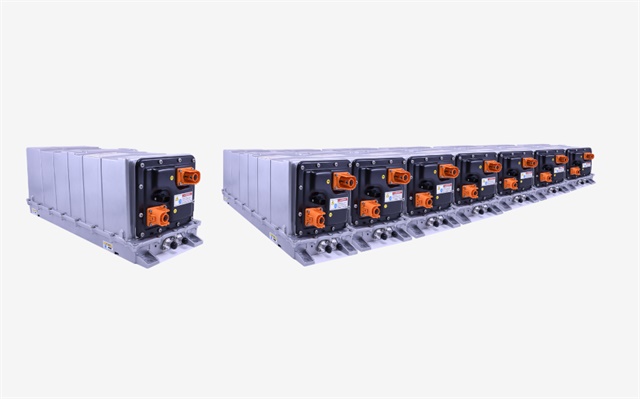
">Korean technology company Kokam has introduced a new battery called Xpand that is designed to improve battery safety and performance for commercial electric vehicles.
By using a liquid cooling system that cools battery cells directly, Xpand batteries have as much as 75% reduced mass compared to air-cooled systems. This allows the company to produce batteries with higher energy density in a more compact package.
The company said that its new batteries exceed current electric vehicle battery standards for safety, with a ceramic separator and other battery pack thermal containment to prevent thermal runaway. The batteries have received an IP67 rating for dust and water protection and also meet many other major standards, per Kokam.
The batteries are also designed for better longevity, with a lifespan of over 6,000 cycles, according to Kokam. They feature a modular plug-and-play design to help adapt to a variety of EV applications while also making them easier to service in the field.
The batteries also come with built-in monitoring capabilities featuring diagnostics, battery state information, and a flexible system architecture to provide more accurate charge and health estimates.
The Xpand battery pack will be offered in two versions: XMP71P, a 7.1-kilowatt hour version, and XMP114E, an 11.4-kilowatt hour version. Both versions are scalable enough to support EV applications from 7.1-kilowatt hours up to 1.5-megawatt hours of capacity in a wide variety of voltages.
"While cost and performance are important considerations for electric bus, tram, and other EV manufacturers when selecting a battery, safety is their number one priority," said Ike Hong, vice president of Kokam's Power Solutions Division. "With Xpand, Kokam now offers manufacturers an EV battery pack that has been tested and certified to be one of the safest EV battery solutions on the market - while still offering high levels of performance at a competitive price."
Related:

An increase in new factory orders is one of the latest economic signs that the Federal Reserve is moving close to another jump in interest rates, some analysts believe.
New orders for manufactured goods in January increased 1.2% from the month before, according to a full Commerce Department report released Monday, slightly better than a Wall Street consensus estimate. It was boosted by sizable jumps in the notoriously volatile aircraft components for both defense and nondefense.
This followed an unrevised 1.3% improvement in December while new orders are up 5.5% from January 2016.
Orders for manufactured durable goods increased 2% in January following two straight months of declines, better than the first estimated 1.8% gain.
Total shipments of factory goods increased 0.2% in January following a 2.5% surge in December, marking 11 consecutive monthly improvements.
Shipments of so-called “core-capital goods,” which are an indication of business investment and are used in calculating the nation's gross domestic product, fell 0.4% in January, better than the first reported 0.6% drop.
“On balance, the hard data in the manufacturing sector continue to show improvement, although the pace has been slower than sentiment indicators alone would indicate,” said Tim Quinlan, senior economist at Wells Fargo Securities.
He noted that core capital goods orders are up 8.7% on a three-month average annualized basis. That's the fastest pace since 2014 and it corroborates some of the rising sentiment seen in other indicators.
This and other recent indications, such an strong employment, rising prices and anecdotal evidence of a firming gross domestic product, have led some analysts to say they believe the Federal Reserve will increase interest rates when it meets later this month.
Among them is CNBC's Jim Cramer, who said last week that "The rest of the economy is strong enough to take it” and there is no excuse for the central bank ...Read the rest of this story