Author: Vitaliy Dadalyan

ATA Forecasts Steady Rise in Truck Tonnage Over Next Decade

<img width="150" src="http://www.automotive-fleet.com/fc_images/news/m-freight-transportation-forecast-1.jpg" border="0" alt="

Image via ATA

" >

Image via ATA

" width="250" height="250">

The American Trucking Associations has released its latest forecast for the next decade of freight transportation, projecting continued growth for freight transportation overall and for the trucking industry.

The ATA Freight Transportation Forecast 2017 projects freight volumes to grow by 2.8% in 2017 followed by 3.4% annual growth through 2023. After that point, the report expects growth to return to a more moderate 2.3%.

In 2017, ATA projects that 15.18 billion tons of freight will be moved by all modes of transportation, rising by 36.6% to 20.73 billion tons in the next 10 years.

“As the U.S. population grows and the economy increases with it, we will see continued gains in demand for freight transportation,” said Bob Costello, ATA chief economist.

ATA worked with IHS Global Insight on the report, with IHS providing the data and forecasts and ATA publishing the analysis.

The forecast covers all modes of transportation, not just trucking, which was important because in cases where trucking is not the primary mode of transportation it usually plays some sort of secondary transportation role, Costello said in a media conference call.

Trucking is projected to grow 33.6% over the forecast period. Overall, truck volumes will continue to rise over the forecast period and will remain the dominant freight mode, but its share of tonnage is expected to dip to 67.2% by 2028 with pipelines gaining the most share.

With an increase in freight tonnage, one of the challenges for the trucking industry is figuring out how to move all of the new freight.

“Over the forecast period, capacity shortfalls will develop,” the report said. “We are starting to see some selected tightness in freight handling capacity, enough to suggest that capacity expansion will be required if the modes are going to be able to handle anticipated growth.”

ATA contends that the role of ...Read the rest of this story

Economic Watch: Concerns Remain Despite Housing Rebound

Housing starts in the U.S. bounced back, according to a new Commerce Department report, but concerns remain about the future of the housing market as well as the wider economy.

Nationwide housing starts rose 8.3% in June from the month before to a seasonally adjusted annual rate of 1.22 million units, the highest level since February and better than a consensus estimate from analysts.

Single-family production, the overwhelming majority of the market, increased 6.3% to a seasonally adjusted annual rate of 849,000 units, while multifamily starts rose 13.3% to 366,000. Single-family production was at its second-highest rate this year.

“We are encouraged by the June production report, but our builders continue to express concerns about lot and labor shortages, and building materials price increases,” said Granger MacDonald, chairman of the National Association of Home Builders (NAHB).

Overall permit issuance in June was up 7.4% to a seasonally adjusted annual rate of 1.25 million units. Single-family permits increased 4.1 percent to 811,000 units while multifamily permits jumped 13.9% to 443,000.

“We are seeing housing production return to trend after a softer reading last month,” said NAHB Chief Economist Robert Dietz. “The gradual growth in single-family starts in 2017 is in line with our forecast, and we should see this sector continue to strengthen throughout the year as consumers show interest in the housing market.”

Housing May Yet Be On Shaky Ground

However, not everyone is convinced about how solid the housing market is following the release on Tuesday of the NAHB Housing Market Index, which fell from 66 to 64 in July, an eight-month low.

This suggests a bit of a contradiction between the two latest reports, according to Lindsey Piegza, chief economist at Stifel Fixed Incomes, because as builders continue to break ground on new projects, builder confidence appears to be waning.

“Housing market participants still remain optimistic about ...Read the rest of this story
Increased Truck Orders Push Volvo Profit Higher


The parent company of Volvo Trucks and Mack Trucks on July 19 reported both increased sales and profitability during the second quarter of the year.

Sweden's Volvo AB said net profit for the period was 6 billion kronor ($725 million), up from 1.9 billion kronor a year earlier, according to AP, and in line with analysts' expectations. Profit a year earlier was hit due to a 2.3 billion kronor payment the company made due to a European Union completion investigation.

Sales increased 12% to 88.4 billion kronor as its net order intake for trucks increased to 55.265 from 45,422 a year earlier. Despite this total, truck deliveries during the quarter fell by 1% due to the North American market, according to the company.

“Recent trends on the truck markets continue with good demand in Europe, including a distinct recovery in Russia, and a gradual improvement in North and South America, with increased order intake,” said Martin Lundstedt, president and CEO.

Volvo said that in North America, the on-highway truck segment is still characterized by over-capacity due to the underutilized population of used long-haul trucks, however, regional distribution is showing signs of higher activity.

In North America, truck deliveries were down 11% for the company during the quarter. Volvo Trucks' market share came in lower at 8.8% while Mack gained market share, reaching 8.2%.

The order intake increase of 30% was driven by both Mack and Volvo reflecting the higher activity within the construction segment and a somewhat improved freight environment, according to the company.

Volvo raised its total North American market forecast for retail sales volume modestly to 225,000 trucks 2017, up from its previous projection of 215,000.

The company is the first truck maker to release earnings for the second quarter, with Daimler and Paccar set to unveil their figures next week.

Related: Volvo Unveils Next-Generation VNL ...Read the rest of this story

ATA: Freight projected to grow 3.4% a year thru 2023

Trade group also predicts 15.18 billion tons of freight will be moved by all modes in 2017.

Freight volumes are expected to grow significantly over the next 10 years, according to analysis by the American Trucking Associations (ATA), with the 15.18 billion tons of goods expected to be moved by all modes this year climbing 36.6% to 20.73 billion tons by 2028.

read more

...Read the rest of this story

Another House Bill Aims to Delay ELD Rule

<img width="150" src="http://www.automotive-fleet.com/fc_images/news/m-driverpaccarfinancial-3-1.jpg" border="0" alt="

Photo: Paccar Financial

">

Photo: Paccar Financial

">

Another Hail Mary Pass has been flung to try and slow the advance of the electronic logging device rule. On July 18, Rep. Brian Babin (R-TX) introduced the ELD Extension Act of 2017 (H.R.3282) to extend the current initial implementation date for the ELD mandate from December 2017 to December 2019. The bill has been referred for consideration by the House Transportation and Infrastructure Committee.

The day before Babin's bill came out, the House Transportation Committee attached a rider to the DOT funding bill that could end up delaying or repealing the electronic logging device mandate.

Both Babin's bill (either as a standalone act or attached to other legislation) and the committee's rider would have to survive the legislative maw of the House and Senate — even tougher to do in this very turbulent year on Capitol Hill — to end up as final legislation and then be signed into law by President Trump before the ELD mandate could be slowed or stopped.

The political reality is that it is only remotely possible that either measure will become law. And even if one did, it would more than likely not be in place before the mandate kicks in this December.

The Owner-Operator Independent Drivers Association applauded the new bill. “We thank Rep. Babin for realizing the serious problems associated with implementation that can only be avoided by putting off the mandate,” said Todd Spencer, OOIDA executive vice president.

“The agency has failed to answer important questions from Congress and industry stakeholders about this mandate,” he continued. “This includes issues related to enforcement, connectivity, data transfers, cybersecurity vulnerabilities, and many other legitimate, real-world concerns.”

Related: Could House Bill Slow or Even Stop ELD Rule?

Follow @HDTrucking on Twitter

...Read the rest of this story

Spot Freight Market Returns to Normal Following Holiday Surge

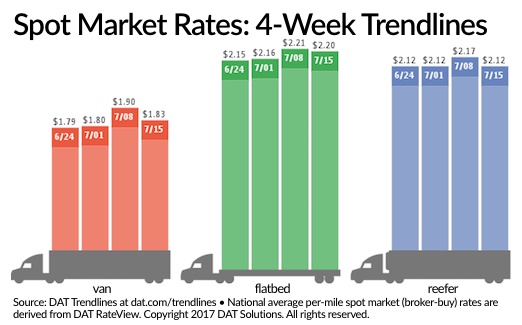
The spot truckload freight market returned to seasonal norms during the week ending July 15 as the number of posted loads increased 35% and truck posts added 28%, according to DAT Solutions and its network of load boards.

Higher demand did not lead to higher rates, however, as urgency subsided during the first full week after the Fourth of July holiday. National average spot van, refrigerated, and flatbed rates all settled down.

The top 100 van lanes hit records for volume last week and van load posts increased 21% and truck posts increased 30% nationally. That caused the van load-to-truck ratio to decline 7% to 5 to 1.

The national average van rate fell to $1.83 mile, down 7 cents after a 10-cent gain the week before but still 3 cents higher than the June average.

Prices were lower in the Southeast, South Central, and Northeast regions. Allentown, Pennsylvania, lost 11 cents for an average of $2.03 per mile and Philadelphia dropped 4 cents to $1.70 per mile. All reported rates include fuel surcharges.

Other major van markets also showed declines over the past week:

Los Angeles: $2.21 per mile, down 8 centsCharlotte: $2.25 per mile, down 8 centsAtlanta: $2.20 per mile, down 5 centsDallas: $1.78 per mile, down 6 centsHouston: $1.84 per mile, down 5 cents

Reefer load posts increased 27% week-over-week while truck posts were up 17%. The national load-to-truck ratio increased 8.5% to 9 to 1. The national average rate retreated 5 cents to $2.12 per mile, matching the June average.

Despite the overall decline, the range for reefer rates is wide with outbound freight paying $1.62 per mile from Lakeland, Florida to $2.75 per mile outbound from Green Bay.

Flatbed volumes didn't slip as expected in the first half of July. Instead, there were 52% more loads posted last week than the week before, and ...Read the rest of this story