Author: Vitaliy Dadalyan

Q. What is driver harassment in the context of the ELD mandate, and how is it addressed?
A. In the context of the ELD mandate, the Federal Motor Carrier Safety Administration (FMCSA) defines harassment as an action a fleet takes toward one its drivers that it knew or should have known would result in the driver violating hours of service (HOS) rules. The FMCSA explicitly prohibits a fleet from harassing a driver in connection of their use of an ELD.

HOS rules prohibit fleets from requiring drivers to drive when their ability or alertness is impaired due to fatigue, illness, or other causes that could compromise the driver's ability to operate his or her vehicle safely.

To be considered harassment, the action must involve information available to the fleet through an ELD or other technology used in combination with an ELD.

The FMCSA ELD technical specifications address harassment directly, including a provision to include a mute function to ensure that the driver is not interrupted in the truck's sleeper berth. In addition, ELD specifications only allow limited edits of the ELD record by both the fleet and the driver—and require that the original ELD record can't be changed and must also be retained. As a result, fleets will be limited in their ability to force drivers to violate HOS rules without leaving an electronic trail that would point to the original and revised records. Required driver certification of any edits or annotations is intended to, in part, protect drives from unilateral changes—a contributing factor to harassment.

A driver may file a written complaint if he or she was subject to harassment.

It is important to note that harassment will be considered in cases of alleged HOS violations, so the penalty for harassment is in addition to the underlying HOS violation. An underlying HOS violation must be found for a harassment penalty to be assessed, according to the FMCSA.

...Read the rest of this story

Commentary: A Whirlwind of Last-Minute ELD Preparations

<img width="150" src="http://www.automotive-fleet.com/fc_images/articles/m-deborah-lockridge1-23-1.jpg" border="0" alt="

Deborah Lockridge

" >

Deborah Lockridge

" width="185" height="243">

The trucking industry has had nearly two years to prepare for the mandate requiring electronic logging devices to track driver hours, which goes into effect Dec. 18. Yet a surprising number of fleets have not yet adopted them.

Morgan Stanley, which has been conducting quarterly ELD surveys of fleets since May 2015, in August reported that nearly 30% of carriers were not yet in full compliance. And 15% of the carriers surveyed did not expect to be fully compliant when Dec. 18 rolls around.

It's likely some smaller carriers have been waiting in hopes that the Owner-Operator Independent Drivers Association's quest to derail the mandate (see the latest on page 14) will bear fruit. But not taking action on the electronic logging device mandate because you're hoping for a last-minute reprieve from the government is a bit like refusing to prepare for a hurricane because you're hoping for a last-minute change in the storm track.

In fact, given our recent experience with Hurricane Irma, I'd say your chances are better for missing the hurricane.

After the Supreme Court declined to hear OOIDA's appeal in its case to block ELDs this summer, the association turned to lobbying tactics to try to get Congress to step in. So far, legislation has been proposed but is going nowhere fast.

OOIDA also filed a petition with the Federal Motor Carrier Safety Administration claiming that it wasn't even legal for many states to enforce the mandate because they needed to incorporate it into state law. But it appears that most of those states have in place laws that make adoption of federal rules for interstate haulers automatic.

When I talked to FMCSA's chief enforcement guru last month, Joe DeLorenzo, he emphasized that the government is ready and able to start enforcing the new rule.

The Commercial Vehicle Safety Alliance ...Read the rest of this story

ITI unveils Sentix for automated training needs

Company says system can help fleets reduce liability by changing dangerous behavior.

Instructional Technologies Inc. (ITI) said its new automated web-based learning management system will be available starting Nov. 1.

The new system is known as Sentix. ITI is the maker of the Pro-Tread online driver training system. The company is based in Vancouver, WA.

Sentix “can automate assignments for new hires, schedule training before an endorsement expires, or trigger corrective training based on an event or trend,” said Aaron Purvis, chief technology officer of ITI.

read more

...Read the rest of this story

Intellipark Takes the Sting Out of Parking Brake Valves

<img width="150" src="http://www.automotive-fleet.com/fc_images/blogs/m-intellipark-1.jpg" border="0" alt="

Intellipark helps mitigate runaway crashes and is the foundation for automated and autonomous truck parking. Photos: Bendix

">

Intellipark helps mitigate runaway crashes and is the foundation for automated and autonomous truck parking. Photos: Bendix

">

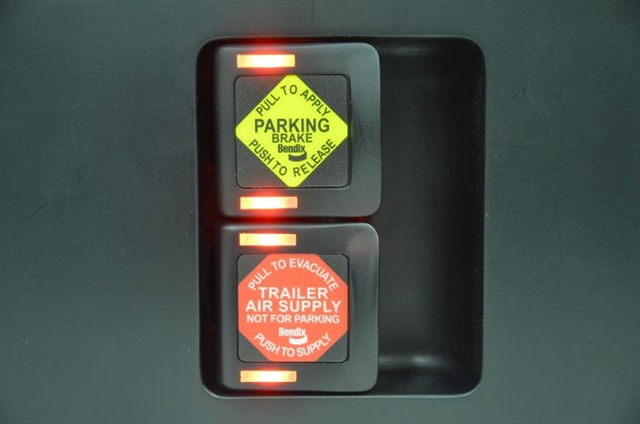
As much as I enjoy driving tractor-trailers, one thing that has irked me for many years is the parking brake valves on the dashboard. The two push-pull valves -- the yellow one for tractor brakes and the red one for trailer brakes – are awkward to release because they must be pushed hard and held before brakes are released. And when pulled to apply the brakes, they pop out, sometimes stinging one's fingers – my fingers, anyway, which I suppose makes me a wimp.

Those valves might be low on professional drivers' complaint lists, but I doubt that I'm the only one who finds them clumsy to use. And there's a better way. European heavy and medium trucks use a handy joystick-like control that applies the parking brakes when swung one way and releases them when swung another. A collar that's pulled up by one's index and middle fingers unlocks the stick for movement either way. It's simple and very easy to use. Paccar employs this on the medium-duty cabovers sold by its Kenworth and Peterbilt divisions.

That the joystick parking-brake device is used here tells me that the system is not illegal in the U.S. Why, then, does every American-built truck have the two push-pull valves (or one yellow valve if the truck is not made to pull a trailer)? Because it's an industry standard, promulgated by the Society of Automotive Engineers in the 1950s, explains Fred Anderskey, director, customer solutions for Bendix, which is among the manufacturers of air-brake equipment. The shape, color, and lettering on the valves is in the standard, but it's not in a federal regulation.

Bendix sees a more serious problem with the valves: They sometimes do not apply the parking ...Read the rest of this story

Great Dane highlights foodservice products at IFDA

At the 2017 International Foodservice Distributors Association (IFDA) Distribution Solutions Conference, Great Dane will showcase several products designed for temperature-sensitive deliveries. Conference attendees can visit booth 239 to view an Everest refrigerated trailer and an Alpine refrigerated truck body both featuring Great Dane's ThermoGuard liner with Microban broad-spectrum antimicrobial protection that helps fight bacteria growth, stains and odors for the life of the trailer or truck body.

read more

...Read the rest of this story

Earnings Watch: J.B. Hunt Third Quarter Profit Slips

Profits for multi-modal freight transportation provider J.B. Hunt Transport Services fell a little more than 8% in the third quarter of the year despite increased revenue, with increased driver recruiting and retention costs part of the reason.

The Arkansas-based company reported net earnings of $100.4 million, or 91 cents per share, compared to $109.4 million a year earlier, or 97 cents per share. The per share performance in the most recent quarter was 5 cents less than analysts were expecting.

Total operating revenue for the third quarter was $1.84 billion, compared with $1.69 billion for the third quarter 2016.

Operating income for the current quarter totaled $165 million compared to $183 million for the third quarter 2016, primarily due to increases in driver wages and recruiting costs, increased rail purchase transportation rates, higher insurance and claims costs, increased legal and consulting costs, higher equipment maintenance costs and acquisition and integration costs incurred by its purchase of Special Logistics Dedicated (SLD) LLC that closed during the quarter.

The company's intermodal segment saw revenue increase 8% during the quarter to $1.05 billion, while operating income declined 7% to $109.1 million despite a 6% increase in overall freight volume.

The network disruption caused from hurricanes Harvey, Irma and Maria limited the company's ability to handle approximately 5,500 loads in the period, according to J.B. Hunt.

The period ended with approximately 87,000 units of trailing capacity and 5,500 power units assigned to the dray fleet.

J.B. Hunt's dedicated segment reported $438 million in revenue, up 11% from a year earlier, as operating income was $42.9 million, an 18% decline.

Productivity, measured as revenue per truck per week, increased by approximately 2% compared to the same time in 2016.

Increased revenue from better integration of assets between customer accounts and customer rate increases was partially offset by lower productivity at new contracts implemented during ...Read the rest of this story

DAT: Freight Index hits all-time high in September

Tight capacity sends spot rates to their highest point since December 2014, according to DAT.

The DAT North American Freight Index achieved record highs in September, with a 9% gain compared to August. Spot freight availability was 74% higher than in September 2016, reported DAT Solutions, which operates North America's largest digital truckload freight marketplace.

read more

...Read the rest of this story