Author: Vitaliy Dadalyan

Maverick Raises Pay for Flatbed, Glass Division Drivers

<img width="150" src="http://www.automotive-fleet.com/fc_images/news/m-maverick-driver-1-2.jpg" border="0" alt="

Screenshot via Maverick Transportation

">

Screenshot via Maverick Transportation

">

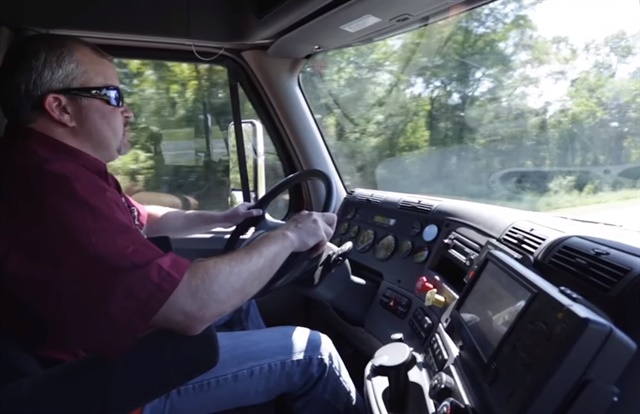
Maverick Transportation is raising driver pay in its flatbed and glass over-the-road divisions by 5 cents per mile. The pay increase is applicable to all drivers in both divisions for the Arkansas-based fleet, including student drivers.

The increase will bring base pay for OTR flatbed drivers to 51-56 cents per mile and regional OTR flatbed drivers to 49-54 cents per mile. Glass division drivers will now make 55-60 cents per mile. Students will start at 43-50 cents per mile base pay, depending on division. The pay increase will go into effect Dec. 18.

Many of Maverick's dedicated divisions will also receive pay increases. This is the second pay increase for Maverick Transportation in recent months. The carrier rolled out a 4-cent-per-mile pay increase for its temperature-controlled division at the end of last year.

“At Maverick Transportation, we pride ourselves on setting the industry standard when it comes to driver compensation,” said John Culp, president of Maverick Transportation. “We are constantly looking for ways we can put more money in our drivers' pockets.”

Maverick offers its drivers increases up to five years, a pay for performance bonus, and a driver referral bonus program. Other driver benefits include home time, weekend guarantee pay, paid orientation and training, paid weigh station bypass and tolls, 401k plan + match, company-paid life insurance, health and dental insurance options, and paid vacation. Additionally, Maverick is currently offering a $5,000 sign-on bonus for drivers with one year of verifiable experience.

Related: How Important is Driver Pay?

Follow @HDTrucking on Twitter

...Read the rest of this story
FMCSA Nominee Martinez Committed to ELD Rule

<img width="150" src="http://www.automotive-fleet.com/fc_images/news/m-fmcsaraymondmartinezwww-nj-gov-1.jpg" border="0" alt="

Raymond Martinez Photo: NJ.gov

">

President Trump's nominee for Administrator of the Federal Motor Carrier Safety Administration affirmed in Senate testimony that he will not delay implementation of the electronic logging device mandate that starts to kick in on Dec. 18, less than seven weeks from now.

Replying to Sen. Ted Cruz's (R-TX) query as to whether FMCSA “should delay the implementation of the mandate prior to Dec. 18” specifically “in light of the cost” estimated to implement it of $2 billion, Martinez said that while “regulatory reform should be an ongoing process,” it is “legally required” that the December deadline to implement the ELD mandate be met.

In his Oct. 31 testimony before the Senate Committee on Commerce, Science and Transportation on his nonirmation to head FMCSA, Martinez went on to state that, if confirmed, he would “look forward to working with industry and all stakeholders-- safety advocates and particularly the impacted sectors of commerce.

“I've heard that this rule could cause serious hardship to some small independent truckers, particularly those working in the agricultural sector,” he explained, “so, I'd want to meet with those involved in those areas who oppose the rule to learn more about their concerns. The goal is to not cripple commerce. The goal is to make our roadways safer. That is our mission and that's in everything we approach… through that lens of safety.

“So, first and foremost,” Martinez added, “[I would] abide by the law, but also have an open door policy and work with all the impacted stakeholders.”

Martinez is currently Chief Administrator of the New Jersey Motor Vehicle Commission. His previous experience includes serving as Chairman of the Governors Traffic Safety Committee in New York.

In his opening statement, Martinez related his bona fides to lead the federal safety-enforcement agency. “As the former Motor Vehicle Commissioner and Chairman ...Read the rest of this story

TA Truck Service Turns Attention to Smaller Fleets

<img width="150" src="http://www.automotive-fleet.com/fc_images/news/m-tatruckservice-1.jpg" border="0" alt="

Photo courtesy of TA Truck Service

">

Photo courtesy of TA Truck Service

">

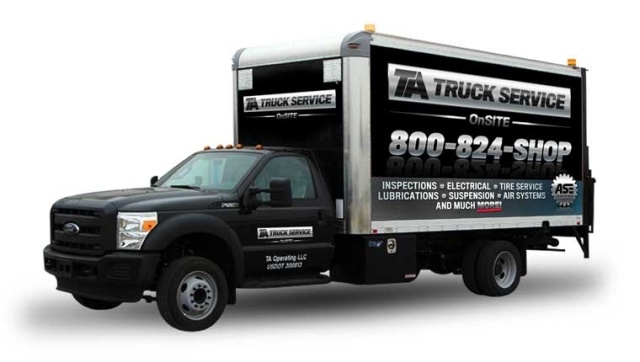
TravelCenters of America LLC is continuing its aggressive march into the commercial tire dealer market. Barry Richards, executive vice president, said the almost-year-old TA Service Commercial Tire Network is "on the right course."

The truck stop company invited a group of truck tire manufacturers to a meeting ahead of the 2017 Specialty Equipment Market Association (SEMA) Show to talk about some of the top issues facing the industry. Greg Frary, vice president of truck service, said the discussion spanned responsible tire resources, Tier 2 tires, and the looming uncertainty of the quashed tariff on truck tires imported from China.

Richards said the company wants to leverage its 244 brick-and-mortar locations (there's one in Canada, but all the rest are in the U.S.) Those are good staging areas, but the company also has 150 on-site service trucks that visit fleet customers' yards to perform maintenance checks, plus 600 road squad trucks that offer roadside service for tire blowouts and other emergency breakdowns.

And while the company has historically focused on large, national fleets, Richards said TA Truck Service has been aggressive in branching out. "We're going after non-traditional fleets," such as vocational fleets (think plumbers, electricians, etc.) plus multi-use construction companies.

Richards said the company has "drastically shifted" its focus and is "doing a much better job" working with smaller fleet customers.

Another new venture created in the last year has been a partnership with auction companies that sell used trucks. TravelCenters has created the "TA Certified" label. The company is working with auction firms to inspect, repair and certify the condition of used trucks before they're sold, much like original equipment manufacturers in the passenger automotive space certify their used vehicles at dealerships.

Related: TravelCenters Launches TruckSmart Parking App

Follow @HDTrucking on Twitter

...Read the rest of this story

Spot Truckload Freight Rates Slip But Stay High

<img width="150" src="http://www.automotive-fleet.com/fc_images/news/m-dat-rtow-wide-71-1.jpg" border="0" alt="

Graphic: DAT

">

Graphic: DAT

">

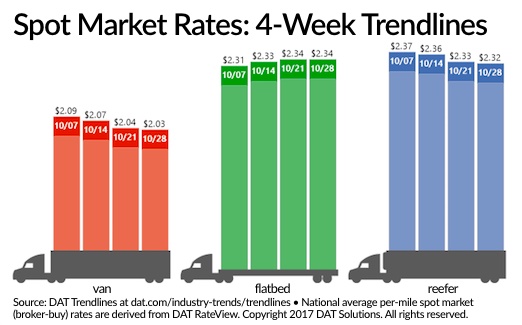
The availability of spot truckload freight dipped 1.8% while the number of trucks posted fell 2.4% during the week ending Oct. 28, according to DAT Solutions and its network of load boards.

National average spot van and reefer rates declined for the third week in a row while the flatbed rate held steady after nearly two months of steady gains. Rates remain elevated for this time of year for all three equipment types:

Van: $2.03 per mile, down 1 cent from last weekFlatbed: $2.34 per mile, unchanged from week beforeReefer: $2.36 per mile, down 1 cent from last week

Spot truckload rates may pick up before Thanksgiving, as retail sales are projected to grow by 6% this holiday season and demand for capacity is solid, according to the freight matching provider.

Volumes for the top van markets rebounded 5% last week as shippers moved freight out the door before month's end. Nationally, van load posts increased 1% and truck posts declined 3%, which caused the van load-to-truck ratio to increase from 5.4 to 5.9 loads per truck. In line with seasonal expectations during October, van load-to-truck ratios have declined since hitting a peak of 7.0 loads per truck during the final week of September.

Several key van lanes showed solid rates, including Dallas-Houston, $2.62 per mile, up 8 cents from last week, and Atlanta-Lakeland, Florida, $3.02 per mile, up 4 cents from the week before.

Reefer load posts held steady and truck posts declined 2%, causing the load-to-truck ratio to increase 1% to 9.7 loads per truck. The reefer load-to-truck ratio has fallen after hitting the highest average ratio in years in late September before turning upward again last week.

Flatbed load posts declined 6% and truck posts declined 2%, which caused the load-to-truck ratio to slip to 35.9 loads per truck, still a high ratio. ...Read the rest of this story