Author: Vitaliy Dadalyan

NATSO Opposes Commercialized Rest Areas in Arizona

<img width="150" src="http://www.automotive-fleet.com/fc_images/news/m-rest-area-sign-ariz-dot-1-1.jpg" border="0" alt="

Photo: Office of Arizona Gov. Doug Ducey

" >

Photo: Office of Arizona Gov. Doug Ducey

" width="301" height="213">

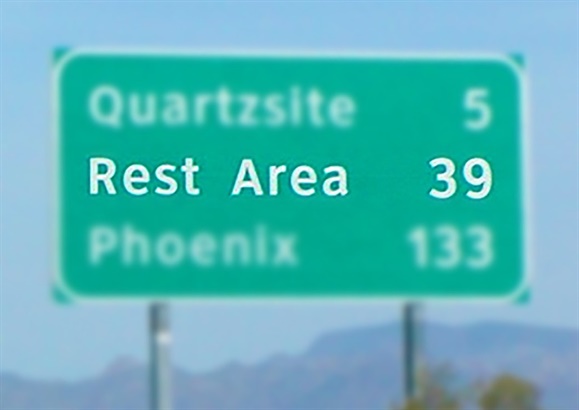
NATSO, a national association representing truckstops and travel plazas, has come out against the Governor of Arizona's push to commercialize rest areas along interstate highways.

In a letter to Department of Transportation Secretary Elaine Chao, Arizona Gov. Doug Ducey (R) asked that Arizona be exempted from a federal law that prohibits commercial activity at the state's rest areas. Gov. Ducey is requesting that Arizona be granted federal permission to launch a pilot program to commercialize rest areas in order to pay for their upkeep.

The federal law had the effect of privatizing highway services in 1960 when Congress prohibited states from offering commercial services at rest areas along the Interstate Highway System. NATSO stated that commercializing truckstops could displace restaurants, travel plazas, truckstops, convenience store,s and other businesses that already exist throughout the state.

"Rest area commercialization threatens thousands of businesses serving travelers at the interstate exits,” said Lisa Mullings, NATSO president and CEO. “This ill-advised proposal risks the livelihood of hundreds of Arizona business owners and their employees, and would hurt local communities who depend on the property taxes these businesses pay to fund schools and police.”

NATSO stated that the governor's actions is not privatizing commerce at rest areas, but rather would act as a way to transfer sales away from the private sector by creating a government-sanctioned monopoly.

"We don't need a pilot program to see the effects of commercial rest areas on local communities and businesses because there are at least a dozen states that oversee commercialized rest areas," said Mullings. "We can witness the anti-competitive effect that commercialized rest areas has on Interstate businesses.”

Related: Truckstop Group Urges Congress to Extend Biodiesel Tax Credit

Follow @HDTrucking on Twitter

...Read the rest of this story
Jumper Cables Designed for Work Trucks

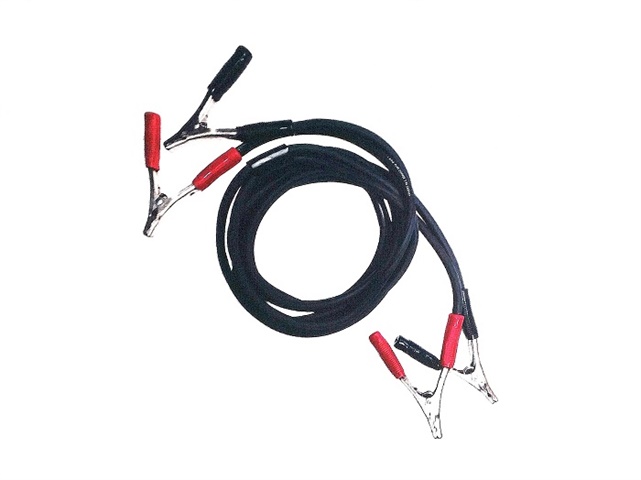
Mississippi Industries for the Blind's Mil-Spec booster cables are designed to jump-start trucks, heavy equipment, and other vehicles.

Developed by MIB for the U.S. Military, the Mil-Spec booster cables combine 1-gauge stranded copper welding type cable with solid copper clamps for better electrical conductivity and more efficient jump starts. The cables are significantly thicker than standard 6-gauge jumper gables and each clamp and cable has a 600-amp minimum current rating.

MIB also constructs each clamp from a solid copper sheet. In addition, the clamp jaws are serrated, and the clamps are assembled with a high tension spring to ensure a good connection to the battery terminal. The clamps are tested to hold 500 pounds.

The oil and abrasion resistant booster cables maintain flexibility in a wide range of temperatures from -94 degrees Fahrenheit to 198 degrees Fahrenheit and are available in up to 25-foot lengths for ease of vehicle positioning.

Follow @HDTrucking on Twitter

...Read the rest of this story
Chanje Electric Vans Unveiled

<img width="150" src="http://www.automotive-fleet.com/fc_images/news/m-chanje-testdrive-jp-1.jpg" border="0" alt="

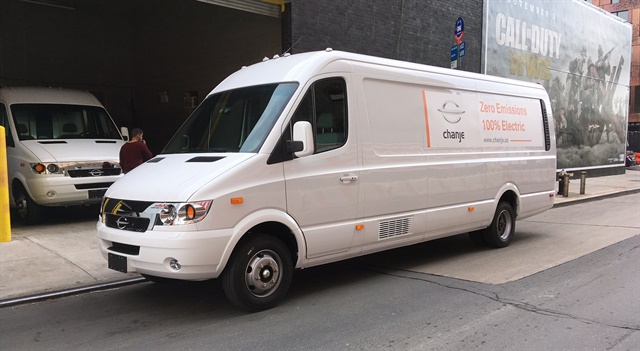
The Chanje van on the streets of Brooklyn. The U.S. market sets the highest bar for vehicle reliability and safety, and it is home to some of the largest delivery companies and consumer brands expected to use the vehicles. Photo: Jim Park

">

The Chanje van on the streets of Brooklyn. The U.S. market sets the highest bar for vehicle reliability and safety, and it is home to some of the largest delivery companies and consumer brands expected to use the vehicles. Photo: Jim Park

">

BROOKLYN, NY – Chanje is here.

The Chinese-based vehicle manufacturer (pronounced “change”) has officially unveiled its electric medium-duty panel van in Brooklyn, New York, with Ryder taking delivery of 125 units for its rental and leasing fleet.

The initial rollout will be in key California markets including Los Angeles, San Francisco, and San Diego, as well as New York and Chicago. Ryder will provide parts distribution, service and support.

“All the trends in diesel are going in the wrong direction,” said Chanje CEO Bryan Hansel, noting that diesel equipment is increasingly expensive to build, purchase, and maintain.

China's demand for electric vehicles is expected to outpace North America's needs in coming years, but the U.S. market sets the highest bar for vehicle reliability and safety, and it is home to some of the largest delivery companies and consumer brands expected to use the vehicles, Hansel says. This is being developed as a “world” truck for markets here and elsewhere, and the company says it has invested about US $1 billion in the design and related tooling.

The Vehicle

The V8070 van will reportedly hold a 6,000-pound payload in its cavernous 580-cubic-foot cargo bay. “For package delivery, it's a lot,” Hansel said, referring to the growing trend in home deliveries as a key driver behind such vehicles.

The turning radius is also a tight 25 feet. “When you're driving this, it feels like you're driving a minivan,” he said. “These were designed for an urban environment. You need to be able to drive them, you need to be able to park them, you need to ...Read the rest of this story

Are We Adopting Advanced Safety Systems Quickly Enough?

<img width="150" src="http://www.automotive-fleet.com/fc_images/articles/m-adas-adoption-1.jpg" border="0" alt="

Forward collision warning is becoming more common, but other ADAS technologies lag behind.

">

Forward collision warning is becoming more common, but other ADAS technologies lag behind.

">

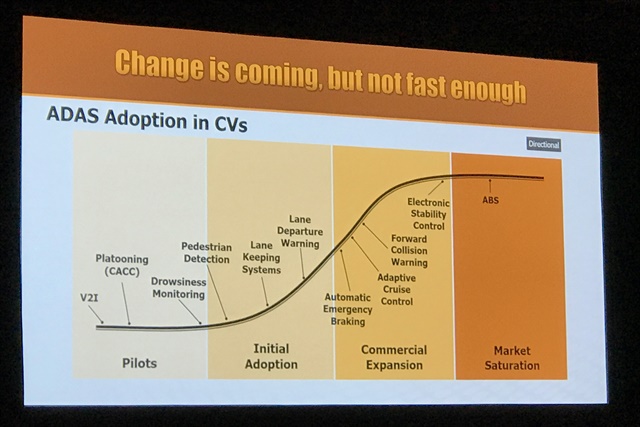
Advanced driver assistance systems present an opportunity to save thousands of lives and drive economic expansion over the next decade – but we need to move faster, contended Brian Collie, partner and managing director of Boston Consulting Group, in a recent speech.

“We can do better, and we have to do better,” said Collie, speaking to a room full of trucking supplier representatives at the Heavy Duty Manufacturers Association's Breakfast & Briefing during the North American Commercial Vehicle show in Atlanta this fall.

Boston Consulting Group helps its clients prepare for transformation to help stay at the top of their markets, and in a 2015 study it found that advanced driver assistance systems, such as forward collision warning/mitigation, blind spot detection, lane departure warning, and others, could avert nearly 30% of crashes. The 2015 study, commissioned by HDMA's parent organization, focused on the sluggish uptake by consumers buying cars, but Collie's remarks at NACV focused on commercial users.

Each year, he said, large-truck accidents result in more than 4,000 fatalities, $2.4 billion in property damage, and more than $50 billion in societal harm — and 90% of those are caused by human error. Since 2009, he said, large truck crashes and the resulting injuries and fatalities have risen significantly.

“It's going to get far worse before it gets better,” he said, as distracted driving continues to increase.

“We do have the answer.” While progress has been made in the last few years seeing adoption of forward collision warning and mitigation systems, he said, in other areas, such as lane keeping systems or drowsiness monitoring, “adoption is not there,” especially among smaller fleets.

And a lot of that comes down to the question of payback, or return on investment. While large fleets tend ...Read the rest of this story