The ‘underground economy’ versus trucking
Source: EIA
" >Source: EIA
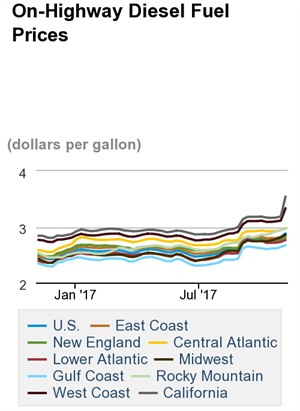
" width="285" height="390">The price of diesel fuel in the U.S. increased to its highest point since June of 2015, according to the latest numbers from the Energy Department.
The average price of on-highway diesel fuel jumped 6.3 cents last week, topping out at $2.882 per gallon at the pump. The price is now 41.2 cents more expensive than it was in the same week a year ago.
Prices were up in all major regions of the U.S. with the largest increase hitting the California with a staggering 35.6-cent rise in a single week. During the same week, California instituted a new fuel tax hike which increased prices by 20 cents per gallon.
The smallest change was recorded in the Rocky Mountain region where prices rose just 2.2 cents per gallon for the week.
Gasoline prices were up by a similar amount, increasing 7.3 cents last week to $2.561 per gallon. The price is currently 32.8 cents more expensive than it was in the same week of 2016.
The largest increase in gas prices was on the West Coast where, prices increased 12.1 cents for the week, again coinciding with a fuel tax increase in the state. The smallest change was in New England where prices rose just 1 cent.
The price of crude oil hit a two-year high on Nov. 6, after news of a purge of important political figures in Saudi Arabia caused the market to spike, according to a CNBC report. The crackdown on corruption in the country included a powerful prince, Mohamad bin Salman, and in the ensuing market trading, crude oil prices hit $64 per barrel.
While there may be some parallels between the price spike and an important oil-producing country's political turmoil, analysts pointed to a general sense of geopolitical uncertainty as a driving force in the price ...Read the rest of this story
Photo courtesy of Today's Trucking
">Photo courtesy of Today's Trucking
">PIT Group have been busy on a project first launched in 2014 that aims to examine the effects of optimized programming on commercial vehicle engines. The Quebec-based PIT Group is a research and engineering outfit focused on improving fleet maintenance and operations.
Today's engines, PIT says, feature nearly 200 programmable parameters, making it possible to optimize engine operation. So in theory, if optimally performed, programming adjustments should provide improvements in fuel efficiency and performance. We know that, but PIT's discussions with engine manufacturers brought to light their interest in a project that would demonstrate and quantify this potential.
It's no secret that most engines leave the factory and then the dealer's yard without ever being programmed to meet the user's specific operational conditions.
With that in mind, FPInnovations, through the PIT Group, launched a project in 2014, aimed at assessing the impact of optimized programming. It's been carried out with government funding received through Transition énergétique Québec, and was supported by major partners, including Cummins Eastern Canada and several carriers that agreed to take part.
The 26-month project had three main objectives: to develop standard programming based on specific applications, to compare the energy and environmental efficiency of vehicles using these programs, and to disseminate the results within the transportation industry.
The first series of track tests were conducted in September 2016 and included school buses, specialized-haul trucks, and regional-haul trucks. A second series of track tests was performed in February 2017 in order to gather more data. These tests included two categories of vehicles: school buses and local delivery trucks. Unlike the tests of September 2016, three different driving techniques were used: aggressive driving, normal driving, and eco-responsible driving.
Overall, the project led to promising results, which are briefly presented below:
Local transportation: 4-28% reduction in average fuel consumption in the city ...Read the rest of this story
The SureFly Octocopter and W-15 pickup will be shown at the 2018 CES in Las Vegas. Photo: Workhorse Group
">The SureFly Octocopter and W-15 pickup will be shown at the 2018 CES in Las Vegas. Photo: Workhorse Group
">Workhorse Group has announced that it will unveil its N-Gen low delivery platform electric van with an integrated HorseFly drone at the Consumer Electronics Show in Las Vegas in January.
The company will also introduce its W-15 electric pickup truck and its SureFly Octocopter, which Workhorse is calling the first personal electric octocopter.
The N-Gen low delivery platform electric van features a 19-inch floor for increased cargo space and ease of operation. It is expected to deliver a range of 100 miles with an optional gasoline range extender adding 75 more miles. The N-Gen is scheduled to begin package deliveries for a large e-commerce company within the next two months, according to Workhorse.
Optionally available with the N-Gen is an integrated HorseFly drone delivery system that's designed to launch an octocopter drone from the roof of an N-Gen delivery van and deliver a package to its destination within the driver's line of sight. The HorseFly system is compliant with all current FAA regulations and can carry a package weighing up to 10 pounds, according to Workhorse.
Additionally, Workhorse will be showcasing the W-15 at CES. This electric plug-in pickup has been designed to offerfeatures and benefits fleets look for in a work truck. Panasonic 18650 Li-on batteries deliver an 80-mile all-electric range. If needed, an on-board gasoline generator will then extend the range. Workhorse said it currently has over 5,000 W-15 vehicles under Letter of Intent from fleets.
Lastly, the company will show off the SureFly, which was first unveiled at the Paris Air Show in June. Workhorse said the SureFly aircraft is designed to be safer and more stable than a typical helicopter. Its redundant design includes four propeller arms, two fixed contra-rotating propellers on ...Read the rest of this story

Truckload and logistics provider Knight-Swift Transportation Holdings Inc. released third quarter earnings on Monday that showed a big drop in profit compared to a year ago, but officials said the numbers do not paint an entirely accurate picture following Knight Transportation's acquisition of Swift Transportation, which closed in September.
Net income totaled $4.2 million, or 4 cents per share, compared to $24.1 billion, or 29 cents per share, a year earlier for Knight Transportation alone.
Total revenue nearly doubled to $521.6 million from $280.5 million in the third quarter of 2016.
The reported results include the results of Swift Transportation only for 22 days after the Sept. 8 merger date, as well as significant merger-related costs, meaning comparisons to prior periods are not meaningful, according to the company.
“Our diluted earnings per share for the third quarter were 4 cents, which includes $12.3 million of legal and professional fees related to the merger with Swift, $6.6 million of other one-time operating expenses associated with the merger, $16.7 million of impairment of software assets identified after the merger and $2.5 million of amortization expense related to the $817.2 million of amortizable intangible assets recorded as a result of the merger,” said Dave Jackson, president and CEO.
Excluding these items, the company's adjusted diluted earnings per share for the third quarter were 25 cents compared to 29 cents a year earlier.
"The freight environment has strengthened throughout the third quarter and into October,” Jackson said. “The non-contract market improved each month sequentially, leading to a 4.6% year over year increase in Knight's revenue per loaded mile, excluding fuel surcharges, for the quarter.”
According to Jackson, strong freight demand is beginning to impact both the contract market and customer expectations for the 2018 bid season.
The company was able to report full quarterly numbers for Knight Transportation, which showed ...Read the rest of this story