New generations of oils begin to take hold
Source: Securing America's Future Energy
">Source: Securing America's Future Energy
">A new report says adopting 33-foot twin trailers and platooning technologies in the trucking industry could help save fuel and reduce U.S. dependence on oil.
Securing America's Future Energy released a report that identifies technologies and policy recommendations aimed to improve safety and efficiency in the trucking industry, while reducing the United States' oil dependence.
The report, entitled “Heavy Duty Innovation: Energy, Automation & Technology in the Trucking Sector,” focuses on vehicle design innovations, connected vehicle technology, and retrofitting of advanced driver assistance systems (ADAS).
SAFE found that at 4% of the U.S. fleet, long-haul trucks, account for 13% of daily petroleum consumption. The report also found that adoption of linked 33-foot twin trailers would result in an estimated 23 billion gallons of diesel saved by 2050. The widespread use of existing platooning technologies could also save up to 20 billion gallons of diesel fuel through 2050, according to the report.
SAFE found the more predictable and less complex nature of freight transportation could lead to early adoption of autonomous vehicles in the trucking industry. However, it pointed out, adoption of autonomous vehicles in trucking is at odds with current legislation that omits heavy-duty trucks from autonomous vehicle guidelines.
In the report, the organization puts forth policy recommendations, including the exemption of truck platooning in following-distance laws, the transition to performance-based standards for commercial vehicles, and authorization of the use of twin 33-foot trailers. SAFE also recommends that the federal government pre-empt the ability of states to set their own autonomous standards, quantify the fuel efficiency implications of ADAS technologies, and preserve the 5.9 GHz spectrum band for V2X communication.
The full report can be found here.
Related: EPA Issues Proposal to Pull Glider Kits from GHG/MPG Rule
Follow @HDTrucking on Twitter
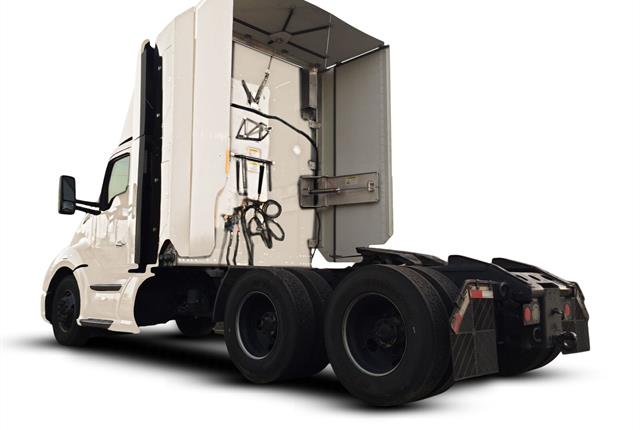
...Read the rest of this storyXStream Trucking says that in addition to fuel savings, drivers report a much smoother ride in crosswinds with its TruckWing trailer gap device deployed. Photo: TruckWings
">XStream Trucking says that in addition to fuel savings, drivers report a much smoother ride in crosswinds with its TruckWing trailer gap device deployed. Photo: TruckWings
">XStream Trucking has introduced TruckWings, which it calls an “active-aero device” that automatically deploys at highway speeds to deliver streamlined aerodynamics, fuel savings, and lower carbon emissions.
According to Daniel Burrows, the company's founder and CEO, TruckWings features a patented design, that has been developed through years of wind tunnel, track, and road testing and is designed to work at highway speeds. The system automatically deploys large panels to cover the sides and top of the tractor-trailer gap. The panels, which are made of high-impact, glass-reinforced composites, create a continuous connection between the truck and trailer that allows the air to flow smoothly over the entire length of the truck. When the truck slows down, the panels retract without driver intervention, providing the necessary clearance for turns at any angle.
“There have been significant investments made in improving truck aerodynamics in other areas,” Burrows said. “TruckWings is the first device which completely solves the turbulence problem created by the open area between the tractor and trailer that contributes significantly to a truck's overall aerodynamic drag. Since two-thirds of a truck's fuel bill is spent overcoming that drag, there is a huge savings to be had by reducing it.”
"The exciting thing about TruckWings is that it is the first solution to automatically and completely enclose the sides and top of the tractor-trailer gap,” said Mike Roeth, Executive Director of the North American Council for Freight Efficiency, NACFE. “This gap area presents as much as a 5% opportunity with little to no other solutions available for truckers today. We performed their first independent on-road fuel economy test in 2016 and XStream has always taken a very customer ...Read the rest of this story
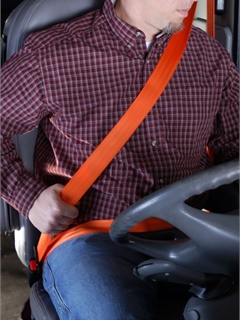
Seat belt use by truck and bus drivers has risen to 86%, compared to 65% in 2007, according to FCMSA survey. Photo: IMMI
" >Seat belt use by truck and bus drivers has risen to 86%, compared to 65% in 2007, according to FCMSA survey. Photo: IMMI
" width="240" height="320">The U.S. Department of Transportation's Federal Motor Carrier Safety Administration says that safety belt usage by commercial truck and bus drivers rose to a new record level of 86% in 2016, compared to just 65% usage in 2007, according to the results of a national survey.
Since 2007, FMCSA, in collaboration with the National Highway Traffic Safety Administration has conducted the Safety Belt Usage by Commercial Motor Vehicle Drivers Survey six times. In each survey, safety belt usage by commercial drivers has been shown to be steadily increasing.
The 2016 survey observed nearly 40,000 commercial drivers operating medium- to heavy-duty trucks and buses at more than 1,000 roadside sites nationwide. The survey found that safety belt usage for commercial drivers and their occupants was highest by trucks and buses traveling on expressways at 89%, compared to 83% on surface streets. Male truck and bus drivers outpaced their female counterparts by buckling-up at a rate of 86% to 84%, respectively.
“Buckling up your safety belt, regardless of the type of vehicle you drive or ride in, remains the simplest, easiest and most effective step you can take toward helping to protect your life,” said FMCSA Deputy Administrator Cathy F. Gautreaux. “While it is good news that we are making strong progress, we need to continue to emphasize that everyone, everywhere securely fasten their safety belt 100 percent of the time.”
Regionally, the survey found that commercial vehicle drivers and their occupants in the West, the Midwest and the South all wore safety belts at an 87 percent rate. Only in the Northeast region was safety belt usage by truck and bus drivers different and significantly lower ...Read the rest of this story
Photo: Office of Senator Bernie Sanders
">Photo: Office of Senator Bernie Sanders
">Sen.Bernie Sanders (I-VT) wants the U.S. government to only provide federal contracts to trucking companies that pay workers a living wage and benefits, he stated in a letter President Trump last week.
In the letter, he cites a controversial USA Today report that described the plight of certain independent-contractor drivers working at the Ports of Los Angeles and Long Beach who worked to pay off truck leases and took home little pay. Sanders urged President Trump to sign an executive order that would deny government contracts and subcontracts for trucking companies that misclassify workers as independent contractors, force workers to lease the trucks they drive, and engage in abusive labor practices.
Sanders also suggested that the Labor Department audit its current contracts and subcontracts awarded to port trucking companies to ensure they are in compliance with the wage and labor requirements of the McNamara – O'Hara Service Contract Act.
“This should not be happening in the United States of America,” Sanders states in the letter. “Truck drivers are the backbone of the American economy. They deserve to be treated with respect and dignity, not like modern-day indentured servants.”
Democrats on Capitol Hill have given extra attention to alleged labor and wage abuses at America's ports since the USA Today expose ran earlier this year. In late October, Rep. Grace Napolitano (D-CA) and Rep. Jerry Nadler (D-NY) introduced two bills aimed at addressing labor and environmental issues at the ports.
However, port trucking companies and stakeholders have maintained that the cases outlined in the USA Today story were too extreme and not representative of industry practices.
They've also characterized it as part of an attempt to unionize labor at the ports by the Teamsters Union. The union has organized several driver strikes at ports ...Read the rest of this story
The Federal Motor Carrier Safety Administration will host a day-long Road Show information and discussion forum on the future of commercial vehicle safety on Nov. 15, in Birmingham, Ala.
The Road Show is the last of four scheduled regional events this year put on by FMCSA to explore the future of large truck and bus safety with state law enforcement and industry stakeholders. FMCSA director Cathy Gautreaux, other senior executives, and program specialists will give presentations followed by an open forum for attendees to discuss and explore the challenges and opportunities of improving large truck and bus safety.
Discussion topics will include:
FMCSA priorities and goals and their alignment with commercial vehicle safety programs and activitiesThe Compliance, Safety, Accountability programThe ELD MandateLarge truck and bus traffic enforcementFMCSA's State grant programs to support grass-roots commercial vehicle enforcement and safety programsThe Road Show will take place at the Birmingham Marriott from 8:30 a.m. to 5 p.m. Central Time. FMCSA held Road Shows in Minneapolis, Philadelphia, and Denver earlier in the year.
Related: FMCSA Slates Summertime Road Show Regional Forums
Follow @HDTrucking on Twitter
...Read the rest of this story