ATRI seeks data to assess impacts of e-commerce
Warren Buffett knows that free trade helps the country at large, but the specific negatives are real and painful. And it's on the president to explain why.
Find out why two casino stocks gained for different reasons.
A court case involving a $559.7 Powerball winner who sued to retain her anonymity shows why it's important to know what to do if you hit the jackpot.

A recent YouTube video showed footage of a Tesla Semi driving in broad daylight on a highway near Sacramento.
This was the first time the vehicle has been seen in operation since the plug-in electric Class 8 truck was unveiled in Nov. 2017. The Tesla Semi is expected to go into production in 2019 but so far, its only public appearance has been at the launch event.
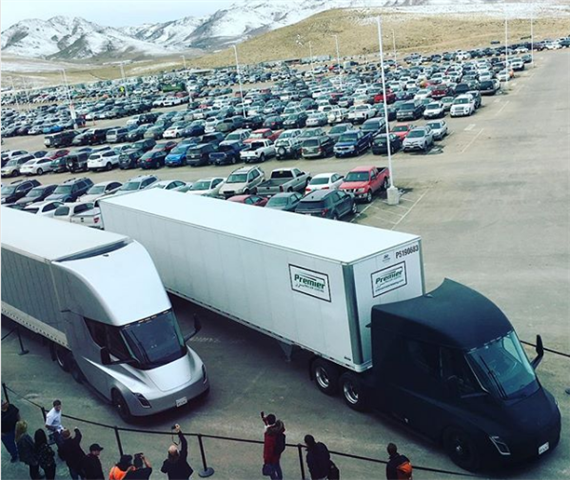
After the video came out, Tesla Founder and CEO Elon Musk posted a picture of two Tesla Semi's with trailers in tow, out in the open. In the photo description he said that the two trucks were on their first production cargo trip, carrying battery packs from Tesla's factory in Nevada to its car factory in Northern California.
A post shared by Elon Musk (@elonmusk) on Mar 7, 2018 at 11:23am PST
This is in line with what the company said in a presentation in Europe after the launch. Jerome Guillen, Tesla's vice president of truck and programs said that Tesla would be its own first customer and would use the Tesla Semi to haul cargo on a 260-mile route between facilities in Freemont, Calif., and Reno, Nev.
The Tesla Semi will be produced in two versions, a base model with a 300-mile range and an extended range version that can go up to 500 miles on a charge. The base model starts a $150,000 and the 500-mile range version will sell for $180,000.
The company is accepting reservations for the vehicle costing $20,000 and so far, high profile fleets like UPS, PepsiCo, Anheuser-Busch, J.B. Hunt and Walmart ...Read the rest of this story
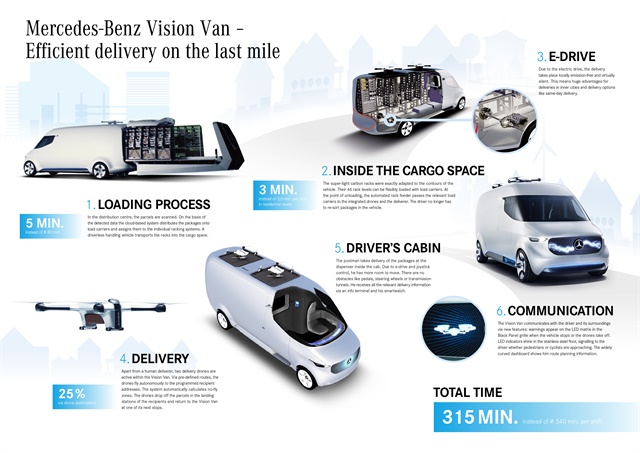
Mercedes Benz vans has developed potential logistics concepts involving electric vans, robots, drones, and smart autonomous loading systems. Photo: Mercedes-Benz
">As urban centers increasingly battle problems with pollution and congestion while e-commerce grows by leaps and bounds, we'll see changing technologies in last-mile logistics – and changing maintenance challenges.
In a session at the Technology & Maintenance Council's annual meeting in Atlanta, panelists explored the issue of last-mile delivery trends.
Nick Tempelhoff shared a possible future vision developed by Mercedes-Benz vans, starting with smart, autonomous loading systems, and using drones and small wheeled robots that would deploy from a “mothership” van – one powered by electricity.
In fact, much of the session centered around electric-powered last-mile delivery vehicles, either full battery electric or hybrids.
“The writing is on the wall” for alternative powered vehicles in last-mile delivery, said Mike Hasinec of Penske Truck Leasing. “When you look at the routes, at the stop density, the infrastructure is very feasible.”
Already, he said, technologies such as compressed natural gas, liquefied natural gas, propane, hybrid and some electric vehicles are in operation. “However, the population is very small and has remained so for many years,” because they are mostly in niche application such as buses and small delivery trucks. OEMs have not heavily pursued alternative power vehicle production, he said, and customers aren't necessarily willing to buy these vehicles in large numbers, so there are few economies of scale to be had. Leasing companies such as Penske have been able to invest in larger numbers and provide these technologies to fleets.
Tim Dollmeyer, director of technology and engineering for Cummins Electrified Power, showed slides of various hybrid and electric vehicles from the past decade or so – most of which are no longer around. It took ...Read the rest of this story