Wide-Single Tires Need a Little More Care
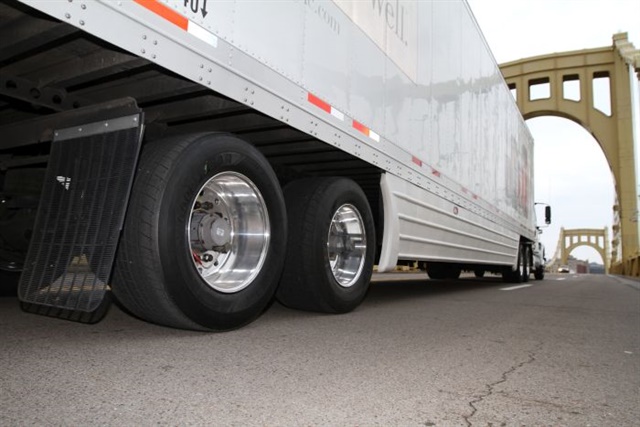
Trailers seldom get the maintenance they deserve, so it’s not surprising that tires don’t fare well. Photo: Goodyear
“>
Trailers seldom get the maintenance they deserve, so it’s not surprising that tires don’t fare well. Photo: Goodyear
“>
Wide-base single tires have saved truck fleets millions of gallons of fuel over the 20-plus years they have been in service and facilitated the transport of thousands of additional tons of payload. Both translate into fewer greenhouse gas emissions and ultimately lower fuel bills for fleets. But for all the good they do, they have certainly cost maintenance managers many sleepless nights.
Those maintenance managers have learned a few things about the wide-single tires over the years, and many have a better understanding today of what works and what doesn’t. In general, they’ve found:
Wide-single tires tend to run better and wear longer when loaded heavy rather than light.Wide-single tires seem to prefer drive positions to trailing positions.Wide-single tires seem more sensitive to mechanically induced wear, such as misalignment, improper inflation, bad camber settings and loose wheel bearings.
Fleets that run wide-base singles successfully probably didn’t start out that way. But after years of observation and some trial and error, they have ironed out most of the wrinkles.
Ryder, for example, found that axle width has an impact on shoulder wear, especially when using offset wheels to compensate for the narrower axles capable of mounting dual or wide-single tires.
“We saw irregular wear all but vanish after moving to wide-track axles with zero-offset wheels,” says Scott Perry, vice president of supply management with Ryder System. But he acknowledges there were consequences to that move. “If you wanted to put duals back on the axle you’d be more than 102 inches wide.”
Other users report reductions in irregular wear with zero-offset wheels. But many buying decisions are based not only on the intended application of the original buyer, but also with residual value in mind. So fleets hedge their bets …Read the rest of this story
