ATA calls on HHS to set hair testing standards

Peterbilt 520, 320 eligible for hybrid, zero-emission voucher

The Peterbilt Models 520 and 320 equipped with the Cummins ISL-G Near Zero engine have been granted eligibility for the California Air Resources Board (CARB) Hybrid and Zero-Emission Truck and Bus Voucher Incentive Project (HVIP). HVIP encourages the commercialization of low-emitting hybrid and zero-emissions trucks by assisting fleets with purchase of these advanced technology vehicles.

read more

...Read the rest of this story

Truckload Linehaul Rates Slip Again, Intermodal Rates Better Than Year Ago

A measure of truckload linehaul rates fell again in February, but it is expected to improve, according to newly issued figures, while a gauge of intermodal rates posted its largest gain in just over four years.

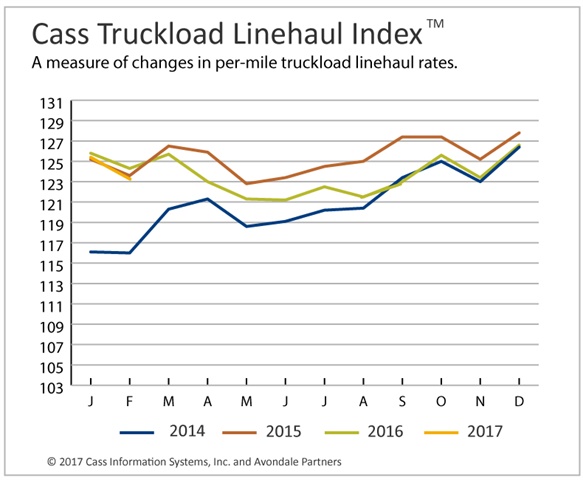
The Cass Truckload Linehaul Index, which tracks monthly changes in linehaul rates, declined 0.8% in February compared to the same time in 2016, after falling 0.3% and 0.9% in January and December, respectively. This latest drop and month-over-month declines in both February and January puts the index at a level of 123.3, its lowest reading since last September.

Although this represents twelve consecutive months of year-ago declines, analysts at Avondale Partners have increased their pricing forecast for a range of a decline of 1% to 2% year-over-year improvement.

The investment banking firm, which provides analysis with the numbers, said that "the current strength being reported in spot rates ... is leading us to believe contract pricing rates should move back into positive territory at least on a sequential basis."

The Cass Truckload Linehaul Index measures market fluctuations in per-mile truckload pricing that isolates the linehaul component of full truckload costs from others, such as fuel and accessorials, providing a reflection of trends in baseline truckload prices.

Meantime, the Cass Intermodal Price Index, which measures changes in total intermodal per-mile costs, increased 4.9% in February compared to the same time in 2016. That marks the largest year-over-year increase since January 2012. Part of the hike was influenced by the 29% jump in fuel surcharges.

Despite this being the fifth year-over-year increase, the index fell to a February reading of 130.8, which is 2.9% lower than it was in the first month of 2017.

Analysts at Avondale Partners expect intermodal pricing to be stronger than last year, given that the price of diesel fuel has recovered from oversold lows.

"The current level of demand ...Read the rest of this story
Ford Offers CK-4 Alternative Oil for Super Duty Diesels

<img width="150" src="http://www.automotive-fleet.com/fc_images/news/m-ford-sd-motorcraft-oil-1.jpg" border="0" alt="

Screenshot via Ford.

">

Screenshot via Ford.

">

Ford is recommending the use of Motorcraft-branded diesel engine oil for its Super Duty trucks and warning fleet and commercial customers to avoid using new CK-4 or FA-4 oils because they may cause damage to the engine, the company told AutomotiveFleet.com.

Motocraft's WSS-M2C171-F1 formulation should be used in all Power Stroke diesels, especially the 6.7L that powers the F-250, F-350, and F-450, because it better protects the engine against high-mileage wear, according to the company. Ford had previously recommended CJ-4 formulations for its Super Duty trucks. On Dec. 1, the American Petroleum Institute began licensing the new CK-4 and FA-4 oils. CJ-4 oils will eventually be phased out.

Commercial users should avoid the FA-4 formulation due to its low viscosity. CK-4 motor oils should be avoided because they provide "inadequate wear protection," according to a statement.

The oil certification information is located on the back of an oil pouch in a circle known as the API donut.

Customers shouldn't use oils labeled CK-4/SN unless they have been approved by Ford to meet WSS-M2C171-F1. This is possible with SAE 10W-40, 15W-40, 5W-40 and 0W-40 oils. SAE 10W-30 oils showing CK-4/SN cannot meet WSS-M2C171-F1.

Motorcraft Super Duty diesel motor oil is formulated with premium hydroprocessed base oils and additive technology necessary to meet WSS-M2C171-F1. This new oil also meets the requirements of Cummins CES20086, Detroit Diesel 93K222, Volvo VDS-4.5 and Mack EOS-4.5, according to Ford.

View a video from Ford here:

Related Photos: Ford's 2017 F-250

Follow @HDTrucking on Twitter

...Read the rest of this story

Spec’ing for Resale

Used truck prices are down. Way down. According to J.D. Power and Associates, last year the retail value of used trucks was 13% lower than in 2015. Trucks sold at auction fared even worse. Predictions are for the supply of used trucks to stay high, which translates into lower prices for this year as well.

While there is not much you can do about the supply of used trucks, the way you spec your vehicles on the front end can have an impact on their value — either positive or negative — at resale time.

Dale Tower, vice president of remarketing for AmeriQuest Used Truck Services, says the market and equipment have become more specialized in recent years. “Fleets are buying for their specific needs and the value that provides on the front side. The assumption is they will still be able to get out of the trucks when they have served their useful life.”

He adds, “Some fleets are being surprised quite a bit as the used truck market has done a 180 in the past one to two years, and is now a solid buyers' market.”

We talked to industry experts to get their input on the role certain specs play in the resale value of a truck.

Downsized engines

While some fleets have been spec'ing smaller engines on new trucks to save weight and cost, Chris Visser, senior analyst and product manager, commercial vehicles, NADA Used Truck Guide, a division of J.D. Power, says there is still a preference for big-bore engines in the highway segment.

Claude Ricciardi, director of purchasing at New York-based Transervice Logistics, agrees that smaller engines, those 13L and under, “have a definite negative effect on resale.” Visser explains that “for those OEMs with 15L and 13L engines, we see a roughly $3,000 deduction for the smaller engine in a ...Read the rest of this story