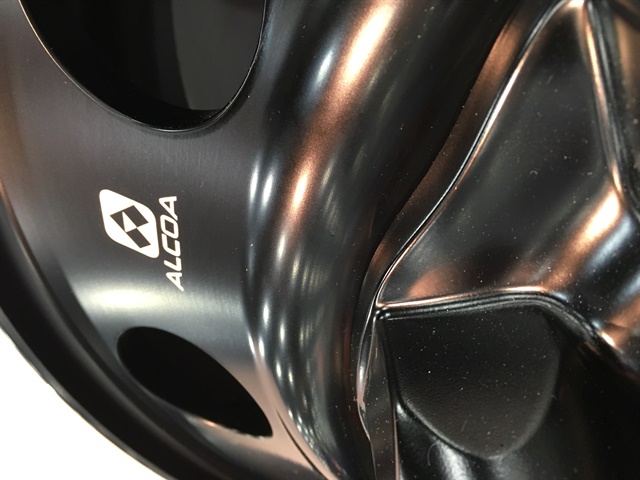
Alcoa Looks to Detroit for Styling

Alcoa Looks to Detroit for Styling

<img width="150" src="http://www.automotive-fleet.com/fc_images/news/m-img-2516-3.jpg" border="0" alt="

Alcoa displayed a few prototype black aluminum wheels at the Mid-America Trucking Show. Photos: Jim Park

">

Alcoa displayed a few prototype black aluminum wheels at the Mid-America Trucking Show. Photos: Jim Park

">

Are you ready for black aluminum wheels? Alcoa is dipping its foot into Detroit auto culture to see if there's enough interest in a black Dura-Bright wheel for trucks. Many of the full-size North American pickup trucks now offer black wheels as an option, and the company believes there's is significant interest in the black Detroit look to warrant producing such a wheel for trucks.

"I think every single person who owns or drives a truck takes pride in their equipment," says Mike Baird, national sales manager at Arconic Wheel and Transportation Products (Alcoa). "Many of them are now seeking a different look or style from the traditional chrome and polished aluminum look."

Baird told HDT the older crowd, the baby-boomers if you will, still prefer the tradition look of polished aluminum, chrome, and stainless steel, while younger drivers are looking for something different. "You could call it styling from Detroit," he says. "I believe there's a market out there for a group of truck owners that what something different, but also want the light weight and corrosion resistance of aluminum."

Alcoa is looking at the potential of producing a black version of the Dura-Bright Evo wheel. It can be done and the company has a few prototypes, several of which were subtly on display at this year's Mid-America Trucking Show. They were hanging at the back of the booth where they weren't immediately obvious. According to Baird, they were trying to see if people noticed them and asked about them.

"And they did," he says. "We're now trying to determine if there's enough of a market to justify making a black Dura-Bright wheel."

Dura-Bright is not a clear-coat type of product and it's not paint. It's actually a treatment ...Read the rest of this story
Congestion, Distracted Driving, HOS Top ATRI’s Research Pirorities

The American Transportation Research Institute has decided on its research priorities for 2017, approving studies on congestion, driver distraction, and hours of service, among others.

ATRI's board of directors approved the 2017 Top Research Priorities that was developed by the Research Advisory Council at its March meeting. Several of ATRI's 2017 top priority studies will focus on improving congestion choke points at the nation's top truck bottlnecks as identified in ATRI's annual listing. The top priority topics will also examine the impacts of technology on the industry today and in the future.

The 2017 ATRI top research priorities are:

Driven to Distraction – examining the impact of technology deployment inside the truck and its effect on truck driver distraction. The research will also look at the role of car driver distraction on trucking industry crash involvement.Cumulative Economic Impact of Trucking Regulations – examining the potential for developing a standardized methodology for conducting regulatory impact analyses of trucking industry regulations, which can then be applied across agencies and regulations to identify industry costs.HOS Flexibility: A Possible Solution to Bottlenecks – exploring the opportunity for addressing some of the nation's worst congestion choke points through flexibility in the federal hours of service rules, which would allow drivers to wait out the most congested periods of the day.Impact of E-Commerce on Trucking – mapping potential impacts of e-commerce to the trucking industry's top industry issues.Truck Bottleneck Trends: Economic Changes or Infrastructure Improvements – conducting a deep dive into ATRI's Annual Truck Bottleneck List to identify specific infrastructure improvements that will improve congestion.Autonomous Truck Impacts on the Truck Driver – a detailed analysis of how autonomous truck technologies will change the operational environment and driving requirements for commercial drivers.

Related: Two Studies Examine Truck Parking with New Methods

Follow @HDTrucking on Twitter

...Read the rest of this story
Rand McNally Offers All-In One Connected Truck Device

Rand McNally has announced an all-in-one dashboard device called the OverDryve 8 Pro that combines navigation, Sirius XM radio, voice assistance, a built-in dash cam, and hands-free calling and texting.

The OverDryve8 Pro is part of Rand McNally's OverDryve OS Connected Vehicle platform and is also E-Log ready. The device is designed to bring together critical driving and business tools, in-cab entertainment and hands-free safety features. The OverDryve 8 Pro is shipping to stores this month and expected to be for sale by the end of May.

“We understand the amount of time professional drivers spend in their trucks so OverDryve 8 Pro brings together not only valuable tools to help get the job done, but also a fully loaded entertainment solution that can be used to watch movies, listen to SiriusXM, access social media, and check email,” said Stephen Fletcher, CEO of Rand McNally.

OverDryve 8 Pro features:

A bright, 8-inch screen that provides access to key items at a glanceRand McNally truck-specific navigation and routing with truck POIs, advanced lane guidance, toll costs, warnings, and fuel logsHands-free calling and textingVoice assistanceAudible news, weather, traffic, and sportsMusic from multiple sourcesA built-in dash cameraA magnetic mount designed to be easy to installA slice in the mount that provides an additional GPS receiver as well as a built-in SiriusXM radio.

The OverDryve 8 Pro also comes pre-loaded with the Rand McNally DriverConnect logbook app, so the device is ELD-ready. The app can be paired to the company's ELD 50 and/or its DC 200 plug-in devices to provide a full electronic logging solution.

Follow @HDTrucking on Twitter

...Read the rest of this story

UPS to Deploy Hydrogen Fuel Cell Truck in Calif.

<img width="150" src="http://www.automotive-fleet.com/fc_images/news/m-ups-newyork-3018-fullsize-edit-1.jpg" border="0" alt="

Photo courtesy of UPS.

">

Photo courtesy of UPS.

">

UPS will begin using a medium-duty delivery truck that uses gaseous hydrogen to power an electric battery and motor in Sacramento, Calif. with an eye toward expanding use of the alternative fuel after a successful test, the delivery company announced.

UPS will begin testing a prototype truck to determine whether the zero-emission fueling technology could be more widely adopted across the fleet. UPS still needs to validate its design and core performance requirements for at least 5,000 hours, said Mike Britt, director of maintenance and engineering for international operations of UPS. If the test is successful, UPS plans to add 16 additional trucks build on a Class 6 chassis.

"The challenge we face with fuel cell technology is to ensure the design can meet the unique operational demands of our delivery vehicles on a commercial scale," said Mark Wallace, UPS senior vice president global engineering and sustainability. "This project is an essential step to test the zero tailpipe emissions technology and vehicle on the road for UPS and the transportation industry."

To develop the truck, UPS partnered with Unique Electric Systems, a vehicle modifier that integrated various components of the hydrogen fuel cell powertrain. Unlike fuel cell auxiliary power units, the vehicle uses the 32-kilowatt-per-hour fuel cell to generate electricity to propel the vehicle. The system uses an electric motor from Nidec, fuel cell stack from Hydrogenics, 45 kilowatt-per-hour battery from Valance, and tanks from Luxfer that can support up to 10 kilograms of fuel.

The truck can carry about 10,000 pounds of payload and travel a range of up to 125 miles, said Scott Philippi, automotive maintenance and engineering manager for UPS.

UPS developed the vehicle in a partnership that also included the U.S. Department of Energy's Center for Transportation and the Environment and the University of Texas' Center for Electromechanics.

Related: ...Read the rest of this story

Webinar: Maximize the business benefits of ELDs

By Dec. 18, 2017, most commercial truck drivers will be required to use electronic logging devices to record their hours of duty. Your fleet can stop there — but why not get more out of it?

There's more potential return on investment here, and with an ELD connected to their trucks' engines, fleets and trucking companies can improve driver performance, lower commercial user-based insurance costs and many other benefits.

read more

...Read the rest of this story