Pre-existing conditions and the health plan: Who’s covered?

Fleet Sentiment Report: Things Are Good, Not Great

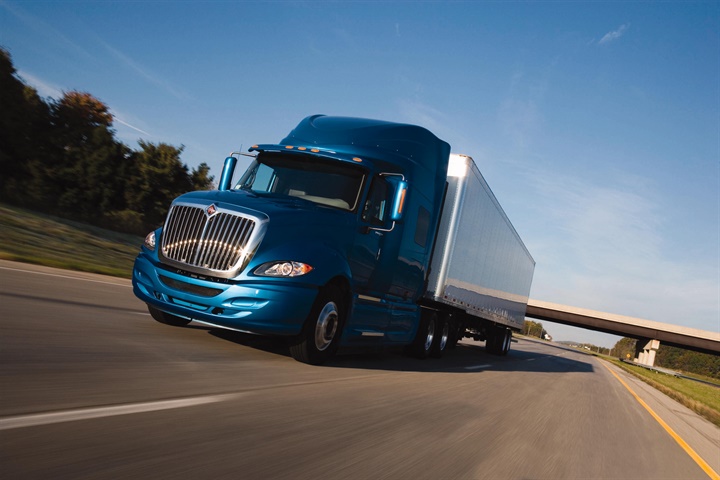
The outlook of fleets in the second quarter of 2017 was generally positive, but it was not much better than in the early part of the year, according to fleets surveyed for CK Commercial Vehicle Research's most recent Fleet Sentiment Report.

Productivity gains and losses were examined in the report. Fleets reported that purchasing vehicles with improved performance in fuel efficiency and uptime have increased productivity over the past two years. Regulations were noted as the primary factor in lowering productivity for most fleets. Despite this, the majority of fleets saw a gain in productivity in recent years.

Fleets picked up truck order activity as well in the quarter with increases compared to the first quarter and 2016. However, CKCVR found that they were ordering fewer vehicles per order. Fleets were also interested in purchasing more used trucks if they could find low mileage, high-efficiency models to meet their needs.

The driver shortage still looms over the industry, as there was a slight increase in the number of fleets looking for qualified drivers in the quarter. Some fleets commented that it was getting harder to find good, qualified drivers while another quipped that they “can't wait for autonomous trucks.”

CKCVR based its findings on 55 survey responses from a representative group of fleets. The questionnaires were received from April 11-26, 2017.

Subscriptions to the quarterly Fleet Sentiment reports are available from CKCVR, for more information, click here.

Related: Productivity Gains Linked to In-House Maintenance

Follow @HDTrucking on Twitter

...Read the rest of this story

Seeing Safe Driving and Self-Driving as Going Hand in Hand

<img width="150" src="http://www.automotive-fleet.com/fc_images/blogs/m-img-0766-1.jpg" border="0" alt="

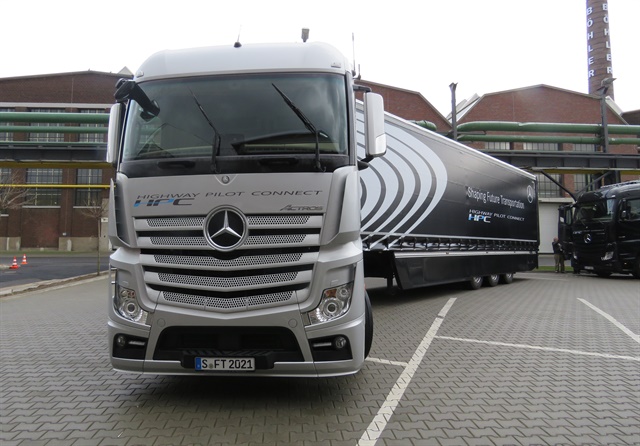
Mercedes Benz Actros cabover fitted with Daimler AG's Highway Pilot Connect autonomous-driving system. Photo: David Cullen

">

Mercedes Benz Actros cabover fitted with Daimler AG's Highway Pilot Connect autonomous-driving system. Photo: David Cullen

">There is a mechanical engineer and professor of mechanical and electrical engineering— whose distinguished and globe-trotting career has already spanned over 40 years— who can simply and succinctly explain how autonomous driving technologies will actually make it onto a road near you… and sooner than you might think possible.

Bharat Balasubramanian, PhD. laid out his road map to the fairly near future in a colorful and engaging talk (complete with comical video clips) on May 1 at the National Private Truck Council's annual meeting in the historic Netherlands Plaza hotel in downtown Cincinnati.

The arc of Balasubramanian's global automotive career is the stuff of a Bollywood epic, or at least of a recruiting video for a top-notch engineering school.

Born and raised in India, he attained a degree in mechanical engineering at the Indian Institute of Technology in Mumbai. He then followed his passion for automotive design to one its epicenters— Germany-- where he went on to earn a master's and then a doctorate in engineering and launched a 38-year career in research and development with Daimler AG.

Balasubramanian retired in 2012 as group vice president of research and advanced engineering for Daimler. Not content to rest on his corporate laurels, Balasubramanian's next move was to accept an engineering professorship at the University of Alabama as well as the post of executive director of UA's Center for Advanced Vehicle Technology.

The long and the short of his résumé is that he knows a thing or two about applying technology to make driving safer.

“Increasing safety and the [SAE] levels of autonomous driving are two facets of an identical technology set using advanced sensors, actuators and ECUs with slightly different software,” is how Balasubramanian said he sees technology converging ...Read the rest of this story

TRALA Outlines Steps to Prevent Truck Ramming Terrorism

<img width="150" src="http://www.automotive-fleet.com/fc_images/news/m-rental-truck-jim-park-1.jpg" border="0" alt="

Photo: Jim Park

">

Photo: Jim Park

">

The Truck Renting and Leasing Association has created a new brochure outlining ways that rental truck company employees can help prevent truck-related terror attacks.

TRALA is responding to a recently declassified report from the Transportation Security Administration that details the risks of truck-ramming attacks in recent years, calling on truck owners and rental agencies to be vigilant about the looming threat.

The association reiterated that it will stand by law enforcement and Homeland Security's efforts to prevent attacks using commercial vehicles.

"TRALA is committed to helping the truck renting and leasing industry remain vigilant against ramming attacks," said Jake Jacoby, TRLA president and CEO. "TRALA already works with the TSA, FBI and other governmental agencies regularly to ensure its members are not only up to date on the latest security developments, but to also partner with those agencies in an effort to stop a future attack."

The TRALA report, entitled Truck Renting and Leasing Security Awareness and Self-Assessment Guide, examines the danger that commercial trucks can pose when used for terrorist acts and outlines some basic steps on deterrence. It emphasizes that mindfulness and demonstration of good security can be an important way to deter a potential terrorist.

The full brochure can be accessed here.

According to the TSA report, there have been 17 ramming attacks around the world in the past three years, responsible for 173 deaths and more than 700 wounded. The majority of deaths from truck rammings occurred in an attack in Nice, France on July 14, 2016, that killed 87 persons and an attack in Urumqi, China on May 22, 2014 that claimed 43 lives.

"TRALA members realize they are often the first line of defense against a possible terror attack that could involve a commercial truck,” said Jacoby. “We will continue to coordinate with public ...Read the rest of this story