What’s at Stake in Iran’s Presidential Election: QuickTake Q&A

Workhorse’s W-15 electric pickup offers power, targets fleet efficiency

Workhorse Group has officially unveiled its new W-15 electric pickup aimed directly at fleet efficiency and utility. While still pre-production, preliminary specs look impressive: 460 hp, all-wheel-drive, 80-mi. all-electric powered range with unlimited additional mileage possible via Workhorse's Range Extender, which uses a small gasoline engine to generate more electric power as needed.

read more

...Read the rest of this story

Airplane Hits Trailer in ‘Amazing’ Encounter

<img width="150" src="http://www.automotive-fleet.com/fc_images/blogs/m-plane-hits-ss-trailer-jpg-1.jpg" border="0" alt="

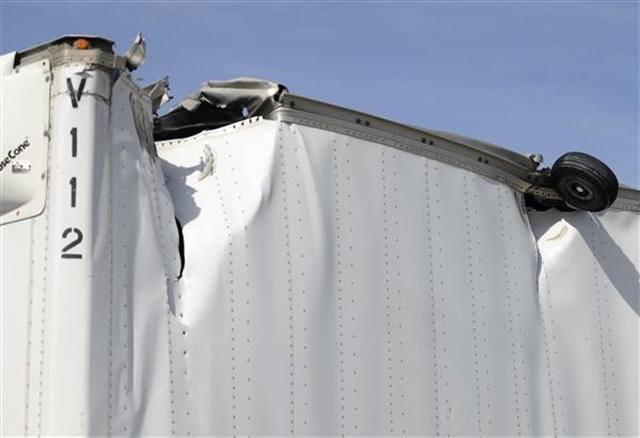
The airplane left part of its landing gear, including a wheel and tire, near the left-front corner of the 53-foot van. Photo: Sandusky Register

">

The airplane left part of its landing gear, including a wheel and tire, near the left-front corner of the 53-foot van. Photo: Sandusky Register

">

It's not every day that an airplane hits a truck, which is why the mishap on Wednesday made news, at least locally. It happened about 4 p.m. along Route 53 in northwest Ohio, and the Sandusky Register covered it right away.

It seems Russ Street, a driver for Sandusky-based South Shore Transportation, was northbound on the highway, minding his own business, when the eastbound plane, a twin-engine Piper, was on its final approach to Fremont Airport.

The plane came in too low and its landing gear clipped the top of the South Shore van, tearing off and embedding itself in the roof and side panels. The plane continued on and its pilot made a safe belly landing. Neither the 71-year-old pilot nor the truck driver was hurt.

“I was just driving down Ohio 53, and I heard a boom,” Street told the newspaper. “It rocked the trailer. I thought the semi was going over… I thought I had blown a couple tires.”

“It's frickin' amazing,” laughed Kevin Tomlinson, maintenance director for South Shore Transportation, the truck's owner, in a call with me. “It's not just what's on the road any more, it's what's up above.”

The van is a 53-foot Stoughton that had carried a load into Indiana, he said, and Street was returning it empty to Gypsum, Ohio, near South Shore's home base, for another load. Tomlinson was at a conference in Arizona when he learned of the incident in a call from a manager.

Thursday morning he hadn't yet seen the trailer so didn't know the extent of the damage or how much it would cost to fix it. Tomlinson had been at the first Heavy Duty Trucking ...Read the rest of this story
Motor Trucks in the Wild West

<img width="150" src="http://www.automotive-fleet.com/fc_images/blogs/m-militaryconvoy1920.jpg" border="0" alt="

Mack Trucks in action during the U.S. Army's 1919 cross-country motor convoy experiment. Photo: U.S. Army Signal Corps

">

Mack Trucks in action during the U.S. Army's 1919 cross-country motor convoy experiment. Photo: U.S. Army Signal Corps

">Given its size and industrial output, at some point the United States would have had no choice but to invest in and build a national highway system. But the actual story of how the Interstate Highway System came to be is amazing because it largely revolves around the unique experiences of an American hero named Dwight D. Eisenhower.

After graduating from West Point in 1916, “Ike” requested an overseas assignment during the First World War, but was posted instead to Fort Leavenworth, Kansas, and missed out on the chance for a career-enhancing combat command. But he was a capable, organized officer. And World War I was the first conflict to see the use of motorized transport, which played a decisive role in staving off a German victory at various points during the fighting.

After the Armistice, the War Department decided to study how trucks could be used to move a convoy of troops and equipment across the continental United States in the event of an invasion of the West Coast. Command of the convoy of trucks fell to young Major Eisenhower, with orders to set out from Washington, D.C. and proceed in as expeditiously a manner as possible to Oakland, California.

The convoy was impressive for the time. According to the Wikipedia entry on the event, it consisted of 81 total vehicles and trailers, including 34 heavy cargo trucks, four light delivery trucks, two mobile machine shops, a mobile blacksmith shop, one wrecker, and an "Artillery Wheeled Tractor" capable of towing nine trucks at once.

There were also two spare parts wagons, two water tanks, one gasoline tank, one searchlight with electrical power plant truck, four kitchen trailers, eight touring cars, a reconnaissance car, two staff observation cars, ...Read the rest of this story