Job cuts surge in May, Challenger report says
Job reductions in May jumped by 41 percent from April, the Challenger report said.
Job reductions in May jumped by 41 percent from April, the Challenger report said.
Photo via International Transport Forum report.
">Photo via International Transport Forum report.
">LEIPZIG, GERMANY— Autonomous trucking might solve the driver shortage problem, save money and reduce emissions, but the massive job losses and other problems caused by the shift over the next 13 years might well lead to serious social disruption. Regulating agencies, industry, and governments in North America and Europe should start planning for the change now.
That's the gist of a new broad-sweeping report released today by the European Automobile Manufacturers' Association (ACEA), the International Transport Workers' Federation and the International Road Transport Union (IRU), the road transport's industry's global body, in a project led by the International Transport Forum, a Paris-based intergovernmental organisation linked to the OECD.
Despite the ungainly title “Managing The Transition to Driverless Roadfreight Transport,” the extensive report doesn't pull punches. Autonomous trucks will lead to huge layoffs. And if regulating bodies don't start working together now to adopt driverless technology, chaos could ensue.
“Automated trucks could reduce the demand for drivers by 50-70% in the US and Europe by 2030, with up to 4.4 million of the projected 6.4 million professional trucking jobs becoming redundant, according to one scenario,” the report says.
Even if the rise of driverless truck dissuades newcomers from trucking, over two million drivers in the U.S. and Europe could be directly displaced, the report says.
The report has four main recommendations for stakeholders and regulators involved in the transportation industry:
Consider a temporary permit system to manage the speed of adoption;Set international standards, road rules and vehicle regulations for self-driving trucks;Continue pilot projects with driverless trucks to test vehicles, network technology, and communication protocols.To download the entire report, click here.
Related: The Dark Side of Autonomous Tech Nobody Wants to Talk About
Follow @HDTrucking on Twitter
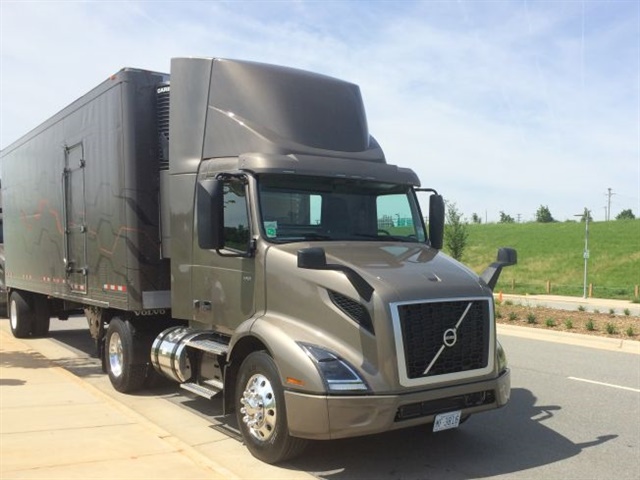
...Read the rest of this storyA bold grill and striking swept-back fenders give the new Volvo VNR tractor a bold, big-truck vibe with real-world aerodynamic and visibility benefits. Photo: Jack Roberts
">A bold grill and striking swept-back fenders give the new Volvo VNR tractor a bold, big-truck vibe with real-world aerodynamic and visibility benefits. Photo: Jack Roberts
">With all the industry buzz today focused on autonomous tech and futuristic designs, trucks still need to work hard in tough surroundings. That's a theme clearly on display with Volvo's new VNR tractor. The truck targets the rapidly evolving regional-haul business model, but this is not a radical design by any means. Rather, the truck is more of a distillation of everything Volvo has learned over decades of vehicle design, combined with the latest in ergonomics, connectivity, and advanced technology. The result is a highly capable urban delivery system that is optimized for uptime, productivity, and safety.
I just completed a route through the center of Winston-Salem, N.C., in a new VNR to see for myself how Volvo is approaching the increasing demands of inner-city delivery demands. The truck itself is loaded with new technology. But the new tech isn't overwhelming or even all that evident while you're driving. It's more accurate to say Volvo engineers have scaled the technology in a way that consistently compliments or aids a driver, as opposed to demanding their attention or attempting to do tasks for them.
Volvo engineers started with the basics. The VNR features outstanding sight lines anywhere a driver looks. Normally, when I talk about sight lines, I'm referring to exterior views to the front, sides and rear of a truck. But Volvo has taken this a step further with the introduction of a new, tilt-neck steering wheel.
It's a pretty slick system all the way around. Depress a foot pedal at the base of the steering column all the way to the floor and the wheel assembly easily pivots up or down, as well as in or out, ...Read the rest of this story

MSNBC says it has completed a deal to keep Lawrence O'Donnell in its prime-time lineup. The network wouldn't release any details Thursday. Contract renegotiations are usually routine, but O'Donnell's became ...

Results from two surveys of the nation's purchasing executives indicate manufacturing activity in the U.S. during May was nearly unchanged from the month before. Meanwhile, separate reports show construction spending eased, but consumer spending increased, resulting in hopes that the current quarter will be stronger for the overall economy than the previous one.
The Institute for Supply Management's Purchasing Managers Index (PMI) registered 54.9%, up 0.1 of a percentage point from the month before, but slightly less than a consensus estimate from analysts of 55%.
This marked the 9th straight month of growth and the 96th consecutive month the manufacturing economy has expanded with a reading above 50%, according to the supply management organization.
The New Orders Index registered 59.5%, an increase of 2 percentage points from the April reading while the Production Index registered 57.1%, a decline of 1.5 percentage points from April. Of the 18 manufacturing industries, 15 reported growth in May.
While the overall May reading doesn't look that strong “the details are very healthy,” said analysts at Econoday, with new orders coming in at a very strong rate while production was also strong with gains in import orders and employment, all indicating a “steady and impressive” report.
A similar survey from financial information services provider IHS Markit shows manufacturing activity in May fell slightly to an eight-month low.
Its final May U.S. Manufacturing Purchasing Manager's Index fell to 52.7, the weakest reading since September, but above the 50 no-change value. A preliminary reading for May, released just over a week ago, had the index slightly lower at 52.5.
This latest reading pointed to a further growth slowdown from the 22-month high recorded in January of 55. Weaker new business growth and softer job creation helped to offset a marginally stronger upturn in production volumes, according to the report.
May data indicated that manufacturing ...Read the rest of this story