<img width="150" src="http://www.automotive-fleet.com/fc_images/news/m-figure-1-crop-0-1.jpg" border="0" alt="
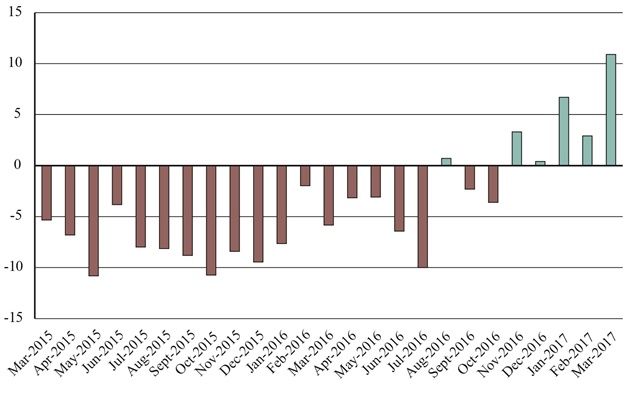
U.S.-NAFTA freight value percent change from the previous year. Graphic: U.S. DOT
">
U.S.-NAFTA freight value percent change from the previous year. Graphic: U.S. DOT
">The value of freight moved between the U.S. and its next door neighbor countries has spiked as all five major transportation modes carried more cargo in March compared to the year before, according to new Transportation Department figures.
U.S.-North American Free Trade Agreement freight totaled $100.3 billion, the first time since October 2014 it has exceeded the $100 billion level.
The 10.9% rise from March 2016 is the fifth consecutive month in which the year-over-year value of U.S.-NAFTA freight increased from the same month of the previous year. It is also the first double digit year-over-year percentage increase in 33 months.
Despite this increase, trucking reported the smallest gain, up 5%, compared to increases of 81.3% for pipeline, vessel by 38.2%, air by 13.5% and rail by 12.6%.
The large percentage increase in the value of goods moving by pipeline and vessel is due in part to a 31% increase in the year-over-year price of crude oil between March 2016 and March 2017, according to the department.
Trucks carried 63.7% of U.S.-NAFTA freight and continued to be the most heavily utilized mode for moving goods to and from both U.S.-NAFTA partners. Trucks accounted for $32.6 billion of the $54.3 billion of imports, or 60%, and $31.3 billion of the $45.9 billion of exports, or 68.1%.
Rail remained the second largest mode by value, moving 15.8% of all U.S.-NAFTA freight, followed by pipeline, 5.9%; vessel, 5.6%; and air, 4.1%. The surface transportation modes of truck, rail and pipeline carried 85.4% of the total value of U.S.-NAFTA freight flows
U.S.-Canada Freight Value Surges More Than 10%From March 2016 to March 2017, the value of U.S.-Canada freight flows increased by 10.4% to $51.2 billion as the value of freight on all five major modes increased from a year earlier.
The