Truckload Linehaul Rates Stabilize, Intermodal Rates Continue Strength

Truckload Linehaul Rates Stabilize, Intermodal Rates Continue Strength

Truckload line haul rates may finally be ready to turn around for the better following recent declines while intermodal rates continue their recent improvements, according to two new reports.

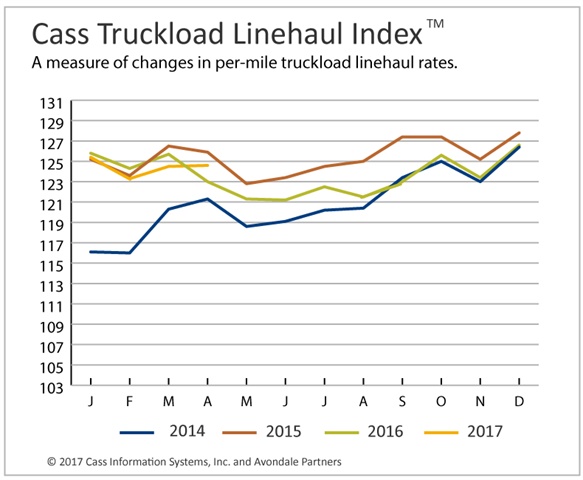
The Cass Truckload Linehaul Index for April increased from the same time a year ago. Despite this gain, the reading is virtually unchanged from the month before but it at its highest level since January.

According to Donald Broughton with Broughton Capital, who provides analysis of the reports, pricing for trucking appears to be stabilizing.

“After being negative for 13 months in a row [in terms of] year-over-year comparisons, April's Cass Truckload Linehaul Index increased 1.3% year-over year to 124.6,” he said. “April's pricing, while promising, was sequentially flat versus March and is still negative, down 1% versus April of 2015.”

Broughton's pricing forecast for 2017 remains in a range of between a 1% decline to a 2% improvement, as the current strength being reported in spot rates is leading him to believe contract pricing rates should move back into positive territory by the end of the year.

The Cass Truckload Linehaul Index measures market fluctuations in per-mile truckload pricing that isolates the linehaul component of full truckload costs from others, such as fuel and accessorials, providing a reflection of trends in baseline truckload prices.

Meantime, the latest data points for the Cass Intermodal Price Index show total intermodal pricing rose 2.7% year-over-year in April to a reading of 133.1 after March's 4.8% increase. Despite this gain, the April reading fell 1.7% from March, which was the index's highest level since April 2014.

April marked the seventh consecutive month of year-over year increases, but suggests that pricing momentum is slowing, according to Broughton.

He expects intermodal rates to continue to show better strength in 2017 than was achieved in 2016, “as the price of diesel fuel has recovered from ...Read the rest of this story
UPDATED: Researchers will test tires for fuel efficiency

POINTE-CLAIRE, QC—Yes, your tires can affect your fleet's fuel economy. And soon, you will know exactly which kind of tires are most fuel efficient. The PIT Group, a research and engineering organization focused on improving fleet maintenance operations in the North American transportation industry has announced that fuel economy of tires will be the focus of its Spring Energotest being held June 9 at the Transport Canada test track in Blainville, QC, ...Read the rest of this story

Researchers will test tires for fuel efficiency

POINTE-CLAIRE, QC—Yes, your tires can affect your fleet's fuel economy. And soon, you will know exactly which kind of tires are most fuel efficient. The PIT Group, a research and engineering organization focused on improving fleet maintenance operations in the North American transportation industry has announced that fuel economy of tires will be the focus of its Spring Energotest being held June 9 at the Transport Canada test track in Blainville, QC, ...Read the rest of this story

FMCSA Yanks Minimum Insurance Rulemaking

<img width="150" src="http://www.automotive-fleet.com/fc_images/news/m-fmcsatruckcrash-3-1.jpg" border="0" alt="

Photo: FMCSA

">

Photo: FMCSA

">

More than three years after launching a rulemaking to increase minimum insurance requirements for trucking, the Federal Motor Carrier Safety Administration is dropping the effort because it says it has not collected enough information to warrant going forward.

The agency had first announced back in April 2014 that it was issuing an advance notice of proposed rulemaking to consider whether it should increase the financial responsibility for motor carriers, freight forwarders, and brokers. FMCSA noted that it is authorized to establish minimum insurance levels for motor carriers at or above the minimum levels set by Congress.

FMCSA had been seeking public comment on whether to exercise its discretion to increase the minimum levels and, if so, to what levels. “After reviewing all public comments to the ANPRM, FMCSA has determined that it has insufficient data or information to support moving forward with a rulemaking proposal, at this time,” the agency stated in a notice that will be published in the Federal Register for June 5.

In the ANPRM (Docket No. FMCSA-2014-02110) issued in 2014, the agency stated it was “considering a rulemaking that would increase minimum levels of motor carrier financial responsibility for bodily injury or property damage and sought information in connection with that potential rulemaking.”

Specifically as to motor carriers, the ANPRM sought public comment on a series of questions addressing the following matters:

Premium RatesCurrent Minimum Levels of Financial ResponsibilityImpacts of Increasing the Minimum Level of Financial ResponsibilityCompensationSources of InformationTimelines for implementation

FMCSA also said at the time that it would be asking “several questions related to broker/freight forwarder financial responsibility as it continues to implement Section 32918 of the Moving Ahead for Progress in the 21st Century (MAP-21) Act” highway bill, which became law back in 2012.

In addition, the ANPRM sought answers to questions pertaining to trip insurance for ...Read the rest of this story