Aerodynamic Devices Can Translate Into Fast Fuel Savings

Aerodynamic Devices Can Translate Into Fast Fuel Savings

<img width="150" src="http://www.automotive-fleet.com/fc_images/articles/m-nussbaum-aero-1.jpg" border="0" alt="

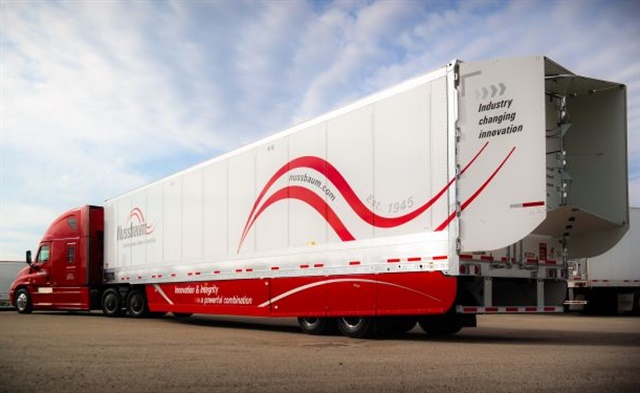
This trailer owned by Illinois-based Nussbaum Transportation has both an aerodynamic “boat tail” from Stemco TrailerTails and extra-long trailer side fairings it developed with Wabash. Photo: Nussbaum Transportation

">

This trailer owned by Illinois-based Nussbaum Transportation has both an aerodynamic “boat tail” from Stemco TrailerTails and extra-long trailer side fairings it developed with Wabash. Photo: Nussbaum Transportation

">

Adding aerodynamic devices to smooth airflow over the vehicle at highway speeds is a (relatively) cheap and easy way for fleets to improve fuel economy in long-haul tractor-trailer applications. But calculating fuel savings and return on investment for aerodynamics can be notoriously tricky. Moreover, not every aerodynamic device on the market today is appropriate for all applications. Luckily, several recent, high-profile studies have made it easier for fleet managers to identify the best devices for their applications and to determine both fuel savings and a realistic ROI timeline.

A particularly valuable information packet was recently released by SmartWay Canada, and it takes an extremely deep dive into the science of tractor-trailer aerodynamics. But on an elemental level, the principles of clean vehicle design can be readily understood by anyone who's ever stuck their hand outside the window of a car moving at highway speeds: Air is a mass that creates resistance to the objects moving through it. Surfaces with sleek, rounded edges move through this air mass more efficiently. Engines moving vehicles through the air mass don't have to work as hard — and therefore burn less fuel.

There is also a secondary component to vehicle aerodynamics beyond the ability to simply slip through the air mass efficiently. And that is the science of dealing with low-pressure pockets in the vehicle profile as air passes over it. Again, the science dealing with this problem can be complex. But the overall concept is easy to grasp: Nature abhors a vacuum. If an area on a vehicle is generating a lower-pressure pocket, air moving past it will naturally try to fill that void to equalize overall pressure. This ...Read the rest of this story


Commentary: Will Electric Trucks Charge Ahead?

<img width="150" src="http://www.automotive-fleet.com/fc_images/articles/m-jack-roberts-2-1.jpg" border="0" alt="

Jack Roberts

" >

Jack Roberts

" width="185" height="243">

Until very recently, “cutting edge” was a term not usually associated with American truck fleets. Even in the hallowed halls at the American Trucking Associations' Technology & Maintenance Council, discussions on emerging technology are often sprinkled with a great deal of caution or even outright pessimism. The technology in and of itself is fascinating, its members will often tell you. But they get paid to make sure freight gets delivered and trucks keep running. And new technology can get really scary fast then you're looking at things through that particular prism. So, it's only natural that many fleet managers look upon electric trucks with skepticism.

Still, the trend lines are plainly visible. There is a lot happening in the electric commercial vehicle space right now, with Nikola to Tesla here in the States, Mitsubishi Fuso and Hino in Japan, Mercedes-Benz in Germany, and now Scania in Sweden.

Electric trucks are already here in small numbers, and several P&D fleets, FedEx, and UPS, in particular, are aggressively evaluating their performance today. At a minimum, it seems reasonable to assume that electric trucks will be attempting to break into the American market in an even bigger way soon — quite possibly within the next couple of years.

And interestingly, we're now seeing electric drivetrains being combined with other alternative fuels to create new hybrid propulsion systems for trucks. Scania is the “other” Swedish truck manufacturer over in Europe: The one that doesn't sell trucks here in the States. But its approach to electric trucks is interesting because the company is not limiting itself to one particular technology path. It has embraced a wide range of new EV technologies, including “conventional” battery-powered vehicles, buses that recharge wirelessly, tractors that connect to an overhead power line — even a new hybrid system that runs ...Read the rest of this story

ATA Joins ‘Our Roads, Our Safety’ Outreach Program

American Trucking Associations has joined the Federal Motor Carrier Safety Administration, AAA, and the American Bus Association, to unveil the Our Roads, Our Safety Partnership, aimed at reducing highway fatalities.

Our Roads, Our Safety is an outreach program focused on producing strong, collaborative highway safety messages through innovative strategies to deliver them to targeted audiences. All of the groups involved share a goal of reducing the number of crashes on U.S. roads, specifically, crashes involving large commercial vehicles.

“ATA, through our Share the Road highway safety program, has been educating the motoring public about safety for more than three decades, and we are excited to expand our partnership with FMCSA and other highway users,” said Chris Spear, ATA president and CEO. “The trucking industry is committed to reducing vehicle accidents, and to meet its safety goals, investing more than $9.5 billion on safety each year in the form of training, technology and developing safety messages like we've done in the Our Roads, Our Safety partnership.”

To reach audiences, the Our Roads, Our Safety campaign is developing a series of safety videos, advertisements, infographics and social media content to spread safety tips and reminders throughout the country.

The first Our Roads, Our Safety video covers commercial vehicle blind spots. Coalition partners developed the animation to provide viewers with a simple explanation of safe and unsafe maneuvers surrounding commercial vehicles. The animation highlights safe zones around a truck and asks drivers to only pass commercial vehicles on the driver's side, if possible.

Our Roads, Our Safety is also launching a nationwide social media campaign to generate positive awareness about highway safety. The campaign aims to spread a safety message among critical demographics in key states to amplify visibility and further reduce highway crashes.

“At ATA, we feel it is our duty to work alongside allies in the ...Read the rest of this story

Ridge Partners with Aerospace Company to Improve Truck Aerodynamics

<img width="150" src="http://www.automotive-fleet.com/fc_images/news/m-aerodynamicsfuel-1.jpg" border="0" alt="

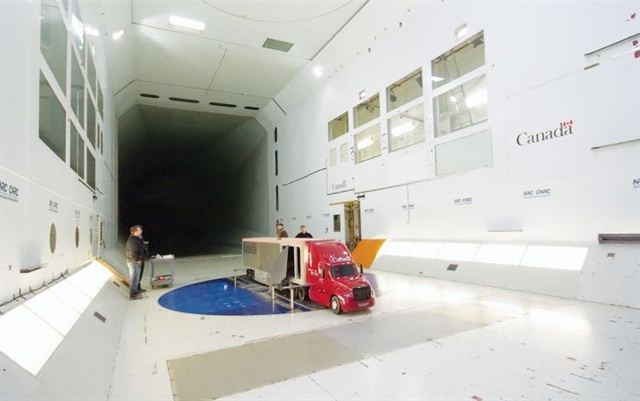
Photo: National Research Council of Canada

">

Photo: National Research Council of Canada

">

Ridge Corporation has partnered with the aerospace technology company FlexSys to help improve truck aerodynamics devices, reducing drag and improving fuel efficiency.

FlexSys is a Michigan-based company that has been developing advanced aircraft wing technologies with the Air Force Research Laboratories and has validated concepts through both NASA flight tests and on private jets.

The company's technology involves variable geometry control surface mechanisms that use the inherent flexibility of aerospace materials to continuously reshape optimal aerodynamic profiles. Ridge wants to incorporate this dynamic technology into its devices to produce, resilient, low-complexity, cost-effective devices that improve fuel savings over currently available technologies.

“Ridge's goal is to incorporate this new technology as a complement to our own engineering expertise and our ability to quickly move new technologies to market,” said Gary Grandominico, Ridge CEO.

The two companies have agreed to join forces to combine the latest aerospace technologies with the real-world requirements of the trucking industry.

“We have found a strong partner in Ridge Corporation and are looking forward to applying our technology to the field of truck aerodynamics,” said Dave Hornick, FlexSys COO.

Related: 7 Ways Aerodynamics Save Fuel

Follow @HDTrucking on Twitter

...Read the rest of this story

Trump eager for big meeting with Putin; some advisers wary

Trump eager for big meeting with Putin; some advisers wary

WASHINGTON (AP) — President Donald Trump is eager to meet Russian President Vladimir Putin with full diplomatic bells and whistles when the two are in Germany for a multinational summit next month. But the idea is exposing deep divisions within the administration on the best way to approach Moscow in the midst of an ongoing investigation into Russian meddling in the U.S. elections.


...Read the rest of this story