Truckers Held Hostage By NAFTA Impasse
The U.S. Marine Corps, like other branches of the American military, conducts annual “rodeo” events to ensure troopers within its motor transportation companies can use all of their vehicle- and combat-skills in “stressful situations.” These rodeo events usually pit teams of Marines against one another in timed competitions backing up trailers, hooking up trailers, securing flatbed loads, making truck repairs, and even assembling/disassembling weaponry. (All photos courtesy of the Department of Defense)
read more
...Read the rest of this storyread more
...Read the rest of this storyImage: U.S. DOT
">Image: U.S. DOT
">The American Society of Civil Engineers has once again assigned a barely passing grade of “D+” to the nation's overall infrastructure and an even more parsimonious “D” to our road network. Bridges, though, fared a bit better— scoring a “C+.”
On the other hand, ASCE conceded in its latest Infrastructure Report Card that there has been “incremental progress” on fixing infrastructure. Still, there hasn't been enough positive movement across the broad infrastructure board yet to secure even an overall rating of “C.”
ASCE said the 2017 grades range from the highest (a “B” for Rail to a “D-“ for Transit). The group said this range illustrates the clear impact of investment – or lack thereof – on the grades. Here is the grading system spelled out: “A” is “exceptional; “B” is good; “C” is mediocre; “D” is poor, at risk; and “F” is—no surprise here-- failing, unfit for purpose.
Three categories (Parks, Solid Waste, and Transit) saw their grade decline this time while seven (Hazardous Waste, Inland Waterways, Levees, Ports, Rail, Schools, and Wastewater) saw slight improvements. Six categories' grades remain unchanged from 2013: Aviation, Bridges, Dams, Drinking Water, Energy, and Roads.
Where there was improvement, it came thanks to “vocal leadership, thoughtful policymaking, and investments that garnered results.” ASCE contended that these improvements “demonstrate what can be accomplished when solutions that move projects forward are approved and implemented.”
"While our nation's infrastructure problems are significant, they are solvable," ASCE President Norma Jean Mattei said in a statement on the report card. In a thinly veiled reference to President Trump among other politicians, she added that, "We need our elected leaders-- those who pledged to rebuild our infrastructure while on the campaign trail-- to follow through on those promises with investment and innovative solutions that will ensure our infrastructure is built for ...Read the rest of this story

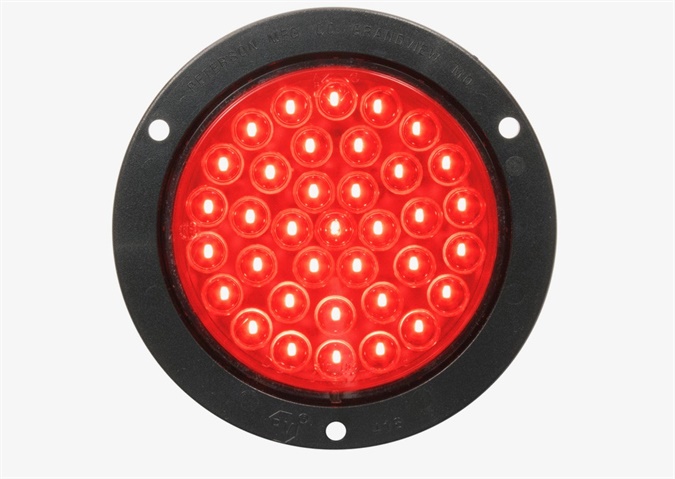
Peterson has combined the look of its original 36-diode Piranha LED lights with modern circuitry and automated manufacturing to create the 817R-36 Stop/Turn/Tail light and the 817A-36 Park/Turn light.
The new 4-inch round models are available as both red-lensed S/T/T lights and amber-lensed Park/Turn lights. Thirty-six bright white diodes provide brilliant illumination with the reliability of an LED. Both models feature an operating range of 9-16 volts with a design that provides consistent light output over the entire voltage range.
The lights are available in either grommet- or flange-mount design and do not require top positioning to meet FMVSS 108 standards. The amber version meets U.S. Department of Transportation requirements for front and rear turn signal, parking lamp, sidemarker, and clearance lights.
“We're proud to add these new items to our growing USA-made line,” said Mark Assenmacher, Peterson marketing director. “They're now in stock and priced to compete with any LED high-count light on the market.”
Follow @HDTrucking on Twitter
...Read the rest of this story