J.B. Hunt Transport Services, Inc., U of A Collaborating to Create Unique Supply Chain Innovation Center
Image: Federal Motor Carrier Safety Administration
">Image: Federal Motor Carrier Safety Administration
">The American Trucking Associations is continuing its push to allow hair-testing to be used in lieu of urinalysis to detect drug use by CDL driver applicants.
In a March 20 letter to Health and Human Services Secretary Tom Price, American Trucking Associations President and CEO Chris Spear called for HHS to quickly release guidelines and standards for the use of hair samples in mandatory drug testing of truck drivers.
ATA pointed out in a statement that HHS has yet to issue the necessary standards that would allow those tests to be implemented. It also noted that this week ,the Substance Abuse and Mental Health Services Administration (an HHS agency) will hold Drug Testing Advisory Board meetings to consider hair-testing, “putting HHS well behind its congressionally mandated deadline.”
“Many trucking companies are using urinalysis to meet federal requirements, while also paying the additional cost to conduct hair testing,” Spear said in the letter. “We are frustrated that the previous administration failed to meet the statutory deadline and believe your leadership will finally see a resolution to this long-standing and important safety rule.”
According to ATA, the association and many of its member carriers contend that, based on experience, "hair-testing is more effective at preventing habitual drug users from obtaining jobs as truck drivers, thus improving highway safety."
“Making sure America's truck drivers are safe and drug-free is among ATA's highest priorities,” Spear said. “This commitment is why ATA led the charge for mandatory drug-testing of commercial drivers, for the creation of a clearinghouse for drug and alcohol testing results, and the use of hair-testing.”
Spear's letter comes a month after the Alliance for Driver Safety & Security (a.k.a. the Trucking Alliance) submitted a set of detailed comments to the Federal Motor Carrier Safety Administration that strongly support a petition calling for ...Read the rest of this story

FedEx Corp. on Tuesday reported increased net earnings in its most recent quarter, but it missed Wall Street expectations.
The parcel and trucking company said revenue in its fiscal third quarter was unchanged from a year ago at $15 billion while net income increased to $562 million, or $2.07 per share, compared to $507 million, or $1.84 per share, a year earlier. While revenue met a consensus estimate from analysts, expected per share net income was greater at $2.62.
Adjusted earnings, which include one-time items such as TNT Express integration expenses, fell to $638 million, or $2.35 per share, down from a year ago when they came in at $692 million, or $2.51 per share, respectively
“Our worldwide FedEx team delivered an outstanding peak season. Even with our highest volumes ever, we achieved record service levels,” said Frederick W. Smith, FedEx Corp. chairman and chief executive officer. “We are confident our strategic investments to expand our global scope and portfolio of solutions position FedEx for greater long-term profitable growth as we adapt to meet the evolving needs of our customers.”
Operating results were impacted by the significantly negative net impact of fuel and one fewer operating day at FedEx Express and FedEx Ground, and network expansion at FedEx Ground, according to the company. These factors were partially offset by the benefits from yield growth at all of the company's transportation segments.
The company's FedEx Express segment saw revenue increase to $6.78 billion in the most recent quarter compared to $6.56 billion a year earlier while operating income fell to $555 million from $595 million.
“Revenue increased 3% as higher base rates and package volume were partially offset by the negative impact from one fewer operating day,” FedEx said. “Operating income declined due to the significantly negative net impact of fuel and one fewer operating day.”
FedEx Freight ...Read the rest of this story

The U.S. Department of Transportation has declared Georgia-licensed truck driver Christopher Speyrer an imminent hazard for instances of drug use and an alcohol-related accident.
In October 2016, Speyrer placed an emergency call for medical assistance at a truck stop in Greenwood, La., from the cab of his truck. While being transported to a hospital by ambulance, he told emergency personnel that he had been using a Schedule II controlled substance. He also admitted to using the same substance earlier in the week and had not slept for the five previous days as a result. Despite this, he continued to operate his truck.
A little more than a month later, Speyrer was responsible for a multi-vehicle chain reaction crash when he struck the rear of a car that had stopped due to traffic conditions. A Virginia court found him guilty of driving under the influence of alcohol at the time of the accident.
For these violations, the Federal Motor Carrier Safety Administration is ordering Speyrer not to operate any commercial motor vehicle in interstate commerce, saying that his driving “substantially increases the likelihood of serious injury or death to [himself] and the motoring public if not discontinued immediately.”
Failure to comply with the provisions of a federal imminent hazard out-of-service order may result in action by the U.S. Attorney's Office for relief and punitive damages. Civil penalties of up to $1,782 may be assessed for each violation of operating a commercial motor vehicle in violation of the order. Knowing and willful violation of the order may also result in criminal penalties.
Speyrer also may be subject to a civil penalty enforcement proceeding brought by FMCSA for his violation of the agency's safety regulations.
Related: Driver Declared Imminent Hazard After 2 Alcohol-Related Arrests
Follow @HDTrucking on Twitter
...Read the rest of this storyDenise Rondini
" >Denise Rondini
" width="231" height="254">It's always interesting to spend time with aftermarket suppliers and distributors and get their take on the truck parts and service business.
I did that late in January when I attended Heavy Duty Aftermarket Week in Las Vegas. One of the sessions, Battle of the Channels, featured both suppliers and fleets talking about trends, expectations and what will be needed to gain a fleet's parts and service business in the future.
To set the stage, data from MacKay & Co. shows that dealers have 49% of the outsourced parts and service business, while independent repair garages have 19% and engine distributors 9%. OE dealers are gaining marketshare at the expense of independent shops. On the parts side, competition has expanded to include auto parts distributors and e-commerce.
Here are some of the trends the panel identified.
Expect more integration: Scott Davis, director of strategic partnerships and customer experience at Eaton, believes there will be deeper powertrain integration and vehicle systems integration. Lee Long, director of fleet services at Southeastern Freight Lines, says, “I believe in the next few years we will see replacement parts for an integrated drivetrain.” And according to Walt Sherbourne, vice president of marketing and partner, Dayton Parts, “Vertical integration is here, and it is not disrupting the aftermarket. Fleets still need parts when and where they need them.”
Technology will continue to be a challenge: According to Joe Mejaly, senior vice president and general manager, Denso, “The OEMs are not slowing down in developing technology. Independents need to be more entrepreneurial in order to catch up [to dealers].”
Training is even more important: Dwayne Haug, principal owner, Dwayne O. Haug Consulting LLC, said, “Complexity has added to the need for training.” He added, “We still have to have training and we are relying on other channels of repair ...Read the rest of this story
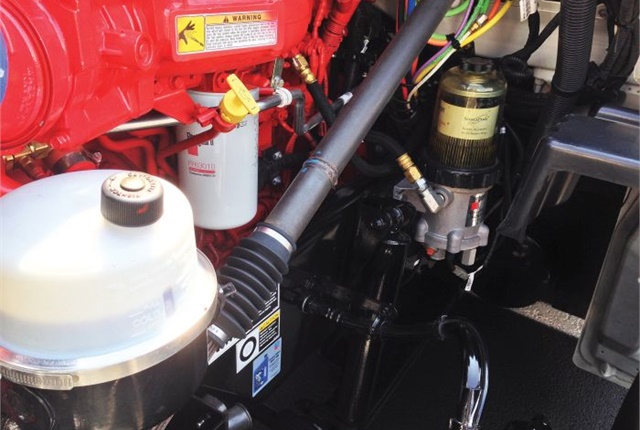
Supplemental fuel processors combine a fuel filter, water separator and heater all in one unit and are designed for severe conditions like extreme cold. Photo: Cummins Filtration
">Supplemental fuel processors combine a fuel filter, water separator and heater all in one unit and are designed for severe conditions like extreme cold. Photo: Cummins Filtration
">Where's the value in putting a $40,000 engine at risk just to save a few bucks on a fuel filter?
It's not always clear when a fuel filter is doing its job. You put it on, you change it for another one a few months later, and since nothing bad happened to your engine in the interim you have to believe the filter worked. Few fleets cut them open to see how well they worked. Even if you did, you likely wouldn't see anything alarming, unless you have a serious fuel system or fuel quality problem.
Contamination comes in many forms. There's ever-present water and debris from the bottom of the fuel storage tanks. Microbial growth in fuel tanks can form algae, which can be ingested by the fuel intake line. And poorly maintained fuel systems can contain rust or other particulates.
If you're not satisfied with the life of your fuel filters, it's probably not the filter you need to investigate.
“At times, variability in fuel quality (high contaminant content, additives and additive drop-out, glycerin from biodiesel production) manifests itself in the form of short filter life,” says Scott Grossbauer, global manager for clean solutions at Donaldson. “In reality, the filter is doing its intended job of removing particles of a size range at a particular efficiency and delivering contaminant holding capacity designed for the intended use.”
Today's high-pressure fuel systems, with their extremely close internal tolerances, do not respond well to contaminated fuel.
“The average gallon of fuel can contain over 18 million potentially harmful particles, which can wear down critical components in your engine,” says Cindy Hawkins, global product manager for fuel at Cummins ...Read the rest of this story