Burlington Skyway closed after winds tip over truck
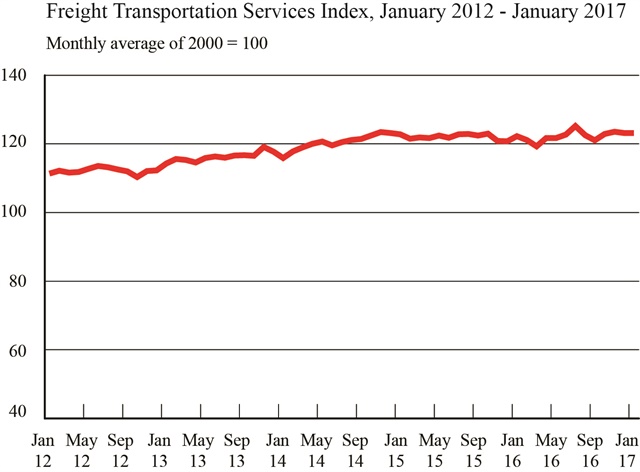
The Freight Transportation Services Index, Jan. 2012 - Jan. 2017. Graphic: U.S. DOT
" >The Freight Transportation Services Index, Jan. 2012 - Jan. 2017. Graphic: U.S. DOT
" width="400">While the amount of freight moved by the nation's for-hire transportation sector was unchanged in January from December, according to a new Transportation Department report, it did manage a slight increase from the same time a year ago.
The Freight Transportation Services Index (TSI) remained at 123.2, but that's up 0.8% from January 2016, and just 1.6% below the all-time high level of 125.2 hit in July 2016.
The December index was revised to 123.2 from 124.7 in last month's release as a result of fewer actual air freight ton-miles than forecast.
The Freight TSI measures the month-to-month changes in for-hire freight shipments by mode of transportation in tons and ton-miles, which are combined into one index. The index measures the output for-hire trucking, rail, inland waterways, pipelines and air freight.
In January, there were increases in air freight, water, and rail carloads, while trucking, pipeline, and rail intermodal declined. The January steadiness in Freight TSI took place against a background of mixed signals in other economic indicators, according to the report, including growth in employment, personal income and manufacturing while housing starts fell by 2.6%.
The January Freight TSI remained in the same narrow range that has continued for two and a half years. Since the index reached 121.1 for the first time in August 2014, it has with only two exceptions fluctuated between a low of 120.5 and a high of 123.5, slightly above the January level. They were in March 2016, when the index dropped to a three-year low of 119.3, and July 2016, when it reached a new peak of 125.2.
The index dropped 3.4% in the two months after reaching that peak, then rose 2.1% in the following two months to reach 123.5 in November 2016, its ...Read the rest of this story