Category: Trucking News

Chinese Tire Investigation Shows ‘Pervasive Underselling at High Margins’

<img width="150" src="http://www.automotive-fleet.com/fc_images/articles/m-chinese-tires-1.jpg" border="0" alt="

Photo: Jim Park

">

Photo: Jim Park

">

The International Trade Commission says there's evidence of “significant” underselling of Chinese truck and bus tires from 2013 to 2015, and that the underselling margins generally increased over that time frame.

Yet, the ITC voted not to impose tariffs on those imported tires.

“We do not find that subject imports depressed U.S. producers' prices to a significant degree.”

Here's what this publication is learning as we wade through the ITC's final report following its decision not to place tariffs on truck and bus tires from China.

In the final phase of its investigation, five domestic tire producers and 27 importers provided usable pricing data on four tires for drive applications (excluding all-position) tires:

size 11R22.5, 16 ply rating, load range of H, speed rating L (75 mph)size 11R24.5, 16 ply rating, load range of H, speed rating L (75 mph)size 295/75R22.5, 14 ply rating, load range of G, speed rating L (75 mph)size 285/75R24.5, 14 ply rating, load range of G, speed rating L (75 mph)

The commission says prices for domestic truck and bus tires declined between the first quarter of 2013 and the fourth quarter of 2015 for both original equipment and aftermarket sales on all four of the specified products.

“While subject import prices also generally declined, the record does not support a finding that subject imports caused price declines for domestically produced truck and bus tires.

“In particular, the record indicates changes in the cost of underlying raw materials affect the price of truck and bus tires. By any metric observed, raw material costs fell by considerably more than the price of domestically produced truck and bus tires during the period of investigation. Between January 2013 and December 2015, the price of rubber, the primary raw material used in the production of truck and bus tires, fell precipitously.”

In that same two-year ...Read the rest of this story
Work Truck Show News

<img width="150" src="http://www.automotive-fleet.com/fc_images/articles/m-wts-fuso-announcement-2.jpg" border="0" alt="

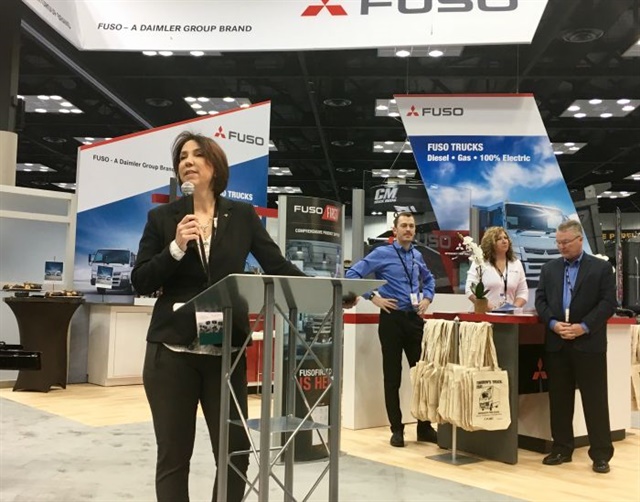
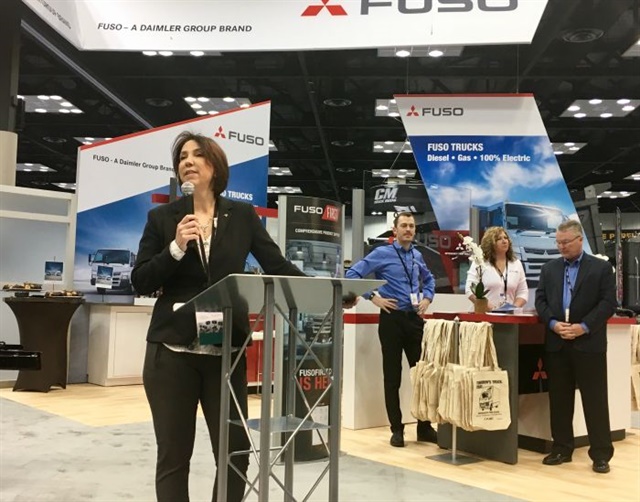
Jecka Glasman, president and CEO of Mitsubishi Fuso, announcing new products at the Work Truck Show in Indianapolis. Photo: David Cullen

">

Jecka Glasman, president and CEO of Mitsubishi Fuso, announcing new products at the Work Truck Show in Indianapolis. Photo: David Cullen

">

The NTEA Work Truck Show is currently underway in Indianapolis, bringing with it important announcements for light- and medium-duty vocational vehicle operators and upfitters. Check our our coverage of the new trucks and technologies, updates on existing vehicles, and the latest engines and products.

Highlights include:

• Green Truck Summit keynote looks at how green electric trucks really are

• Mitsubishi Fuso's all-electric truck

• Detroit's new medium-duty vocational engine

• What to expect in Chevy's new medium-duty truck

• More applications for Eaton's Procision transmission

And more.

Follow @HDTrucking on Twitter

...Read the rest of this story

Work Truck Show News

<img width="150" src="http://www.automotive-fleet.com/fc_images/articles/m-wts-fuso-announcement-2.jpg" border="0" alt="

Jecka Glasman, president and CEO of Mitsubishi Fuso, announcing new products at the Work Truck Show in Indianapolis. Photo: David Cullen

">

Jecka Glasman, president and CEO of Mitsubishi Fuso, announcing new products at the Work Truck Show in Indianapolis. Photo: David Cullen

">

The NTEA Work Truck Show is currently underway in Indianapolis bringing with it important announcements from the trucking world.

That's why we're sending out a newsletter filled with all the biggest news from the Work Truck Show so far, to keep our readers up to date on what is going on, as it's happening.

From new trucks and technologies, to updates on existing vehicles, as well the latest engines and products, we're covering it all. So scroll through the newsletter and stay up to date on the past few days' news.

Follow @HDTrucking on Twitter

...Read the rest of this story

Economic Watch: Fed Pushes Interest Rates Higher Amid Improving Signs

<img width="150" src="http://www.automotive-fleet.com/fc_images/news/m-screen-shot-2017-03-15-at-1-58-52-pm-1.jpg" border="0" alt="

Federal Reserve Chair Janet Yellen talking with reporters follwing Wednesday's Fed announcement it is increasing interest rates. Photo: Evan Lockridge via FOMC website.

" >

The Federal Reserve on Wednesday increased the nation's benchmark interest rate for the third time since its first hike in nearly a decade in December 2015, amid evidence of a steady economy and indications of more interest rate increases later this year.

The 0.25% jump in the federal funds rate (the interest rate banks charge each other for overnight loans to meet reserve requirements), pushes its target to 0.75%-1% following the previous hike in December 2016.

According to the Federal Reserve, information received since the Federal Open Market Committee met in February indicates that the labor market has continued to strengthen, that economic activity has continued to expand at a moderate pace, and that job gains have remained solid with little change in unemployment.

“Household spending has continued to rise moderately while business fixed investment appears to have firmed somewhat,” the statement said. “Inflation has increased in recent quarters, moving close to the committee's 2% longer-run objective. Excluding energy and food prices, inflation was little changed and continued to run somewhat below 2%.”

The central bank is forecasting two more rate hikes this year, three in 2018 and at least three in 2019, to bring the federal funds rate to 3%, slightly earlier than its previous goal of 2020. Earlier some analysts were predicting there could be as many as four rate hikes in 2017.

The Fed also left its total economic growth GDP forecast nearly unchanged at 2.1% for this year and 1.9% for 2019, while projecting an unemployment rate of 4.5% for the next three years.

When asked what this and other rates hikes mean for trucking, American Trucking Associations Chief Economist Bob Costello said, “Obviously financing costs will rise with the rise in interest rates, including for equipment and loans for expansions.” But he also noted there are positives.

“Two of the biggest for ...Read the rest of this story

The Hottest Industry In The Land

<img width="150" src="http://www.automotive-fleet.com/fc_images/blogs/m-mb-uber-1.jpg" border="0" alt="

New technology is transforming trucking and bringing new players with new ideas into the industry. Photo: Mercedes-Benz 

">

New technology is transforming trucking and bringing new players with new ideas into the industry. Photo: Mercedes-Benz 

">

On Monday morning this week, MIT, one of the leading engineering schools on the planet, published its list of Breakthrough Technologies for 2017, with “Driverless Trucks” holding down the number one position.

At this point, if you've been in the trucking industry for longer than five years, it's perfectly fine to sit back, look around in amazement and wonder just what in the hell is going on?

Trucking hasn't been this hot a property since Burt Reynolds had real hair. At this point, mainstream media news stories concerning this industry - and the technological revolution it is either going through, or about to go through (depending on who you're talking to) - are becoming a daily event.

Why is that?

The movement of goods has been a staple of civilization since humans figured out the fundamentals of trade. It goes without saying that a lot of history and technology has been fueled by the desire to move goods around the planet as efficiently as possible. A century ago, some early pioneers decided to put the internal combustion engine to work doing exactly that and, over time, the industry that we know and love today gradually took shape. And while this industry has never been as efficient and professional as it is today, it's still not good enough.

That, in a nutshell, is what in the hell is going on.

We've been in the developing stages of an Internet-fueled global super economy for a decade or so now and it seems fair to say that we're on the cusp of seeing that super economy go white-hot. The signs are everywhere:

The widening of the Panama Canal.Chinese efforts to build their own canal across Nicaragua.The ever-increasing demand for next-day, or now ...Read the rest of this story

UPS Invests More Than $90M In Natural Gas

<img width="150" src="http://www.automotive-fleet.com/fc_images/news/m-ups-cng-tractor-1.jpg" border="0" alt="

Photo: UPS

">

Photo: UPS

">

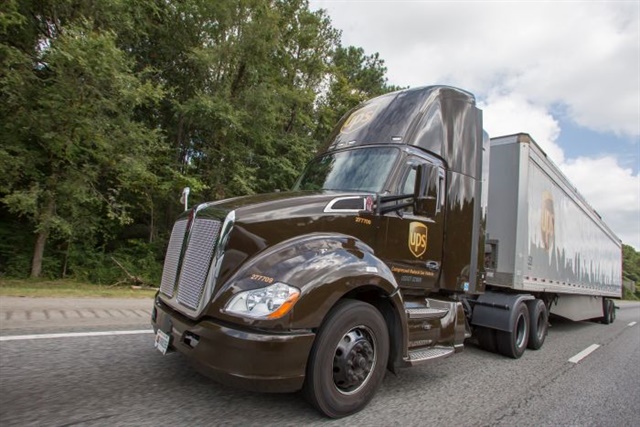
UPS said it will invest more than $90 million in natural gas facilities and vehicles, including fueling stations, compressed natural gas trucks, and liquefied natural gas vehicles.

The company plans to build an additional six CNG fueling stations and add 30 new CNG tractors and terminal trucks as well as 50 LNG vehicles to its alternative fuel and advanced technology fleet.

“With more than 4,400 natural gas vehicles and a network of fueling stations, UPS has had great results using natural gas as an alternative fuel in our fleet,” said Mark Wallace, UPS senior vice president of global engineering and sustainability. “We know the importance of investing in natural gas globally for our fleet and the alternative fuel market. In 2016, we used more than 61 million gallons of natural gas in our ground fleet, which included 4.6 million gallons of renewable natural gas. This helped us to avoid the use of conventional gas and diesel, and decreased CO2 emissions by 100,000 metric tons.”

Last year, UPS invested $100 million in CNG fueling stations and vehicles. The company currently operates 31 CNG fueling stations in Alabama, Arizona, California, Colorado, Georgia, Kansas, Kentucky, Louisiana, Nevada, Oklahoma, Pennsylvania, Texas, Virginia, Tennessee and West Virginia. It runs CNG vehicles in 38 states in addition to ones in Germany, the Netherlands, and Thailand.

The six new CNG stations will be built in Ontario, California; Orlando, Florida; Salina, Kansas; Louisville, Kentucky; Greensboro, North Carolina, and Vancouver, British Columbia, Canada. Renewable natural gas will be used at the station in Ontario. UPS also purchased 50 additional LNG vehicles that were deployed in Indianapolis, Indiana; Chicago; Earth City, Missouri; and Nashville, Tennessee, where UPS has existing LNG stations.

Since 2009, UPS has invested more than $750 million in alternative fuel and advanced technology vehicles and fueling stations globally. The company has ...Read the rest of this story