Author: Vitaliy Dadalyan

Waymo Exploring Self-Driving Trucks

<img width="150" src="http://www.automotive-fleet.com/fc_images/news/m-waymo-chryslerpacificaminivan-7-1.jpg" border="0" alt="

Waymo's fully self-driving Chrysler Pacifica Hybrid minivan. Photo: Waymo

">

Waymo's fully self-driving Chrysler Pacifica Hybrid minivan. Photo: Waymo

">

Alphabet Inc.'s autonomous-driving unit Waymo is now also developing self-driving trucks, per published reports.

Reuters has reported that Waymo expects autonomous vehicles to be in a position eventually to take over long-haul trucking, although human drivers would still cover local P&D routes.

“Self-driving technology can transport people and things much more safely than we do today and reduce the thousands of trucking-related deaths each year,” a Waymo spokesperson told BuzzFeed News. “We're taking our eight years of experience in building self-driving hardware and software and conducting a technical exploration into how our technology can integrate into a truck.

According to its posted report, BuzzFeed News first learned of Waymo's truck work through a photograph. Waymo then confirmed that it was testing a truck by manually driving the semi on a public road to collect data. The Waymo spokesperson also confirmed that the company is currently testing only one truck.

Related: Uber Fires Self-Driving Head at Center of Legal Battle

Follow @HDTrucking on Twitter

...Read the rest of this story
Truckload Linehaul Rates Stabilize, Intermodal Rates Continue Strength

Truckload line haul rates may finally be ready to turn around for the better following recent declines while intermodal rates continue their recent improvements, according to two new reports.

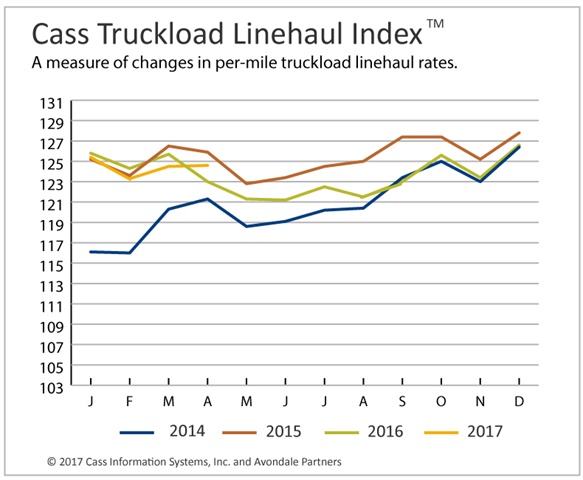
The Cass Truckload Linehaul Index for April increased from the same time a year ago. Despite this gain, the reading is virtually unchanged from the month before but it at its highest level since January.

According to Donald Broughton with Broughton Capital, who provides analysis of the reports, pricing for trucking appears to be stabilizing.

“After being negative for 13 months in a row [in terms of] year-over-year comparisons, April's Cass Truckload Linehaul Index increased 1.3% year-over year to 124.6,” he said. “April's pricing, while promising, was sequentially flat versus March and is still negative, down 1% versus April of 2015.”

Broughton's pricing forecast for 2017 remains in a range of between a 1% decline to a 2% improvement, as the current strength being reported in spot rates is leading him to believe contract pricing rates should move back into positive territory by the end of the year.

The Cass Truckload Linehaul Index measures market fluctuations in per-mile truckload pricing that isolates the linehaul component of full truckload costs from others, such as fuel and accessorials, providing a reflection of trends in baseline truckload prices.

Meantime, the latest data points for the Cass Intermodal Price Index show total intermodal pricing rose 2.7% year-over-year in April to a reading of 133.1 after March's 4.8% increase. Despite this gain, the April reading fell 1.7% from March, which was the index's highest level since April 2014.

April marked the seventh consecutive month of year-over year increases, but suggests that pricing momentum is slowing, according to Broughton.

He expects intermodal rates to continue to show better strength in 2017 than was achieved in 2016, “as the price of diesel fuel has recovered from ...Read the rest of this story

Pre-Filters Keep Filters Cleaner for Longer

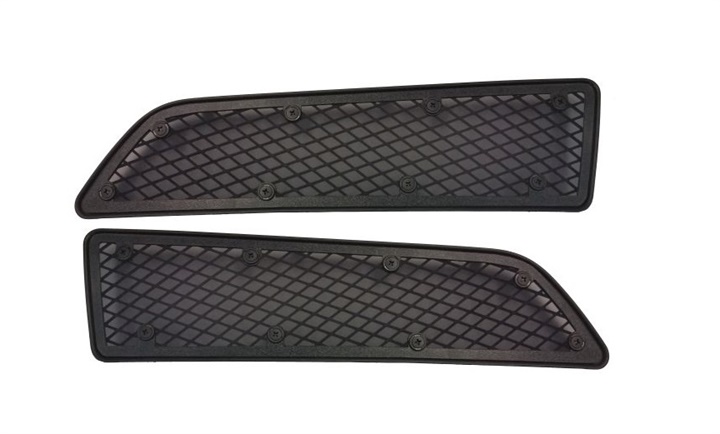
FreedomAirFilters.com has released a new quick install pre-filter pair for Kenworth T880 trucks.

The pre-filters are designed to offer protection and extended filter life without drilling, gluing, or removing the intake grilles. The pre-filters are designed to fit over the factory plastic intake grilles and the kit comes with retainer clips for a faster installation.

Pre-Filters keep out larger particles of debris such as grain chaff, dirt, and sand from getting into and clogging the air filter element. By keeping out the large particles, air filters stay cleaner for longer, improving performance and fuel economy.

The pre-filters are treated with a hydrophobic water repellent process which helps keep out rain, ice, and snow. They are reusable and can be cleaned with soap and water.

Follow @HDTrucking on Twitter

...Read the rest of this story
Fumoto Engine Oil Drain Valve Approved for Trademark

Fumoto has announced that its Engine Oil Drain Valve was approved for a trademark for its visual appearance.

The Engine Oil Drain Valve was recognized as visually distinctive and was a source of identifying the product, according to Fumoto.

The Fumoto SX-series is comprised of two distinct but fully integrated parts: the through bolt and oil-flow control body. These features allow the valve to be positioned for more convenient and easy oil changes.

The SX-series valve allows installation without an adapter on some vehicles that may have previously required one. A larger body and quad channels allow for improved flow rates and faster oil changes in certain sizes.

Follow @HDTrucking on Twitter

...Read the rest of this story

Bicyclists Were the Original Advocates for Good Roads

<img width="150" src="http://www.automotive-fleet.com/fc_images/blogs/m-old-trails-1.jpg" border="0" alt="

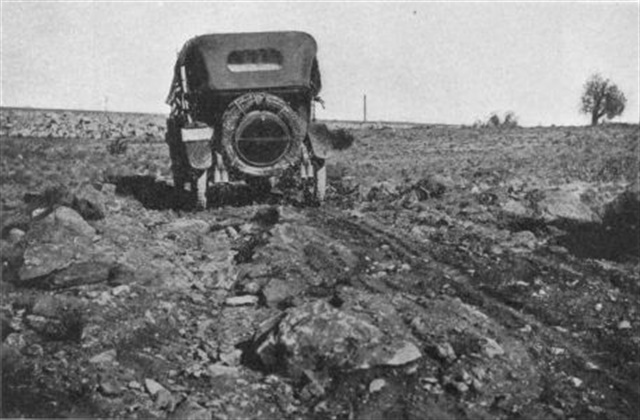
Rutted dirt was the rule on rural roads, like this one in Arizona. Rains made them muddy quagmires. Tall wheels with narrow tires worked well in these conditions. Photos: America on the Move

">

Rutted dirt was the rule on rural roads, like this one in Arizona. Rains made them muddy quagmires. Tall wheels with narrow tires worked well in these conditions. Photos: America on the Move

">

“Infrastructure” was once an arcane word known to civil engineers and not many other people. But it has recently worked its way into news stories and, more importantly, into the language of lawmakers, especially those in the U.S. Congress.

Something may well come out of this new interest, and the realization that crumbling concrete and rutted asphalt ain't the modern and efficient way to go (not to mention aging water mains, sewers, electrical grids, capacity strapped rail lines, and everything else that makes a 21st Century civilization function).

In more primitive times, travel by carriage and freight wagon — forerunners to today's cars, trucks, and tractor-trailers — usually meant fighting deep ruts and being mired in mud because most streets and roads were bare dirt. Exceptions were cobblestone and wood-block streets in major cities, privately operated turnpikes paved with wooden planks, logs (known as corduroy) or crushed stone (macadam), and the National Road (the first federally funded highway, dating to 1817.

In cities, copious amounts of horse and mule manure lay about, generating stench and drawing flies that upset the sensibilities of ladies and gentlemen. Women and sometimes men carried perfumed kerchiefs to mask the odor, and it's likely that respiratory diseases were a more serious result.

Most travel of any distance was by train, as the railroads quickly expanded to meet demand and capture healthy and lucrative business from shippers and passengers. But people wanted more freedom.

By the 1920s, a Good Roads movement pressured local, state and federal politicians to raise money and make major improvements, including grading and paving, and marking and mapping road networks. Major corporations like General ...Read the rest of this story
FMCSA Yanks Minimum Insurance Rulemaking

<img width="150" src="http://www.automotive-fleet.com/fc_images/news/m-fmcsatruckcrash-3-1.jpg" border="0" alt="

Photo: FMCSA

">

Photo: FMCSA

">

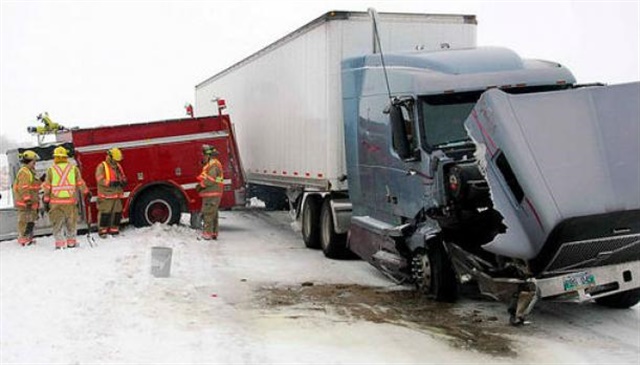
More than three years after launching a rulemaking to increase minimum insurance requirements for trucking, the Federal Motor Carrier Safety Administration is dropping the effort because it says it has not collected enough information to warrant going forward.

The agency had first announced back in April 2014 that it was issuing an advance notice of proposed rulemaking to consider whether it should increase the financial responsibility for motor carriers, freight forwarders, and brokers. FMCSA noted that it is authorized to establish minimum insurance levels for motor carriers at or above the minimum levels set by Congress.

FMCSA had been seeking public comment on whether to exercise its discretion to increase the minimum levels and, if so, to what levels. “After reviewing all public comments to the ANPRM, FMCSA has determined that it has insufficient data or information to support moving forward with a rulemaking proposal, at this time,” the agency stated in a notice that will be published in the Federal Register for June 5.

In the ANPRM (Docket No. FMCSA-2014-02110) issued in 2014, the agency stated it was “considering a rulemaking that would increase minimum levels of motor carrier financial responsibility for bodily injury or property damage and sought information in connection with that potential rulemaking.”

Specifically as to motor carriers, the ANPRM sought public comment on a series of questions addressing the following matters:

Premium RatesCurrent Minimum Levels of Financial ResponsibilityImpacts of Increasing the Minimum Level of Financial ResponsibilityCompensationSources of InformationTimelines for implementation

FMCSA also said at the time that it would be asking “several questions related to broker/freight forwarder financial responsibility as it continues to implement Section 32918 of the Moving Ahead for Progress in the 21st Century (MAP-21) Act” highway bill, which became law back in 2012.

In addition, the ANPRM sought answers to questions pertaining to trip insurance for ...Read the rest of this story