Author: Vitaliy Dadalyan

CarriersEdge Course Instructs Truck Drivers on Accident Reporting

<img width="150" src="http://www.automotive-fleet.com/fc_images/news/m-carriersedge-accident-reporting-1.jpg" border="0" alt="

Photo: CarriersEdge

">

Photo: CarriersEdge

">

CarriersEdge has announced a course on accident reporting to help drivers deal with an accident scene and handle the stressful situation.

The course is more than a basic list of steps to follow, according to Jane Jazrawy, CEO; instead it teaches a full process that is designed to be easy to remember for drivers.

“The best time to plan how to handle an accident is before it happens,” said Jazrawy. “We've designed a course to give drivers the tools they need so that when an accident occurs they know how to prevent further damage or injury, work with law-enforcement and emergency personnel, and gather information, all while staying calm.”

The course teaches a simple four-step process – stop, secure, report and document – and what goes into each. Topics covered in the course include:

Appropriate behavior at an accident sceneHow to secure a vehicle with warning signalsHow to assist the injuredInformation to be included in an accident report and how to collect witness information and take photographsDrug and alcohol testing

The course also addresses post-traumatic stress disorder for drivers who have been involved in accidents. The course was developed with feedback from fleets as well as with insurance companies.

“Our insurance partners really saw a gap in their clients' knowledge base with regard to accident scene reporting,” said Jazrawy. “We were able to combine our own research into truck-safety best practices and what those partners have learned to come up with training that answers that need.”

The course is part of CarriersEdge's employee training offering, a library that includes more than 70 full-length and refresher/remedial courses, covering topics such as cargo securement, hours of service rules, logbooks, and safe driving techniques.

For more information on CarriersEdge training courses, click here.

Related: CarriersEdge Addresses Food Safety Training

Follow @HDTrucking on Twitter

...Read the rest of this story
Natural Gas Road Rally Kicks Off In Long Beach

<img width="150" src="http://www.automotive-fleet.com/fc_images/news/m-ngv-rally-1.jpg" border="0" alt="

Photo: Clean Energy Fuels

">

Photo: Clean Energy Fuels

">

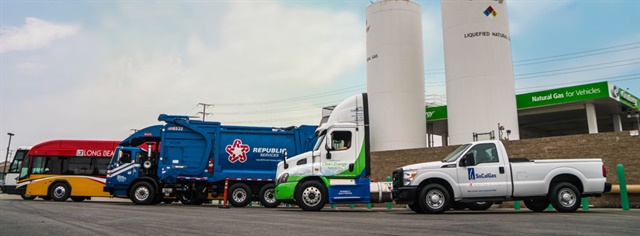
The Natural Gas Road Rally Across America has kicked off in Long Beach, Calif., sending several heavy-duty trucks and other vehicles powered by natural gas on a coast-to-coast road trip to Washington, D.C.

The event was attended by representatives from the California Natural Gas Vehicle Coalition, which is calling for the adoption of low nitrous oxide emission heavy-duty truck technology powered by renewable natural gas in the Clean Air Action Plan of the San Pedro Bay Ports.

The rally is a 4,825-mile cross country trip sponsored by NGVAmerica. It aims to demonstrate the benefits of clean trucks and cars fueled by natural gas. Many vehicles powered by natural gas will participate in the two-week trek across America, stopping at various locations such as Albuquerque, N.M., Tulsa, Okla., Salisbury, N.C., and Newport News, Va., among others. At each stop, advocates for natural gas vehicles will give educational demonstrations highlighting the importance of natural gas as a clean fueling source.

The Rally's spotlight on natural gas trucks is relevant to the Long Beach area where heavy-duty diesel trucks regularly haul goods from the ports of Los Angeles and Long Beach every day. Around 80% of the region's smog is estimated to come from the transportation sector, with the largest contributor of the pollution being heavy-duty trucks moving in and out of the ports complex, according to CNGVC. Replacing some of these vehicles with cleaner-burning natural gas trucks could have a significant impact on local air quality.

“NGVAmerica and its membership, including companies like Clean Energy and SoCalGas, believe that natural gas-fueled vehicles are the best and most immediate solution for eliminating the negative impacts of diesel and combatting climate change,” said Chad Lindholm, vice president of sales for Clean Energy and representative of NGVAmerica. “By putting on this rally, we hope to draw ...Read the rest of this story

FMCSA Finally Releases Entry-Level Driver Training Rule

<img width="150" src="http://www.automotive-fleet.com/fc_images/news/m-driverpaccarfinancial-2-1.jpg" border="0" alt="

Photo: Paccar Financial

">

Photo: Paccar Financial

">

Talk about taking the long way around the block: A final rule on minimum entry-level CDL training requirements-- issued in December year-- has at last gone into effect, having been delayed several times due to having been placed under a “Regulatory Freeze Pending Review” in January by the Trump administration.

The Federal Motor Carrier Administration has stated that the effective date of the final rule is June 5, 2017. However, the agency has not announced any change to the rule's all-important compliance date coming now in less than three years— Feb. 7, 2020 (which was based on the rule's original effective date).

The agency had begun work on this rulemaking back in 2007, but efforts to advance a rule setting standards for entry-level driver training date actually started in the 1980s.

The rule was mandated by Congress under the MAP-21 highway bill, passed in 2012. FMSCA said the rule was based, in part, on recommendations of the agency's Entry-Level Driver Training Advisory Committee, a negotiated rulemaking committee that held a series of meetings in 2015.

Although applauded by trucking interests, including the American Trucking Associations, the rule remains controversial because it does not include a requirement for 30 hours of behind-the-wheel training for new drivers, which had been included in the notice of proposed rulemaking that FMCSA had issued in March, 2016.

Per the final rule, applicants seeking a CDL will have to demonstrate proficiency in knowledge training and behind-the-wheel training on a driving range and on a public road. Also, training providers must determine that each CDL applicant demonstrates proficiency in all required elements of the training to successfully complete the program.

In addition, the driver training must be obtained from an instructional program that meets qualification standards set forth in the final rule. FMCSA said ...Read the rest of this story

ELDs: In July, FMCSA to Hold Live Q&A Sessions on New Rule

<img width="150" src="http://www.automotive-fleet.com/fc_images/news/m-fmcsa-truck-2.jpg" border="0" alt="

Image via FMCSA

">

Image via FMCSA

">

The Federal Motor Carrier Safety Administration has announced that in July, it will hold two live question-and-answer sessions about electronic logging devices.

The hour-long sessions will enable participants to submit ELD-related questions to be answered by FMCSA's ELD subject matter experts.

Participants are asked to email their questions in advance of the live Q&A sessions or submit their questions during the session. Closed captioning will be provided.

Once a participant registers online, they will be able to listen to the session by phone if an internet connection is unavailable.

Registration is on a first-come, first-served basis with a 200-participant limit per session. The first session will take place on Thursday, July 6, 10:00 a.m. – 11:00 a.m. EDT. To register for this date click here.

The second session will take place the following Thursday, July 13, 1:00 p.m. – 2:00 p.m. EDT. To register for this date, click here.

Email questions in advance to [email protected].

Related: 14 Things You Need to Know Before ELDs Become Mandatory

Follow @HDTrucking on Twitter

...Read the rest of this story

Last Legs for Long-Haul Trucking?

<img width="150" src="http://www.automotive-fleet.com/fc_images/news/m-vnr-2.jpg" border="0" alt="

Magnus Koeck says a new industry emphasis on regional haul routes was a prime design driver for Volvo's new VNR tractor.

Photo: Volvo 

">

Magnus Koeck says a new industry emphasis on regional haul routes was a prime design driver for Volvo's new VNR tractor.

Photo: Volvo 

">

The long-haul model has been the dominant model for moving freight in North America for decades, but there are signs that could be changing, according to Magnus Koeck, vice president, marketing and brand management for Volvo Trucks North America.

The long-haul model for freight distribution developed organically after the Second World War in an age of cheap diesel fuel, a large driver pool, and infrastructure limitations at the time: The Panama Canal was not able to accommodate larger freighters and a new class of container ships. This placed an emphasis on East and West Coast ports, with corresponding long-haul truck routes becoming the norm.

A lot of the pieces that set the long-haul freight model in place have changed dramatically over the past several years, however. The size of the driver pool has not kept pace with the rise in freight volumes. Moreover, a new generation of potential drivers sees the isolation and long periods away from home associated with long-haul routes as a distinct negative.

At the same time, the widening of the Panama Canal (with a new, Chinese-funded canal across Nicaragua under construction now) has made it easier for larger container vessels to reach Gulf Coast ports.

Industry experts tracking these trends have predicted they could lead many truck fleets to adopt short-haul, regional, or super-regional routes, leveraging port expansions on the Gulf Coast to get drivers home sooner, while still maintaining increasingly important efficient freight deliveries.

While there is still some ways to go before trucking sees a full-blown shift away from long-haul routes, Koeck sees signs the shift is underway. “We actually don't see that happening yet in a larger scale as there are still some work to ...Read the rest of this story

Q&A: Ramona Hood of FedEx Supply Chain

<img width="150" src="http://www.automotive-fleet.com/fc_images/articles/m-ramonahood-1.jpg" border="0" alt="

Ramona Hood. Photo courtesy FedEx.

" >

Ramona Hood. Photo courtesy FedEx.

" width="240" height="320">

Ramona Hood
Vice president, FedEx Supply Chain

The Women In Trucking Association honored Ramona Hood with its Influential Woman in Trucking award. In this interview with HDT Editor in Chief Deborah Lockridge, Hood emphasizes the importance of recruiting and mentoring a diverse talent pool in the industry. This interview has been edited for length and clarity.

HDT: Let's start out at the beginning. How did you get into trucking?

Hood: It was a career path that was somewhat unintended. I had recently graduated from high school and was in my first year of college and started working as a receptionist for Roberts Express [a pioneering expedited freight company later purchased by FedEx.] From that opportunity, I quickly realized that it was a fascinating industry and organization and a company [where I] had great opportunity to really grow and learn a lot more. So here 25 years later here I am, still with the organization.

HDT: What were you studying at the time?

Hood: My initial area of study was accounting. However, I change that, like many students do, and my undergrad and executive MBA are in business. I was a single mom at the time as well, so I was working full time as well as going to school during that time frame.

HDT: Wow.

Hood. I did not do my executive MBA immediately after college. That was part of my learning plan as I continued to progress.

HDT: Late last year, you became Vice President at FedEx Supply Chain. For those who may be more familiar with FedEx as the company that delivers overnight packages, can you give a quick overview of FedEx Supply Chain in your own words?

Hood: We were formerly Genco. In the industry we are known as a third party logistics provider, and we support the challenges that ...Read the rest of this story