Rush Truck Centers unveils Denver location in style
COMMERCE CITY, CO. One of the latest additions to the Rush Truck Centers (RTC) dealership network – a 83,300 sq.-ft.
read more
...Read the rest of this storyCOMMERCE CITY, CO. One of the latest additions to the Rush Truck Centers (RTC) dealership network – a 83,300 sq.-ft.
read more
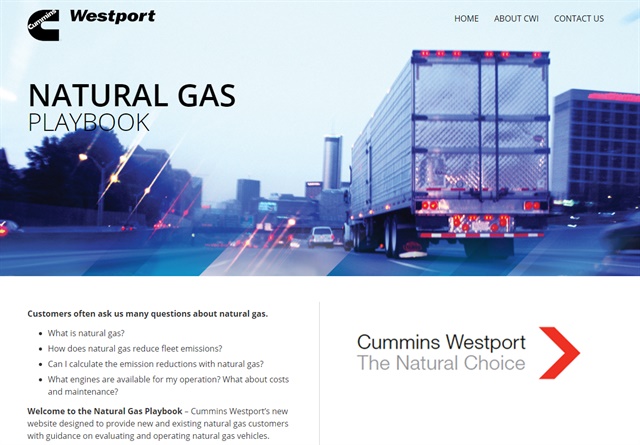
...Read the rest of this storyScreenshot of Natural Gas Playbook website
">Screenshot of Natural Gas Playbook website
">Cummins Westport's new Natural Gas Playbook is a website to give new and existing natural gas customers guidance on evaluating and operating CWI-powered natural gas vehicles.
Located at www.cwiplaybook.com, the five-step Natural Gas Playbook features information and tips on how to assess, specify, prepare, implement, and operate/maintain a CWI-powered natural gas fleet. The website provides answers for fleets that have questions about operating natural gas vehicles.
The Natural Gas Playbook answers questions such as:
What is natural gas and how does it reduce fleet emissions?Can I calculate the emission reductions with natural gas?What are zero carbon renewable fuels?How do natural gas engines operate, and what about my application and the operational costs and maintenance requirements?In addition to tips and tools for CWI products, the playbook also offers the opportunity to connect with Cummins and CWI experts to answer questions and support the adoption of natural gas into truck, refuse, school bus and transit applications.
The site features two new calculators. A Greenhouse Gas Emissions Calculator calculator is based on three published North American well-to-wheel GHG Models: GREET, GREET California, and GHGenius. It provides the carbon dioxide equivalent WTW emission reductions possible with the use of natural gas or renewable natural gas in a variety of applications.
A Payback Calculator is a tool to calculate fuel savings, average fleet speed, service intervals, and fuel system capacity requirements.
Related: Cummins Improves MidRange Engine Lineup for 2017
Follow @HDTrucking on Twitter
...Read the rest of this storyA big challenge for drivers who want to eat healthy meals is just getting past the typical high-calorie fare to find inexpensive but healthy food choices while out on the road. Photos: J.J. Keller & Associates
">A big challenge for drivers who want to eat healthy meals is just getting past the typical high-calorie fare to find inexpensive but healthy food choices while out on the road. Photos: J.J. Keller & Associates
">The news came as a shock to Emily Plummer. Her blood sugar level had jumped, threatening to end her 18-year career as an interstate truck driver.
“I had picked up a load and was on my way to Washington state when I got the phone call,” the Springfield, Missouri, driver said. “You're thinking, ‘This can't be happening.' I've worked too hard to get where I'm at.'”
Plummer is far from the first driver to have health issues jeopardize her career. Seven in 10 drivers are obese, which puts them at risk of developing type 2 diabetes, sleep apnea, and heart disease, according to a study from the National Institute for Occupational Safety and Health. The medical conditions that often accompany obesity, such as high blood pressure and diabetes, can put a driver at risk of not being medically qualified to drive.
Plummer had been diabetic for five years, and maintained acceptable blood sugar levels with the help of medication, before her blood sugar spiked. She knew her diet wasn't great, but wasn't sure how to change it.
“I was still eating the cheeseburgers, French fries, soda, and candy, and chips,” she says. “I was just eating whatever I wanted to eat, and that was horrible.”
Beyond the doughnut displayOne of the challenges Plummer and other drivers face is lack of easy access to inexpensive healthy food. Truck stops are loaded with deals on supersize candy bars and soda. Restaurant specials often revolve around high-calorie offerings. Healthy food is available, but doesn't dominate the selection and is rarely on sale.
“The places where you can find easy parking are truck ...Read the rest of this story
Fleets must balance the need to reduce idling with the need to attract and retain drivers. Photo: Randy Heinitz via Flickr/creative commons license
">Fleets must balance the need to reduce idling with the need to attract and retain drivers. Photo: Randy Heinitz via Flickr/creative commons license
">Ten years ago, we would have predicted that by now no truck would be idling anywhere in the United States,” says Mike Roeth, executive director of the North American Council for Freight Efficiency, which studies fuel-efficiency tactics and technologies. Yet despite widespread anti-idling laws and lots of available idle-reduction technology, go to any truck stop today and you'll see plenty of trucks still idling.
Even in California, which has the strictest emissions regulations in the country, new trucks with advanced emissions control systems can be certified as “Clean Idle.” And right now, diesel prices are low enough that for some truck owners, it's just not a priority — or at least not as high a one as keeping drivers comfortable and happy in the face of an ever-worsening driver shortage.
Yet even with lower fuel prices, there's still plenty of money to be saved by reducing idling. A 2016 report by Argonne National Laboratory found that all idle reduction options save money when fuel costs more than $2 per gallon. Harder to quantify but just as real is the saved wear and tear on the truck engine.
Taylor White, vice president for 235-truck dry van fleet Alabama Motor Express, says his company adopted APUs over a decade ago. The fleet has tried both diesel and battery-powered versions, but currently has Thermo King's TriPac diesel APU on all its trucks. “When fuel got to its peak we would see a return [on our investment] in 18 months just on fuel numbers,” he says.
While lower diesel prices mean the ROI isn't as fast, he says, using APUs has improved trade-in values. With the hours on the truck engine significantly reduced, AMX has been ...Read the rest of this story

Kenworth and Peterbilt dealers will represent the brands at the inaugural North American Commercial Vehicle Show Sept. 25-28 at the Georgia World Congress Center in Atlanta.
The two Paccar-owned brands were the only North American heavy truck makers not exhibiting at the new show, instead opting to exhibit at the Mid-America Trucking Show last March.
“Kenworth and Peterbilt dealers understand that the NACV Show is the foremost North American gathering place for anyone involved in the business of commercial vehicles,” said Larry Turner, president and CEO of Hannover Fairs USA and co-organizer of the NACV Show. “Securing all the leading brands on the show floor to showcase their latest innovations reinforces our vision for this new and important industry event.”
The NACV show will be open to the press only on Sept. 24 and is open to exhibitors and their guests starting Sept. 25. General admission opens Sept. 26 and runs through the end of the show.
NACV is a new event being put on by North American Commercial Vehicle Show Partnership, owned half by Newcom USA, a subsidiary of Canada's Newcom Business Media, and Hannover Fairs USA, a subsidiary of Germany-based Deutsche Messe, which plans and stages trade fairs around the globe, including the big IAA Commercial Vehicle Show in Hannover, Germany.
“We expect North American fleet decision makers, leaders and influencers to convene at the show to not only learn about the newest and latest innovations from the leading manufacturers but to meet, network and conduct business onsite,” said Joe Glionna, president of Newcom and co-organizer of NACV.
Fleet decision makers can register to attend the North American Commercial Vehicle Show 2017 at attendee registration. To view the entire trade show floor, visit NACV Show 2017 floorplan. A current list of exhibitors is located here.
Related:

Speed-related, at-fault collisions involving large commercial vehicles fell by a whopping 73% after mandatory speed limiter legislation took effect in Ontario, according to a recent study by the Ontario Ministry of Transportation.
The year-long study conducted between 2014-2015 examined data from pre- (2006-2008) and post- (2010-2012) speed limiter legislation by using fatal, injury and police reported property damage collisions on high-speed highways. It also looked at MTO enforcement officers' large vehicle driver speed data, among other real-world data.
The Ontario Trucking Association, a strong proponent of mandatory speed limiters, said that although speed limiter opponents believed slowing down large trucks would lead to a dangerous speed differential and cause more collisions with passenger cars and other vehicles, the study concluded there is no evidence that has happened. “Moreover, the study also dispelled the myth that in a speed limiter environment, drivers adjust their driving behavior to compensate for any perceived time lost as a result of driving slower,” the OTA said in a release.
The percentage of truck drivers struck in the rear stayed the same from pre- to post legislation (10.03 % of total collisions 2006-2008 and 10.47% 2010-2012), while the rate increased for other drivers (18.6% 2006-2008; and 21.3% 2010-2012).
Going forward, the study suggests some recommendations to raise compliance and realize the full benefits of the speed limiters, including increased enforcement and enhancing the electronic control module readers available to enforcement officials.
The study could give ammunition to supporters of a proposed speed-limiter rule in the U.S. that appears to be stalled.
After a decade-long push by trucking and safety advocates, last August the National Highway Traffic Safety Administration and the Federal Motor Carrier Safety Administration jointly proposed a rule that would require that heavy-duty vehicles be equipped with speed-limiting devices — but did not lay out what speed they should be limited ...Read the rest of this story

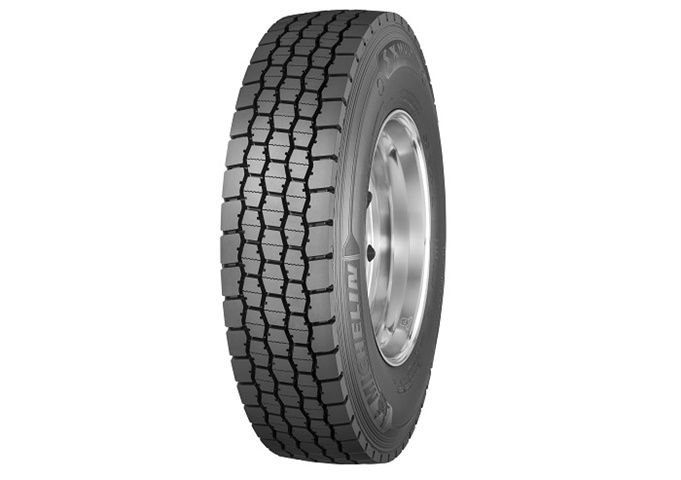
Michelin Americas Truck Tires has introduced the Michelin X Multi D, a regional position tire, for use in less-than-truckload, pick-up and delivery, food and beverage, and other demanding vocational segments.
Michelin is bringing this tire to market to serve the demanding needs of regional fleets, specifically those with 4x2 and 6x2 configurations. The tire is available in the United States, Canada, and Mexico in 11R22.5 size in load ranges G and H, and 11R24.5 size in load range H, with additional sizes to follow in the coming months.
The X Multi D tire is designed with a regenerating tread that provides water evacuation and traction over the life of the tire, while full-depth Matrix siping allows for a biting grip as the tread wears. The tire features co-extruded, scrub-resistant rubber for first class mileage and cooler running rubber to help minimize heat build-up and improve casing life.
“This next-generation regional drive tire offers first-class performance and is designed to excel in high torque applications and delivers all the key performance benefits needed in a regional tire — traction, high removal mileage and scrub resistance — with no trade-offs,” said Adam Murphy, vice president of marketing for Michelin Americas Truck Tires. “With an aggressive open-shoulder design that contributes to outstanding water evacuation for an optimized contact patch in all-weather conditions, the new Michelin X Multi D delivers the maximum tread life, traction and casing durability fleets demand.”
The X Multi D features a pass-through open shoulder that allows quick evacuation of water, mud, and slush from beneath the tread surface area, and the edges of the tread allows the tire to grip onto surfaces in difficult conditions, such as snow.
Michelin says the X Multi D tire can achieve 65% better mileage than the Michelin XDE M/S tire. The sidewall also features TW6 OzoneShield technology ...Read the rest of this story