Author: Vitaliy Dadalyan

Why the ELD Mandate is a Problem for Temp Drivers

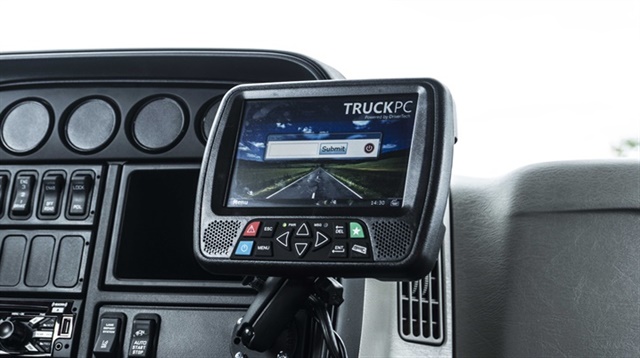
One of the shortcomings of the new electronic logging device mandate that goes into effect in December is that it causes problems for drivers who are working for a driver service or a temporary driver pool.

These drivers are unable to transfer their hours of service information from one carrier to another. Even though this probably applies to a relatively small group of drivers, it will cause them considerable inconvenience.

Related – ELDs: What Happens When You Have to Rent a Truck?

This is known in the ELD world as inter-operability, and in drafting its rule, FMCSA choose not to address it.

"Continental and others submitted comments requesting the agency address the issue of inter-operability, but that is as far as we got," says Alexis Cappelle, ELD program manager for Continental Corp. "The standard addresses the electronic formatting of the data for export, for inspection, but it doesn't require ELD providers to accept incoming data, so nobody has made provisions to accept data from one ELD brand to another."

A driver working for Carrier A this week and Carrier B next week would have to print out the previous 7 or 14 days worth of logs from Carrier A and manually enter them into Carrier B's ELD so the hours would all be accounted for. Paper copies of the last week's logs might pass muster at a roadside inspection, but would be insufficient in an audit, because the Carrier B's system would not show the hours worked by the driver in the previous week.

"The driver will have to get his or her RODS [records of duty status] from each fleet he or she is working for," says Capelle. "To date there is no standard to exchange RODS information from one ELD system to another one, so the data import will have to be ...Read the rest of this story

Out-of-Service Violation Rates Jumps in 2017 CVSA Roadcheck

<img width="150" src="http://www.automotive-fleet.com/fc_images/news/m-brake-inspection-3-1.jpg" border="0" alt="

Photo via CVSA

">

Photo via CVSA

">

The rate of out-of-service violations for both vehicles and drivers increased in this year's Commercial Vehicle Safety Alliance International Roadcheck, according to the recently released results.

During the 30th annual International Roadcheck, which took place on June 6-8, 23% of vehicles and 4.2% of drivers that received Level I inspections were placed out of service.

This represents an upswing compared to last year's Roadcheck when only 21.5% of vehicles and 3.4% of drivers were placed out of service in Level I inspections.

During an inspection, if an inspector identifies critical violations, he or she will render the driver or vehicle out of service, which means the driver cannot operate the vehicle until the critical vehicle mechanical conditions or defects, and/or driver qualifications, are corrected.

In fairness, last year's rates were the lowest that CVSA had seen since 1991 when it began tracking data on violations. However, it was also significantly higher than in 2015, which were just a few ticks higher than in 2016.

In total, 62,013 Level I, II, and III inspections were conducted this year, slightly down from the 62,796 conducted in 2016. Level I inspections made up 40,944 of the total number of inspections. Because the number of inspections fluctuates year to year, comparing rates is a better metric for comparing years.

Brake system violations were once again the leading reason for vehicles being placed out of service at 26.9%, followed by cargo securement and tires/wheels at 15.7% and 15.1%, respectively.

Drivers were placed out of service most often through violations of hours of service, wrong class license, and false log books. There were 710 safety belt violations.

Each International Roadcheck has a specific focus and this year's emphasis was placed on cargo securement, finding 3,282 violations in total. While checking for compliance with safe cargo securement regulations is always part of roadside ...Read the rest of this story

Increased Costs Could Mean Less Favorable Trucking Conditions

<img width="150" src="http://www.automotive-fleet.com/fc_images/news/m-june-tci-1-1.jpg" border="0" alt="

Source: FTR

">

Source: FTR

">

FTR's Trucking Conditions Index fell by more than two points in June as a result of increased costs for labor, fuel, and equipment, reflecting less favorable conditions for trucking.

The June TCI dropped to a reading of 4.54 for the month. Market tightness is seen as likely shorter than expected due to a possible drag on capacity caused by upcoming regulations, according to FTR.

“Despite the monthly drop from May to June, the TCI has stayed in a relatively stable range since this time last year,” said Jonathan Starks, FTR's COO. “It remains positive, but does not yet indicate that a significant change in operations is occurring.”

FTR is maintaining a favorable freight forecast for the rest of the year, but does not expect as strong of a result for 2018. It is projecting around half of the growth for next year with an increased risk of recession toward the end of 2018.

“The potential for such a change increases as we move through 2018, with ELD implementation and continued freight growth hindering truck capacity,” said Starks. “We are also beginning to hear stories of increased difficulty in hiring as the economy begins approaching full employment.”

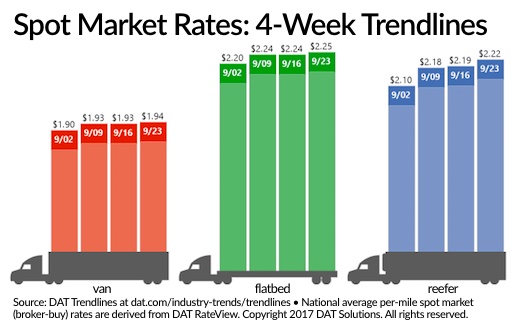
The spot market has shown strong increases in recent weeks it could be an indicator as to how rates in the contract market are likely to move, according to Starks.

“Spot data in early August shows that the rate increases have hit the double-digit mark and are still moving up,” said Starks. “Market participants need to continue evaluating conditions ahead of the ELD implementation in December to make sure that they are prepared for the possible disruptions that could occur.”

Related: Controlling Creeping Fleet Costs

Follow @HDTrucking on Twitter

...Read the rest of this story

Women In Trucking Partners with TransConnect for Fuel Discounts

<img width="150" src="http://www.automotive-fleet.com/fc_images/news/m-transconnect-app-1.jpg" border="0" alt="

Photo via TransConnect Services

" >

Photo via TransConnect Services

" width="300" height="224">

Women In Trucking has partnered with discount fuel card company TransConnect Services, offering savings for member companies.

The exact details of the partnership were not disclosed, however, a representative for TCS told HDT that the discount would be off of the cash price and an owner-operator or carrier could save $300-$500 each month per truck on diesel fuel.

TCS serves the over-the-road trucking industry, offering smaller trucking companies discounts on diesel fuel that are typically only available to large fleets.

Carriers and owner-operators can receive discounts on diesel fuel at more than 1,800 participating TCS discount locations including Pilot Flying J, AMBEST, Speedway, TA and Petro, Sapp Bros, Roady's, Petroleum Wholesale, and other truck stop locations nationwide.

“We are excited about our partnership with Women In Trucking and fully support their mission,” said Chris Courts, president and managing director of TCS. “We believe that each client, no matter their gender or the size of their fleet, should expect exceptional customer service, and get the best savings possible on fuel.”

TCS said it offers competitive transaction fee structures with no hidden or monthly fees, a free website, and mobile app tools designed to help clients manage their day-to-day needs. It also provides discounted fuel price information along any route.

“Partnering with TCS supports our mission to address obstacles for women employed in the trucking industry,” said Ellen Voie, president and CEO of Women In Trucking. “By offering a fuel card that provides discounts on fuel for owner operators and small carriers, we can help our members save money and increase their profits."

Related: Nominations Open for Influential Woman in Trucking Award

Follow @HDTrucking on Twitter

...Read the rest of this story

15 DHL Drivers Compete in Safe Driving Competition

DHL's top 15 couriers competed for the company's safest driver award in Dallas earlier this month in the second Safe-Driving Rodeo competition, the company announced.

The 15 finalists were chosen among 640 full- and part-time drivers who volunteered to participate in the test of defensive driving skills on Aug. 17. DHL used Geotab's GPS-based telematics system to monitor the competitors, who drove on freeways and city streets. Drivers also took a written exam and underwent a vehicle inspection.

Driving safety organization, Smith System, judged the competitors. The event was the follow-up to the initial safe-driving competition hosted in October.

"Rather than making this a one-day, one-off affair, our rodeo measures safety over an extended period of time, because at DHL, we view safety as an everyday event," said Cain Moodie, senior vice president of network operations for DHL Express. "By monitoring and assessing couriers' driving performances for nearly half a year through this competition, we are able to further commit ourselves to the safety of both our employees and the many communities where we conduct business."

Smith System's "5 Keys to Space Cushion Driving" figure prominently in the competition and include Aim High in Steering, Get the Big Picture, Keep Your Eyes Moving, Leave Yourself an Out, and Make Sure They See You.

Related: Chicago Courier Wins DHL's Safe Driving Rodeo

Follow @HDTrucking on Twitter

...Read the rest of this story

Ford and DHL Preview Transit-Based Electric Van

<img width="150" src="http://www.automotive-fleet.com/fc_images/news/m-dhl-electric-1.jpg" border="0" alt="

The StreetScooter Work XL Photo: Ford

">

The StreetScooter Work XL Photo: Ford

">

Ford and Deutsche Post Group subsidiary StreetScooter GmbH have rolled out the first of their jointly produced electric delivery vans, the StreetScooter Work XL.

The Work XL is based on a Ford Transit chassis fitted with a battery-electric drivetrain and a body designed and built to Deutsche Post's DHL specifications. The company plans to build 150 of the e-vans at the StreetScooter plant in Aachen, Germany, which DHL will run to support its urban parcel service in Germany.

The two companies plan to build 2,500 e-vans by the end of 2018 and they could be sold to third-party customers like StreetScooter's other electric models, the Work and Work'L. The new e-van will have stowage space for more than 200 packages, and a range of 50 to 125 miles.

“The new StreetScooter Work XL expands our e-fleet in the commercial vehicle segment. It is the perfect vehicle for parcel deliveries in major cities and large urban areas, and will enable us to cope with the rising parcel volumes in an even more environmentally friendly and quieter manner,” said Jürgen Gerdes, member of the board of management post, eCommerce, parcel, at Deutsche Post DHL Group. "With this commitment, we are also underlining our claim of being the market leader in green logistics.”

Work XL's load area is fitted with shelves and is accessible from the driver's cab. The vehicle can be loaded via the tailgate and a curbside sliding door. With a charging capacity of up to 22 kW, the average charging time is three hours.

“We're really proud of this ambitious project, and of the strong partnership, we've developed with Deutsche Post DHL Group and StreetScooter. This joint project will be Europe's largest manufacturer of emission-free, medium-sized e-vans, and it doesn't come a moment too soon,” said Steven Armstrong, group vice president ...Read the rest of this story