Author: Vitaliy Dadalyan

PeopleNet Launches Four New Products at MC&E

PeopleNet announced the debut of four products designed to improve fleet security, safety, and efficiency at the American Trucking Associations Management Conference and Exhibition in Orlando.

These products include the PeopleNet Connected Gateway bridging device, Video Intelligence Backup Camera, Fault Intelligence Monitoring Solution, and the LoadDocs Scanning App.

Connected Gateway

The PeopleNet Connected Gateway is an intelligent vehicle-bridging device that connects a vehicle to a wide range of in-cab displays and mobile devices through WiFi or cellular networks. The PCG is connected to a vehicle's diagnostic port and mounted to the truck's dashboard.

“The debut of the Connected Gateway marks the continued evolution of PeopleNet's mobility solutions to connect drivers, displays and vehicles to improve safety and performance,” said Eric Witty, vice president, product for PeopleNet. “Not only is the compact Connected Gateway device designed with security in mind but it is also built to enable fleets to harness the enhanced performance and reliability of 4G LTE networks.”

Video Intelligence Backup Camera

PeopleNet's new Video Intelligence Backup Camera is designed to be wirelessly paired with the tractor to stream live video to the cab. The Backup Camera is an addition to the company's current forward and side-facing camera options and allows fleets to have 360 degree video view of a vehicle.

The Video Intelligence Solution triggers video from company-controlled settings from a truck's Onboard Event Recording, augmenting traditional driver and truck analytics with onboard event recording.

The Backup Camera is powered by the anti-lock braking system (ABS) of the trailer and uses a transmitter to automatically pair it to any tractor equipped with a PeopleNet Video Intelligence receiver. This pairing also allows for wireless streaming of live video on an in-cab display when the vehicle is in reverse, reducing blind spots for the driver. Because the system is not battery powered, it never needs to be charged.

“The introduction ...Read the rest of this story
Volvo Expert: Truck Safety Begins and Ends with All of Us

<img width="150" src="http://www.automotive-fleet.com/fc_images/news/m-volvosafettyexpertcullen-1.jpg" border="0" alt="

Volvo's Carl Johan Almqvist: “The multimillion dollar question is why do accidents happen?” Photo: David Cullen

">

Volvo's Carl Johan Almqvist: “The multimillion dollar question is why do accidents happen?” Photo: David Cullen

">

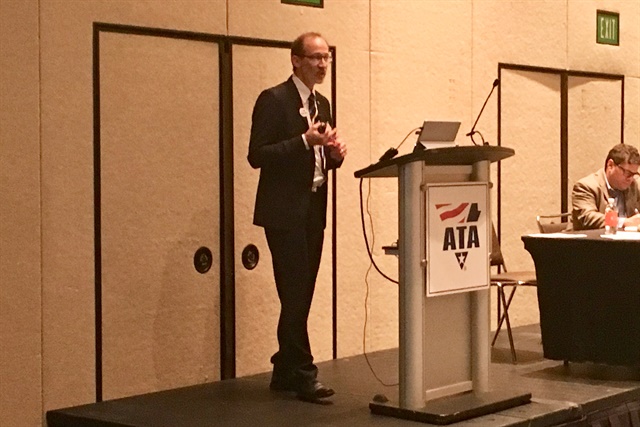
ORLANDO – Getting beyond the always sobering yet stultifying dry facts and figures that safety experts often recite to make their case, Volvo Trucks' Traffic and Product Safety Director Carl Johan Almqvist presented a common-sense take on why vehicle accidents occur and what we can all do to help prevent them.

“Every year, about 1.2 million people are killed in road traffic accidents worldwide,” he said in opening his talk on Oct. 27 here at the American Trucking Associations' Management Conference & Exhibition. “That's the equivalent in lives lost to having 10 airliners crash every day. If that were to happen, we would ground all airplanes.” But, he pointed out, we don't “see” highway fatalities in the same way — as massive losses of human life.

Almqvist, who helped direct the latest annual Volvo Trucks Safety Report (produced by the Swedish OEM's Accident Research Team), then said one of the first obstacles pretty much everyone has to overcome to sharply reduce the carnage on roads across the global is the “it won't happen to me” feeling.

He said to instead think of who it will it happen to. “But is it ever okay,” he asked, “the number of people killed? Is it okay if it is someone in your family?” Almqvist said the recognition that it matters that anyone has to die in accidents is why “Volvo's vision is to have zero accidents with our trucks.” He added that what no one wants to talk about “must be talked about or [improvement] will never happen.

“The multimillion dollar question is why do accidents happen?” Almqvist continued. He said that in his own globetrotting travels, no matter where he has gone, he has heard tell that “one major cause is ‘bad ...Read the rest of this story

Driver Shortage Tops ATRI’s Critical Industry Issues List

ORLANDO – For the first time since 2006, the driver shortage is number one on the American Transportation Research Institute's annual top industry issues report, surging six spots higher, followed by two concerns closely related to drivers: ELDs and hours of service.

In fact, the top five on the list are all related to drivers.

The not-for-profit research institute, an arm of ATA, released the report during the 2017 American Trucking Associations' Management Conference and Exhibition.

Dropping one position from its top ranking last year, the upcoming electronic logging device mandate ranked second on the overall list – was number one among commercial driver respondents to the survey.

In an overview for reporters, ATRI President Rebecca Brewster noted that among drivers, “there are concerns about what full ELD implementation will mean, but they often point to the number three issue, which is hours of service.”

Hours of service was at the top of the list for three years in a row, thanks to the more restrictive 34-hour restart provisions. Since FMCSA's issuance of a final ruling earlier this year to remove that, it did drop somewhat, but carriers and drivers are looking for increased flexibility in the rules.

“We had hours of service at the top of list three years in a row,” Brewster said. “We have a top research priority this year focused on looking at the potential to deal with some of the nation's worst traffic bottlenecks if drivers could select when they would go through those chokepoints [with some hours of service flexibility]. So I tie a lot of the ELD concerns with the hours of service concerns.”

The lack of available truck parking held its fourth place overall but moved up to the number two issue for commercial drivers – again, something closely related to hours of service and ELDs. In recent ...Read the rest of this story