Author: Vitaliy Dadalyan

Spot Freight Rates for Vans, Reefers Rise Sharply
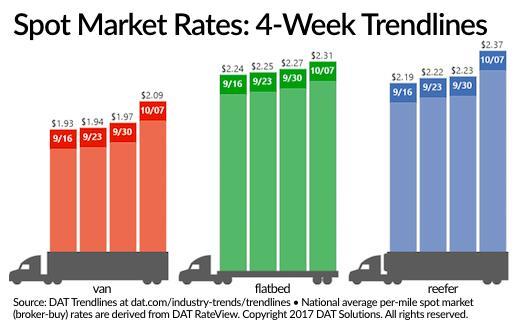
Spot truckload rates hit multi-year highs during the week ending Oct. 7, according to DAT Solutions and its network of load boards, as the number of available loads fell.

The 3% decline in freight availability following the close of the third quarter and generally tight capacity kept spot load-to-truck ratios elevated:

Van: 6.7 available loads per truckFlatbed: 46.7 loads per truckRefrigerated: 12.4 loads per truck

National average spot truckload rates, which include fuel surcharges, jumped significantly compared to the previous week:

Van: $2.09 per mile, up 12 centsFlatbed: $2.31 per mile, up 4 centsReefer: $2.37 per mile, up 14 cents

The market for van freight remains solid despite a 6% decline in volume and 1% increase in truck posts last week, according to DAT. In Seattle and the Pacific Northwest, higher reefer load counts in the region contributed to tighter van capacity, meaning that fewer reefer trucks were competing for van loads. Rerouted port traffic from Houston to Seattle after Hurricane Harvey may have added to demand for trucks in the area.

In the spot reefer market, both load posts and truck posts were unchanged from the previous week. The national average reefer rate moved higher due to seasonal demand and relief efforts following Hurricanes Irma and Harvey.

The number of flatbed load posts dipped 1% and truck posts increased 6%, with rebuilding efforts in Florida and the Gulf Coast driving demand for flatbed capacity.

Follow @HDTrucking on Twitter

...Read the rest of this story

Bridgestone names new president of GCR Tires & Service

Damien Harmon to lead company's commercial tire and service business.

Bridgestone Americas announced that Damien Harmon, current chief operating officer (COO), Bridgestone Retail Operations (BSRO), has been named president, GCR Tires & Service (GCR), effective Nov. 1. Harmon succeeds John Vasuta, who was named senior vice president, global sales, Firestone Building Products (FSBP).

read more

...Read the rest of this story

Oilfield Company No Renegade When it Comes to ELDs

<img width="150" src="http://www.automotive-fleet.com/fc_images/articles/m-renegade-wls-640x300-1.jpg" border="0" alt="

Renegade Wire Line Services has been running on J.J. Keller ELogs for more than three years. Photo: Renegade Wire Line Services

">

Renegade Wire Line Services has been running on J.J. Keller ELogs for more than three years. Photo: Renegade Wire Line Services

">

Todd Caughey was a state trooper for 25 years who retired and took on a new career as HSE/DOT Compliance Supervisor for Renegade Wire Line Services. The company put in electronic logs back in 2014, so he has an unusual perspective on how enforcement will go when the electronic logging device mandate kicks in come Dec. 18.

RWLS, which stands for Renegade Wire Line Services, is a Texas-based fleet serving the gas and oil field industry in Texas and other states. “I knew what ELDs would do for us,” says Todd Caughey, a retired state trooper who's heading up safety and compliance for the company, “and ownership wanted to go this direction before it became mandatory.”

The company initially rolled out e-logs in two of its 12 districts, then added districts. Today it has ELDs in all 300 units, everything from big tandem-axle heavy-duty wire line straight trucks to pickup trucks with trailers.

Caughey chose J.J. Keller's Encompass with ELogs. He was familiar with Keller from his time in enforcement, and liked the ability to use existing tablets or cell phones. “Most everyone today has a smartphone, so I didn't have to make an additional investment.”

However, he says, those smartphones have caused problems with enforcement officials who erroneously believed cell phone e-logs were not allowed. “They're not realizing their connected to an ELD [engine connection hardware] via Bluetooth,” Caughey says. When that happens, he explains, the regulation says the company has 48 hours to provide the logs at the trooper's request. So he prints them out in the office and emails them to the enforcement official.

“I'm seeing law enforcement not knowledgeable on ELDs,” he says – even some people in the Federal Motor ...Read the rest of this story

Volkswagen Truck and Bus Reveals its Future Transport Vision

<img width="150" src="http://www.automotive-fleet.com/fc_images/news/m-nav-nacv-1.jpg" border="0" alt="

VW's Andreas Renschler is flanked by Navistar CEO Troy Clarke (l) and Navistar CFO Walter Borst (r) while talking about the launch of the VW-Navistar strategic alliance a year ago at the IAA truck show in Hannover, Germany Photo: David Cullen

">

VW's Andreas Renschler is flanked by Navistar CEO Troy Clarke (l) and Navistar CFO Walter Borst (r) while talking about the launch of the VW-Navistar strategic alliance a year ago at the IAA truck show in Hannover, Germany Photo: David Cullen

">

Germany's Volkswagen Truck and Bus Group laid out its long-term plans for shaping the future of transportation this week at its Innovation Day Summit, held in Hamburg, Germany.

Andreas Renschler, member of the board of management for Volkswagen AG and chief executive officer of Volkswagen Truck and Bus GmbH, made extensive opening remarks at the conference, laying out VW's vision for what it identifies as the three key areas crucial for the future of trucking, logistics and transporation: autonomous vehicles, connected vehicles, and clean transportation.

Renschler began by noting that Volkswagen Truck and Bus began as a startup just two years ago, with a goal of creating a climate of cooperation among VW's various brands competing in various transportation and logistics markets, including MAN, Scania, Volkswagen Commercial Vehicles, Volkswagen Brazil, and Rio.

According to Renschler, the effort by VW to coordinate the technological development paths of these brands occurred at “just the right time to shape the future of transportation as a group.”

He added that the company's research and development group, based in Sweden, was now coordinating and moderating each brand's technological development efforts to coordinate and synchronize those projects across brands, companies, and countries with notable success.

“We all know that logistics and transportation is changing massively,” Renschler added. “We must consider the needs of our customers – and their customers – as well as environmental issues, technology and infrastructure and the competitive landscape if we are to shape these changes. This challenges us to rethink our business and pursue the fast development of information technology and data processing, which offer us completely new ...Read the rest of this story