Author: Vitaliy Dadalyan

ATA Truck Tonnage Index Surges 9.9% Year over Year

<img width="150" src="http://www.automotive-fleet.com/fc_images/news/m-ata-chart-2.jpg" border="0" alt="

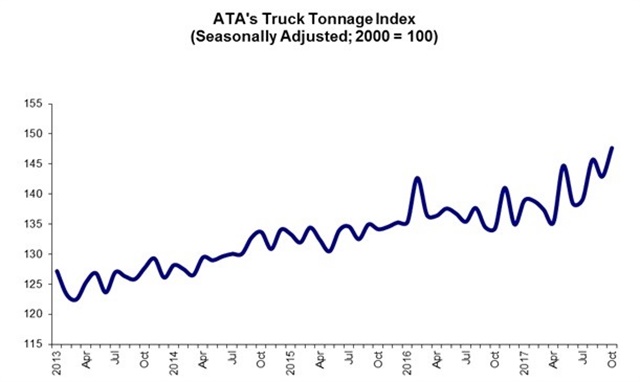
The American Trucking Associations' advanced seasonally adjusted (SA) For-Hire Truck Tonnage Index rose 3.3% in October, following a 1.9% decline during September. In October, the index equaled 147.6 (2000=100), up from 142.9 in September. Graph: ATA

">

The American Trucking Associations' advanced seasonally adjusted (SA) For-Hire Truck Tonnage Index rose 3.3% in October, following a 1.9% decline during September. In October, the index equaled 147.6 (2000=100), up from 142.9 in September. Graph: ATA

">

The American Trucking Associations' advanced seasonally adjusted (SA) For-Hire Truck Tonnage Index rose 3.3% in October, following a 1.9% decline during September. In October, the index equaled 147.6 (2000=100), up from 142.9 in September.

Compared with October 2016, the SA index surged 9.9%, which was the largest year-over-year increase since December 2013. In September, the index increased 6.3% on a year-over-year basis. Year-to-date, compared with the same ten months in 2016, the index is up 3.1%.

ATA also revised its September decline in the index down to a 1.9% drop from the previously reported 0.9% decrease.

The not seasonally adjusted index, which represents the change in tonnage actually hauled by the fleets before any seasonal adjustment, equaled 151 in October, which was 5.1% above the previous month (143.7).

“Continued improvement in truck tonnage reflects a much stronger freight market,” said ATA Chief Economist Bob Costello. “This strength is the result of several factors, including consumption, factory output, construction and improved inventory levels throughout the supply chain. Additionally, the 6.7% rise in tonnage over the last four months suggests to me that retailers are expecting a good holiday spending season.”

Trucking serves as a barometer of the U.S. economy, representing 70.6% of tonnage carried by all modes of domestic freight transportation, including manufactured and retail goods. Trucks hauled nearly 10.5 billion tons of freight in 2016. Motor carriers collected $676.2 billion, or 79.8% of total revenue earned by all transport modes.

ATA calculates the tonnage index based on surveys from its membership and has been doing so since the 1970s. This is a preliminary figure and subject to change in the final report ...Read the rest of this story

Ryder Expands Use of Natural Gas

<img width="150" src="http://www.automotive-fleet.com/fc_images/news/m-ryder-lng-1.jpg" border="0" alt="

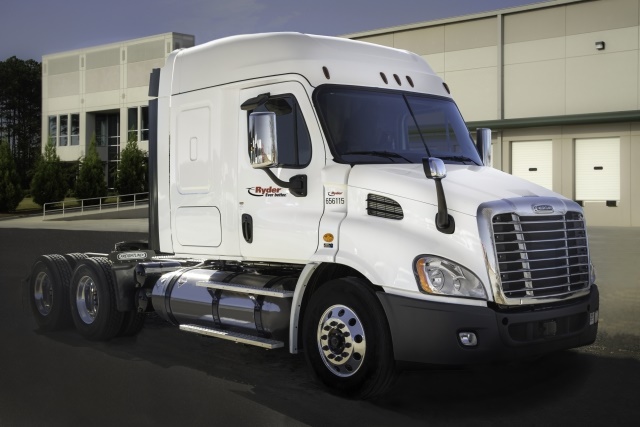
Ryder operates a fleet of liquified natural gas (LNG) heavy-duty trucks and has now partnered with Clean Energy. (Image courtesy of Business Wire)

">

Ryder operates a fleet of liquified natural gas (LNG) heavy-duty trucks and has now partnered with Clean Energy. (Image courtesy of Business Wire)

">

Ryder System Inc. awarded Clean Energy a four-year fueling contract for a fleet of liquified natural gas (LNG) heavy-duty trucks that move goods for Toyota Motor Manufacturing, Kentucky, Inc., Toyota's largest manufacturing facility in North America located in Georgetown, Ky.

Clean Energy will open a station in Georgetown to fuel the trucks that are expected to consume approximately 380,000 gasoline gallon equivalents (GGEs) of LNG each year.

Ryder has made sustainability a priority and has been a leader in expanding its offering of advanced vehicle technologies. Toyota has also rapidly expanded into alternative fuels and has encouraged its third-party carriers to move its goods in a more sustainable way.

Related: Ryder Taking Delivery of 125 Chanje Electric Vans

Follow @HDTrucking on Twitter

...Read the rest of this story

OOIDA Seeks to Exempt ‘Small-Business Truckers’ from ELD Rule

<img width="150" src="http://www.automotive-fleet.com/fc_images/news/m-driverstalkfmcsa-6-1.jpg" border="0" alt="

Photo: FMCSA

">

Photo: FMCSA

">

With the new electronic logging device mandate set to take effect in less than four weeks, the Owner-Operator Independent Drivers Association has petitioned the Federal Motor Carrier Safety Administration to issue a temporary but lengthy exemption to the new safety rule for “small-business truckers.”

The petition seeks an exemption from the ELD rule of “no less than five years” (and subject to renewal upon application) for any carrier considered to be “a small transportation trucking business” as defined by the Small Business Administration and “can document a proven history of safety performance with no attributable at-fault crashes” and that do not have a Carrier Safety Rating of “Unsatisfactory.”

OOIDA further stated in its request that the exemption would “not have any adverse impacts on operational safety, as motor carriers and drivers would remain subject to the HOS regulations… as well as the requirements to maintain a paper record of duty status… The exemption would also allow small-business motor carriers to maintain their current practices that have resulted in a proven safety record.”

Todd Spencer, executive vice president of OOIDA, got to the crux of why the group is seeking the exemption in a statement, saying that “Small-business truckers that have already proven their ability to operate safely should not be subject to purchasing costly, unproven and uncertified [electronic logging] devices.”

In the request, filed with FMCSA on Nov. 21, the self-certification of ELD vendors is discussed as a key issue for OOIA: “FMCSA has stated that they do not know if the self-certified ELDs listed on their website fulfill regulatory requirements in the mandate. At present, none of the 193 devices listed have been validated by the agency or any unbiased, third-party testing program.”

“Most small-business motor carriers can ill afford to make these purchases only to learn later ...Read the rest of this story

Report: Autonomous Vehicles Could Save Trucking $300 Billion in Labor Costs

<img width="150" src="http://www.automotive-fleet.com/fc_images/news/m-tesla-semi-best.jpg" border="0" alt="

Autonomous technology could offer trucking net savings between $100 billion and $125 billion, according to a report by Wall Street analysts. Photo: Jack Roberts

">

Autonomous technology could offer trucking net savings between $100 billion and $125 billion, according to a report by Wall Street analysts. Photo: Jack Roberts

">

The trucking industry could save hundreds of billions of dollars in labor costs annually if it continues to embrace self-driving technology.

That's according to a Wall Street analyst firm, as reported in Business Insider earlier this week.

According to the Bernstein analyst group:

Full automation of the trucking industry could save $300 billion in labor costs, according to Bernstein analysts.The net savings are likely to be between $100 billion and $125 billion because the costs of using self-driving trucks would offset some of the savings from wages.

"At face value, full automation of the $719B trucking market results in ~$300B in potential labor savings," a team of Bernstein analysts, including David Vernon said, according to Business Insider. "This benefit is expected to grow due to structural challenges in the labor market," including a rise in trucking rates after 2000 partly caused by labor shortages and regulatory changes.

The report noted the then-pending launch of Tesla's new, all-electric truck, which will come standard with autonomous vehicle technology including platooning capabilities. Additionally, the analysts pointed to recent reports that autonomous technology company Embark is already operating autonomous trucks between Texas and California — though with a human rider. Mercedes-Benz first put a self-driving big-rig on a public road in 2015, and Uber started its efforts in the space a year later.

According to Bernstein analysts, nearly half of the trucking industry's costs — 43% — go toward labor. Fuel is the second-largest cost, at 21%.

"The gains from automating heavy truck activity have far-reaching implications across the broader transportation landscape," Vernon said. "Companies in our coverage that will benefit from this include UPS (high-cost union truck labor in line haul and feeder operations), ...Read the rest of this story

Eroad Tapped for Major Mileage-Based User Fee Pilot

<img width="150" src="http://www.automotive-fleet.com/fc_images/news/m-highwayi95coalitionorg-1.jpg" border="0" alt="

Photo: I95Coalition.org

">

Photo: I95Coalition.org

">

Eroad, a global provider of fleet-management technology, has been selected to take part in the first multi-state truck pilot to explore the feasibility of instituting a Mileage-Based User Fee along I-95, the East Coast's main north-south Interstate highway, running from the Canadian border in northern Maine through Miami in South Florida.

The I-95 Corridor Coalition truck pilot, slated to begin next year, will encompass the length of the highway, which is a critical freight lane feeding the U.S. economy. Over 5 billion tons of freight, representing almost 40% of the country's GDP, moves annually across the area's 1,917 miles of roads— which add up to approximately 20% of all U.S. roadways. Average daily truck traffic in the region includes over 10,000 vehicles with peak daily traffic averaging over 31,000 units. Looking to the future, the amount of truck traffic in the corridor is expected to more than double by 2035.

The pilot will include 50 vehicles equipped with Eroad in-vehicle hardware for a period of six months. The system will record accurate mileage data and apply applicable formulas for a truck-based MBUF as prescribed by the program's Steering Committee, which includes the American Trucking Associations. Eroad will produce “dummy invoices,” demonstrating payments to appropriate agencies within the I-95 Corridor Coalition.

“This is an extremely significant opportunity for Eroad as it's the first truck pilot in the U.S. to explore the feasibility of a Mileage-Based User Fee across multiple states,” said Steven Newman, CEO of Eroad. “It will highlight our ability to demonstrate a highly flexible, feasible and cost-effective way to introduce road charging across jurisdictions without needing an intrusive and expensive roadside infrastructure, while also reducing the reporting burden on motor carriers.”

Eroad noted that for the $1.6 million pilot program, the I-95 Corridor Coalition has partnered with the Delaware Department ...Read the rest of this story

ELD for Oil and Gas Services Fleets

Trimble has self-certified its eDriver Logs solution for oil and gas services fleets to comply with the federal Electronic Logging Device (ELD) mandate, which goes into effect Dec. 18.

Trimble's eDriver Logs automate hours of service and give fleets the ability to reduce violations and improve driver safety and efficiency. They require no additional hardware or software and are designed specifically for fleets in the oil and gas industry. Robust reporting capabilities include daily driver reports and violations.

“Oil and gas fleets in the U.S. face a unique challenge. Not only do they need to comply with the ELD mandate, but they also need a solution that is built for the industry they serve,” said Brian Traub, senior vice president and general manager, Trimble Oil & Gas Services. “Our ELD is compliant with FMCSA's ELD mandate and tailored specifically to the oil and gas industry, enabling these fleets to maximize safety and efficiency.”

Trimble's eDriver Logs enable fleet managers and drivers to identify safety risks and pinpoint potential violations by automatically recording driving status, calculating available driving time and notifying the driver of his or her compliance status. Comprehensive back-office reporting also allows fleet personnel to make proactive decisions about driver availability to avoid HOS violations and optimize resources.

For more information on Trimble Oil & Gas Services, visit http://oilandgas.trimble.com.

Follow @HDTrucking on Twitter

...Read the rest of this story