Author: Vitaliy Dadalyan

70 Answers to Top ELD Questions

To download a PDF of this supplment, click here.Chapter 1: ELD BASICS

The electronic logging device mandate, effective on Dec. 18, requires most carriers and drivers to convert from using paper logs or logging software to a registered ELD if they do not have an automatic on-board recording device in use. And those using AOBRDs prior to the mandate's effective date will only be able to keep using them for two more years (until Dec. 16, 2019).

It's a mandate that has led to a lot of questions, with the government continuing to clarify and tweak the regulation even as we went to press. We've endeavored to find answers to the most common questions that arise, starting with the basics.

1. What is an Electronic Logging Device?

An ELD is a recording device that records vehicle parameters through its synchronization to the vehicle's engine. It also allows for entries related to a driver's record of duty status (RODs) to show compliance with hours of service regulations.

2. How is an ELD different from e-logs currently in use?

The e-logs — either in the form of logging software or AOBRDs — that some fleets have been using do not meet the new technical specifications prepared by the Federal Motor Carrier Safety Administration that ELD providers must adhere to.

For example, under the 1988 rule enabling AOBRDs, they were not required to be able to present a graph grid of the driver's daily duty status changes either on a display or on a printout. ELDs, however, must fully provide that capability. (For a table outlining the differences, see www.fmcsa.dot.gov/faq/what-are-differences-specs-1988-aobrd-rule-and-eld-rule )

“From a carrier perspective, they may not see a whole lot of difference depending on the system they're using,” explains Joe DeLorenzo, director of the FMCSA's Office of Enforcement and Compliance. Some ELD providers may be able ...Read the rest of this story
NTSB: Highway Deaths Responsible for Rise in Transportation Fatalities

<img width="150" src="http://www.automotive-fleet.com/fc_images/news/m-ntsb-highway-deaths-2.jpg" border="0" alt="

Source: NTSB

">

Source: NTSB

">

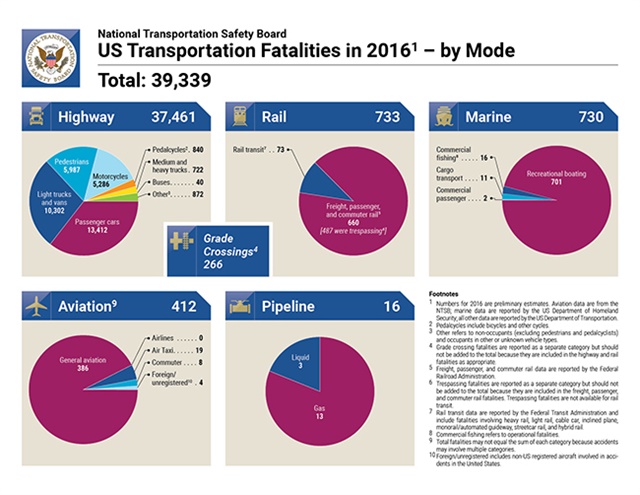
The National Transportation Safety Board has released data showing that 2,030 more people died in transportation accidents in 2016 than in 2015, with highway deaths accounting for 95% of all transportation fatalities.

The data indicate 39,339 people lost their lives in transportation accidents in 2016, compared to the 37,309 who died in 2015. In addition to the increase in highway fatalities, rises were also seen in the marine and railroad sectors, with a slight decrease in aviation fatalities.

U.S. roadway deaths increased from 35,485 in 2015 to 37,461 in 2016. Of that number, fatalities in passenger vehicles increased from 12,761 in 2015 to 13,412 in 2016.

"Unfortunately, we continue to see increases in transportation fatalities," said Robert Sumwalt, NTSB chairman. "We can do more, we must do more, to eliminate the completely preventable accidents that claim so many lives each year. Implementation of the 315 open safety recommendations associated with the NTSB's Most Wanted List of Transportation Safety Improvements has the greatest potential to reverse this alarming trend.”

Because of the increase in travel around holidays like Thanksgiving, NTSB is reminding drivers to watch out for distracted, drunk, and drowsy drivers, who are often key factors in highway deaths.

There was an increase in deaths from railroad and marine deaths for the year as well, but aviation deaths were down very slightly from 416 in 2015 to 412 in 2016. Most aviation deaths occur in civil aviation accidents. The number of fatal general aviation accidents decreased to 213 in 2016 resulting in the fatal accident rate dropping below 1 fatal accident per 100,000 flight hours for the first time in 50 years. Aviation statistics are tracked and compiled by the NTSB. The U.S. Department of Homeland Security provides marine statistics, and the U.S. Department of Transportation provides statistics for all other modes.

A link to ...Read the rest of this story

New Tech, New Challenges for Axles & Suspensions

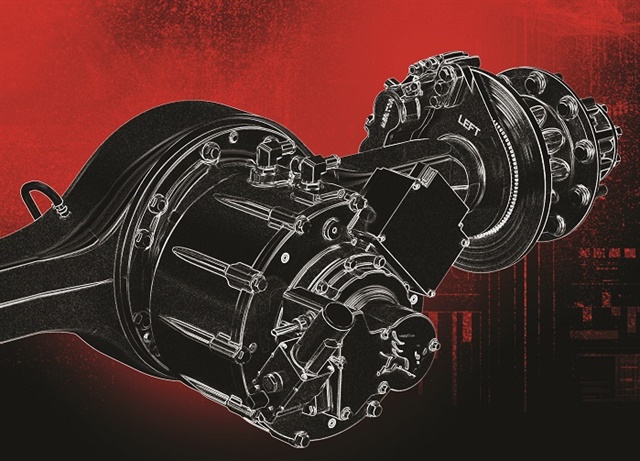
Despite decades of supplying and improving upon some of the oldest and most reliable components found on trucks, axle and suspension manufacturers are facing new challenges as new operational demands and technology take hold in trucking.

Conventional truck designs are laser-focused on uptime and fuel economy, requiring lighter designs and even new lubricating fluid metering systems to reduce parasitic horsepower loss due to “churn” at cruising speeds. As with any vehicle system, electronic sensors that can communicate data on an axle's health in real time are finding their way onto new axles.

And axles are in the spotlight now as new electric vehicle technology takes root in trucking with a new set of unique operational demands.

In fact, Meritor CEO Jay Craig says he's never seen the trucking industry undergo such rapid change. At the North American Commercial Vehicle Show in Atlanta in September, Meritor announced that it is developing a new portfolio of electric drivetrains to meet these new demands and ensure electric truck customers have the capability and reliability they'll need.

“We're also committed to electrification,” Craig said. “We've had a lot of interest from OEs on how we can start to work with them to launch demonstrator and production vehicles as well.”

Essentially, Meritor is focusing on integrating an electric motor into the differential carrier. The flexible e-carrier design will be the foundation for various drivetrain configurations, including full electric, hybrid, single, or tandem axles with various options based on application.

Also at NACV, Bosch showcased several future-focused powertrain concepts, including the eCity Truck diesel hybrid system for light commercial vehicles that uses an electric axle. The eAxle is a scalable, modular platform with the motor, power electronics, and transmission forming a single compact unit.

Late last year, Dana announced a Spicer Electrified portfolio of fully integrated motor, control, and e-drive technologies designed to ...Read the rest of this story

HDT’s 2018 Class 8 Truck Preview

<img width="150" src="http://www.automotive-fleet.com/fc_images/articles/m-cascadia-1-2.jpg" border="0" alt="

The latest enhancements to Freightliner's new Cascadia include 48-, 60- and 72-inch mid-roof XT sleeper cabs in both 116- and 126-inch BBC platforms.

">

It seems likely that 2018 will be looked back on as the year North American Class 8 trucks made serious moves toward a more efficient and safer future. The past 12 months have seen a flurry of activity on the Class 8 front as OEMs launched significantly upgraded or all-new trucks.

These new and enhanced trucks will be the building blocks and enablers for much of the new technology coming to trucking over the next decade. Yet despite much talk about futuristic trends such as autonomous driving, platooning, drones and electric trucks, the bulk of the introductions are clearly focused on the human factor — making drivers safer, more comfortable, and more productive. New interiors being introduced across truck brand lines were developed with heavy driver input. And aerodynamic and powertrain improvements are driving further increases in fuel efficiency.

At the same time, OEMs are significantly expanding the concept of a “connected” truck that is constantly gathering data and sharing it with fleets, capable of over-the-air (OTA) powertrain upgrades and leveraging telematics to slash downtime.

“The next five years are going to be insane given the amount of technology that is coming into trucking. It's going to be fast and furious,” said Bill Kozek, who is tasked with identifying future transportation trends for Navistar, at the North American Commercial Vehicle Show in Atlanta in September.

Kozek's comments echoed others at the show, such as those by Richard Howard, senior vice president of sales and marketing for Freightliner. He said his company's current theme was to be “100% connected” in terms of vehicle capability. Daimler Trucks North America President Roger Nielsen noted that the company is performing real-world platooning tests now in both Oregon and Nevada. David Pardue, vice president of Mack Trucks connected vehicle technologies, said the company will have OTA powertrain updates available ...Read the rest of this story