Webinar: Confidence at the Roadside: Getting Ready for ELD enforcement
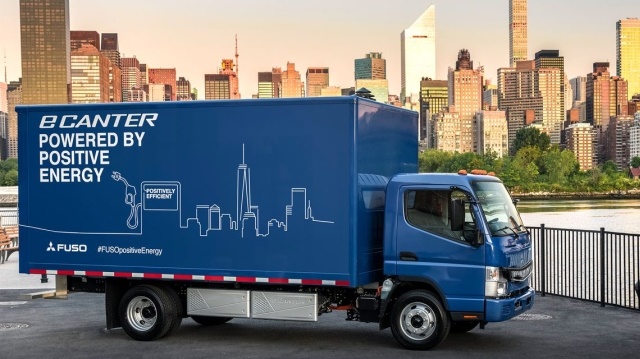
One of the electric trucks that are adding to the growth in future estimates is the Mitsubishi eCanter. (Photo courtesy of Mitsubishi Fuso)
">The overall medium- and heavy-duty truck market is projected to continue its reliance on conventional diesel powertrain for the next decade, but hybrid and electric powertrains populations will increase, with volumes expected to grow from about 125,500 to 1.66 million from 2017 to 2027, according to Navigant Research.
This is compared to last year's prediction of 332,000 trucks Navigant Research estimated by 2026.
A new report from the market research provider examines the global market for medium- and heavy-duty trucks across hybrid, electric, and fuel-cell powertrains providing forecasts for annual sales and vehicle population, through 2027.
With the potential to provide lower operational costs, noise reduction, and environmental benefits, electric trucks are attractive to fleets, yet high up-front costs are still prohibitive. Nonetheless, manufacturers continue to work toward commercially viable electric trucks, thanks to mounting pressure from governments to reduce pollutants from diesel fuel combustion and tackle greenhouse gas emissions.
“We could see a breakthrough in the adoption of electrified trucks once total cost of ownership benefits can be clearly demonstrated for fleet operators,” says Lisa Jerram, principal research analyst with Navigant Research. “For the next few years, trials and small-scale deployments by major fleets and manufacturers will help clarify potential cost benefits and could set in motion a significant increase in orders for electrified trucks.”
While the electric truck market has lagged behind the electric bus market, the sector is likely to benefit from its progress as the cost of key components comes down thanks to increasing volumes. Until this occurs, electric trucks deployments are expected to be focused in places where there are incentives or other government programs in place.
View a summary of the report <a target="_blank" rel="nofollow" ...Read the rest of this story
Rollout on Nov. 15 of new Freightliner 360 2528, a Mexico-specific Class 8 truck. Photo: David Cullen
">PUERTO VALLARTA, MEXICO -- Freightliner is maintaining an impressive 39% share of the Mexican commercial truck market as 2017 draws to a close— and is looking to build on that standing in 2018.
That's according to Freightliner Mexico President and CEO Flavio Rivera, who spoke to North American trucking journalists at a press briefing here on Nov. 29.
Noting that Freightliner Mexico is in a unique market that faces challenges and competitors unknown north of the border in the United States, Rivera outlined the strategies the company is using to not only maintain its market share but also to expand its role as the truck “pacesetter” in Mexico going forward.
He began with an overview of Freightliner Mexico's operations, which include a robust manufacturing presence in Saltillo and Santiago, as well as a proprietary dealership network. According to Rivera, Mexico is the 8th largest builder of trucks in the world today, and the 4th largest exporter of trucks globally. Additionally, he said the country is projected to build 5 million passenger cars over the next two years.
This potent manufacturing presence has kept the Mexican trucking industry strong, Rivera added, despite slowed growth in other key economic sectors, such as construction and oil fields. However, he was optimistic that the Mexican construction truck market would soon heat up again, citing major government infrastructure projects including the high-profile development of a new, ultra-modern airport as well as a key rail network connecting port facilities to Mexico City.
Rivera also noted that the unique realities of the Mexican market are prompting Freightliner Mexico to develop new models and strategies to maintain its competitive edge in the country. He said the top challenges include poor infrastructure, heavy congestion, ...Read the rest of this story

Total U.S. economic activity in the third quarter of the year increased more than originally estimated, according to revised numbers issued Wednesday by the Commerce Department.
It reported the nation's gross domestic product (GDP) grew at an annual rate of 3.3%, beating analysts' expectations and up from a 3% rate reported a month earlier. This is also the best pace since the second quarter of 2014 and compares to a second quarter 2017 rate of 3.1%.
This also marked the first time this total measure of the output of goods and services has increased 3% or more for two straight quarters since 2014.
Business investment increased at a 7.3% annual rate in the third quarter, the biggest pickup for that category since the end of 2016, according to AP. However, consumer spending, which accounts for about 70% of U.S. economic output, grew at an annual pace of just 2.3%, down from 3.3% in the second quarter.
The third quarter was also when the U.S. mainland felt the effects of two devastating hurricanes while there was also a downturn in imports. In addition, there were smaller decreases in state and local government spending and residential fixed investment.
With the GDP posting a lackluster 1.2% gain in the first quarter of the year, Lindsey Piegza, chief economist at Stifel Fixed Income, noted that overall growth is trending at 2.5% thus far for 2107, modestly above the 2.2% pace established since the end of the financial crisis. Year over year, growth continues to trend at a 2.3% pace, up slightly, however, from a 2.2% pace reported at the end of the first half of the year.
“Since April, the U.S. economy has been growing at a noticeably accelerated 3% clip relative to a more moderate 2.2% trend of the past eight years. But while growth has been more impressive ...Read the rest of this story