Author: Vitaliy Dadalyan

Busy Truck Stop Finds Success with Biofuels

Fontana Truck Stop Center has an ideal location. It's just off one interstate and near another, both of them taking traffic to and from Los Angeles. It's also in an industrial area populated with distribution centers, manufacturers and equipment dealerships. “Fontana is a major hub for trucking,” says truck stop co-owner Lonnie Tabbaa. “You have all the big industries here. And, we service all the major fleets and the smaller ones, both local and out-of-state drivers.”

But, with fierce competition in the area for drivers, success is not guaranteed. Fontana Truck Stop Center has found that offering renewable fuels is one way to stand out, so they sell biodiesel blends and a blend of biodiesel and renewable hydrocarbon diesel (RHD) at its diesel islands.

Sustainability comes into play a couple of different ways. First, companies and municipalities are increasingly adopting sustainability plans that aim to reduce their carbon footprints. Transportation fuels are a significant part of those efforts.

Second, the state of California is a global leader in setting policies to cut emissions. That includes the Low Carbon Fuel Standard (LCFS), which requires a reduction in the carbon intensity of transportation fuels.

Fontana Truck Stop Center began selling biodiesel blends in 2015, starting at a B5 blend before quickly moving up to B20.

“Biodiesel is better for the environment than regular diesel,” says Abdul Mardini, the truck stop's general manager. “It also gives us an advantage on the price we pay for fuel. At the same time, we can offer it to the drivers at a lower price. And it gives us an advantage on the truck stops that don't use it.”

In 2017, Fontana Truck Stop Center began offering renewable hydrocarbon diesel for similar reasons: sustainability and economics. Then REG, which they buy fuel from, made them aware that blending biodiesel and renewable hydrocarbon diesel ...Read the rest of this story

Federal-Mogul Launching Heavy-Duty TechTraining Program

Federal-Mogul Motorparts is launching Garage Gurus HD, a heavy-duty training program for technicians who perform heavy-duty vehicle repairs.

The new program will be rolled out during Heavy Duty Aftermarket Week 2018 in Las Vegas, to be held Jan. 22-25. Available online, onsite, or as an on-the-go service, the program offers training on how to repair medium- and heavy-duty trucks, perform diagnostic checks, prepare for ASE certification exams, and keep up with the latest tools, maintenance, and repair techniques.

Garage Gurus HD will initially be offered across three modules, including nine classes pertaining to foundation brakes, air disc brakes, and bearings, and seals. Federal-Mogul will add other training classes on Garage Gurus HD throughout 2018, including for FP Diesel, ASE prep, and preventive maintenance inspections.

For more information on Garage Gurus HD, click here.

Follow @HDTrucking on Twitter

...Read the rest of this story

How Fleets Can Get the Most From A National Tire Account

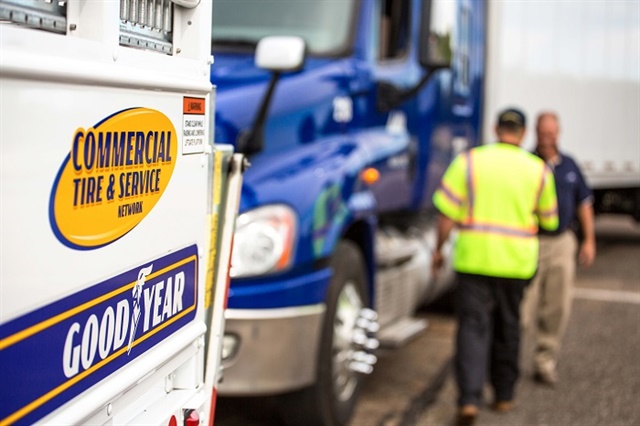
National tire management programs initially began as roadside assistance services, but now include complete tire life cycle management and data analysis options as well. Photo: Goodyear

">

Tires are tough to manage, even in ideal conditions. Start adding hundreds of tractors and trailers, spread them across the vast expanse of North America, and a tough problem can become an impossible one almost immediately. National tire accounts, offered by major tire manufacturers nationwide, evolved decades ago to help long-haul fleets deal with their most pressing problem: failures and roadside service in areas far away from home.

Tire management has steadily become more sophisticated, and tire management programs have evolved as well. Today, fleets can choose a host of management options, from simple roadside service packages to comprehensive, on-site cradle-to-crave management programs.

Rich Cottrell, general manager, fleet solutions, Goodyear, says fleet feedback through the years has led to a continuous improvement effort for its national tire program, with an emphasis on understanding emerging needs while optimizing tire performance and lowering operating costs. But he says, that experience has also taught Goodyear that not every fleet is a good candidate for large, national programs. “We've learned that offering alternatives is important as well,” he says. “This is why we also offer our Preferred Fleet program, which is geared toward small and mid-size fleets. Fleets have different needs and we strive to meet them ‘where they are.'”

Fleet managers already have plenty do, says Tom Fanning, Continental Tire's vice president of sales and marketing for commercial vehicle tires in North America. And a national tire program gives them a break from worrying about tires, which can be a demanding job for a full-time employee. Among the benefits he points to are a single point of contact at a tire OE for all a fleet's tire needs, as well as ...Read the rest of this story

Survey: Regional Small Fleets Slower to Comply With ELD Mandate

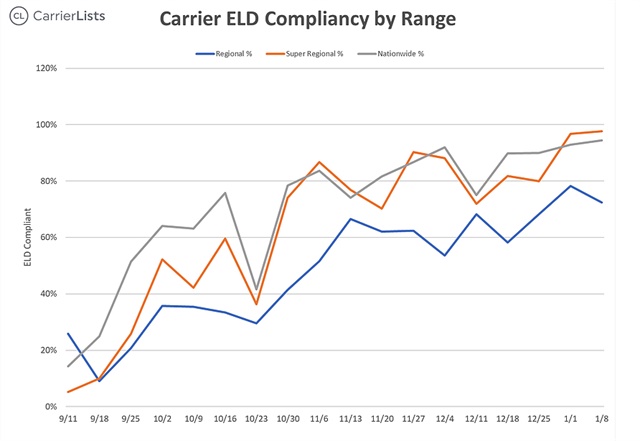
ELD compliance rates for regional fleets are still roughly 20 points below longer haul OTR fleets, according to CarrierLists' survey. Graph courtesy CarrierLists

">

Regional small fleets appear to be lagging behind national fleets when it comes to adoption of mandatory electronic logging devices, according to the latest weekly survey numbers from CarrierLists.

Although the ELD mandate went into effect last month, there is a phased-in enforcement period until April 1, as many fleets were scrambling at the last minute to comply.

CarrierLists, which offers lists of carriers to freight brokers and shippers, has been conducting weekly surveys of fleets on its lists about ELD compliance. As of Jan. 15, according to 205 interviews running fleets from five to 100 trucks, the ELD compliance rate came back down to earth from the polling high of 89% in the first week of the year to 79%.

When asked about the drop, CarrierLists President Kevin Hill explained, “It is due to the mix of regional and longer haul fleets. ELD compliance rates for shorter haul regional fleets have consistently been about 20 points below longer haul nationwide and super regional fleets. As the preferred lanes aren't known before our calls, the mix between regional and nationwide carriers swings week to week.”

The three-week moving average, however, surpassed the 80% mark for the first time, climbing five points to 82%. Carrierlists says the main themes it has heard on the phones over the past two weeks include:

ELD compliance rates for regional fleets are still roughly 20 points below longer haul OTR fleets. Back-ordered ELD hardware is coming in and being installed quickly. Driver training on ELDs for the procrastinators is problematic and is causing disruptions with pickup and deliveries times. ELD enforcement is still inconsistent and difficult to measure. Trucking companies are now ...Read the rest of this story