Author: Vitaliy Dadalyan

Test Drive: Chanje Electric Cargo Van

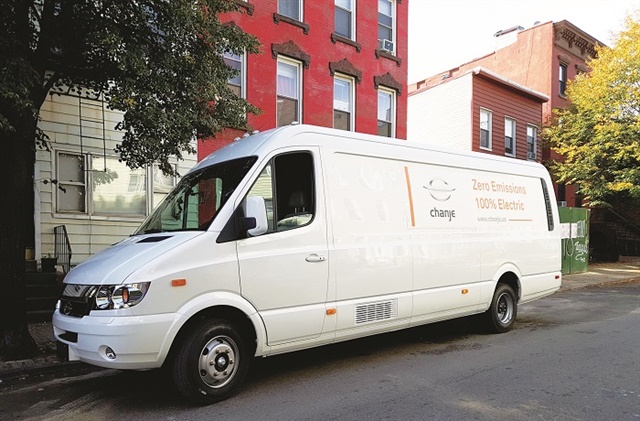
The Chanje V8070 boasts a 580-cubic-foot cargo space on a 26-foot-long chassis that will haul up to 6,000 pounds of payload – and happens to be electrically powered. Photos: Jim Park

">

With my electric-vehicle driving experience limited to electric golf carts on one end of the spectrum and the Class 8 Transpower at the other extreme, I was wide open to a brand-new experience with the Chanje electric van. I have driven comparable-sized delivery vans before, such as Mercedes' Sprinter and Ford's Transit, both diesel- and gasoline-powered. I had some baseline upon which to base my evaluation, but the electric powertrain was new territory.

Chanje's V8070 is billed as a Class 6 truck, with a gross vehicle weight of 16,535 pounds, capable of a 6,000-pound payload in a 580-cubic-foot cargo space. It's positioned as a last-mile delivery truck, intended for service in cities and urban areas where daily mileage usually doesn't exceed 60-80 miles. The Chanje has an advertised range of 100 miles, half loaded on a full battery charge. On paper, it's well spec'd and well positioned to serve the burgeoning package delivery market, or any other application where distance isn't a limiting factor in the choice of powertrain.

It takes about eight hours for a full charge, but partial charges will restore much of the battery's capacity in just a fraction of that time. The company claims a diesel-gallon-equivalent “energy economy” of 50 mpg, with a 70% reduction in energy costs compared to diesel.

Chanje says the van was designed from the ground up as a battery-powered electric vehicle, so the basic structure of the vehicle was conceived to accommodate the battery pack, the motors and the rest of the electrics that run the thing. Under the hood, however, is a traditional engine tunnel, which suggests that in some previous incarnation the ...Read the rest of this story

6 Ways to Stay on Top of Your Parts Inventory

A well-managed parts inventory helps can help a heavy-duty truck fleet prevent downtime and save money. Photo: Paul Hartley

">

There is little more frustrating than having a truck down and not having the parts on hand to fix it. The breadth and depth of your parts inventory and the way you manage that inventory are critical to having the right parts, when you need them, where you need them.

Parts availability is an important factor in an efficient service value chain, says Javier Ferraez, senior director of product management at Decisiv, a provider of service relationship management solutions.

“Having a well-managed parts inventory is a great way to reduce preventable delays and overall downtime,” he explains.

With parts, it's all about “the right part, in the right place at the right time,” says Edward Kuo, founder of Kuo Consulting Group, a consulting firm that focuses on the heavy-duty truck parts aftermarket. “If a fleet has a good vendor who gets them parts right away, that eliminates the need for the fleet to have a big inventory,” because they will have the parts they need for maintenance and repair when they need them.

Here are some tips to help you do a better job of managing parts.

1. Use VMRS codes

Vehicle Maintenance Reporting Standards provide complete and consistent details about parts use. Ferraez says VMRS codes help fleets identify which parts to keep in inventory and which should be procured on an as-needed basis.

“When fleets consistently use VMRS codes in their operations, they're able to look back at component and usage trends,” he says. “That historical perspective helps them improve parts inventory management and the purchasing process.”

According to the American Trucking Associations' Technology & Maintenance Council, VMRS established a “universal language” for fleets, original equipment manufacturers, industry suppliers, computers, and the people who specify, purchase, operate and ...Read the rest of this story

Help Inc. Adds Seven PrePass Sites in North Carolina

Photo: Help Inc.

">

Help Inc. announced seven new operational weigh station bypass locations in North Carolina, increasing the number of stations available to PrePass users traveling in the state.

These sites are in addition to the PrePass sites on I-85 at Hillsborough, which have been in service since 2015. Three additional PrePass sites will be activated in the coming months at Interstate 85 southbound near Charlotte, Interstate 85 northbound in Gaston County, and Interstate 77 northbound near Mount Airy.

The new PrePass sites include:

  • I-95 northbound near Lumberton
  • I-95 southbound in Halifax County
  • I-77 southbound near Mount Airy
  • I-40 eastbound near Asheville
  • I-26 westbound near Hendersonville
  • I-40 eastbound and westbound near Statesville

North Carolina rules require that to be eligible to bypass a state weigh station, each PrePass fleet must have a representative photo on file with the State. If a fleet has more than one truck of the same make and color, only one photo per make and color is necessary. PrePass customers can upload the photos through Prepass.com, or email them to [email protected]. Additional instructions are available here.

Follow @HDTrucking on Twitter

...Read the rest of this story