GOP spending bill not what Republicans voted for?
Former CKE Restaurants CEO Andy Puzder on the Republican spending bill and the feud between former Vice President Joe Biden and President Trump.
Former CKE Restaurants CEO Andy Puzder on the Republican spending bill and the feud between former Vice President Joe Biden and President Trump.

Manufacturing activity this month hit a three-year high, while other reports showed healthy increases in where the economy is headed over the next several months.
U.S. manufacturers experienced a robust and accelerated improvement in their overall business conditions in March, as the IHS Markit Flash U.S. Manufacturing Purchasing Managers' Index rose to a reading of 55.7, from 55.3 in February. A reading above 50 indicates expansion.
The gauge signaled the strongest upturn in manufacturing operating conditions since March 2015. Stronger contributions from the employment, inventories and suppliers' delivery times components helped to lift the headline reading.
The latest data also pointed to robust rises in manufacturing production and new orders, although in both cases the rates of expansion eased since February.
Also, input buying increased at the fastest pace since September 2014, which a number of survey respondents linked to pre-purchasing and stock-building ahead of expected raw material price rises, particularly steel-related items. A number of survey respondents cited higher prices for metals and increased charges by suppliers amid strong demand for raw materials.
The findings are part of a larger report that includes a look at the services industry. The IHS Markit Flash U.S. Composite PMI Output Index declined slightly to a reading of 54.3 this month from 55.8 in February.
“The Flash PMI surveys indicate that the economy likely continued to expand at a robust pace in March, rounding off a solid opening quarter of the year,” said Chris Williamson, chief business economist at IHS Markit. “The surveys are running at a level consistent with annualized first quarter gross domestic product growth approaching 2.5%, though we note that official GDP estimates may once again understate growth in the opening quarter of the year.”
He said the survey found average prices charged for goods and services are rising at one of the strongest rates ...Read the rest of this story

WASHINGTON (AP) — President Donald Trump was ready to hit China with billions of dollars in trade sanctions Thursday for stealing American technology and pressuring U.S. companies to hand it over. Farmers, electronics retailers and other U.S. businesses braced for a backlash as the Chinese government vowed to take "all necessary measures" to defend itself in an emerging economic showdown.

Huawei can't catch a break in the States. Just at the company was set to

Spot truckload freight volume slipped 1.2% and truck posts increased 2% for the week ending March 17, according to DAT Solutions and its load boards, while load-to-truck ratios and rates were relatively even, although both are considerably higher compared to a year ago.
The national average load-to-truck ratio for all freight was 14.1 to 1, meaning there were 14.1 loads for every available truck, nearly double what it was at this time last year.
Load-to-truck ratio for all three equipment types were stable week-over-week:
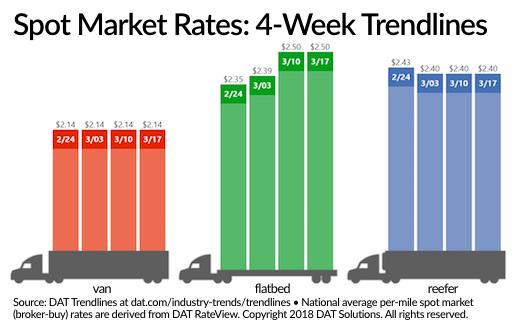
National average spot rates, which include fuel surcharges, were unchanged compared to the previous week but are well ahead of last year's pace:
The number of van loads increased 3.1% last week and truck posts rose 2.2% last week. Overall, rates trended up on 54 of the top 100 lanes while 41 were down and five were unchanged.
Houston volume jumped 4.6% last week. Industrial freight has helped make Houston the leading van market in terms of growth in 2018 so far, according to DAT. Houston-Oklahoma City, a key lane for energy-related freight, gained 22 cents for a rate of $2.35 per mile.
Refrigerated freight volume rose 9% last week, led by increases in 13 of 17 major markets. They include Chicago and Grand Rapids, Michigan, in the Midwest; Sacramento and Twin Falls, Idaho, in the West; New Jersey and Philadelphia in the Northeast; and Dallas in the South Central.
California reefer volumes were up 7.6% ...Read the rest of this story