Are We Adopting Advanced Safety Systems Quickly Enough?
Forward collision warning is becoming more common, but other ADAS technologies lag behind.
“>
Forward collision warning is becoming more common, but other ADAS technologies lag behind.
“>
Advanced driver assistance systems present an opportunity to save thousands of lives and drive economic expansion over the next decade – but we need to move faster, contended Brian Collie, partner and managing director of Boston Consulting Group, in a recent speech.
“We can do better, and we have to do better,” said Collie, speaking to a room full of trucking supplier representatives at the Heavy Duty Manufacturers Association’s Breakfast & Briefing during the North American Commercial Vehicle show in Atlanta this fall.
Boston Consulting Group helps its clients prepare for transformation to help stay at the top of their markets, and in a 2015 study it found that advanced driver assistance systems, such as forward collision warning/mitigation, blind spot detection, lane departure warning, and others, could avert nearly 30% of crashes. The 2015 study, commissioned by HDMA’s parent organization, focused on the sluggish uptake by consumers buying cars, but Collie’s remarks at NACV focused on commercial users.
Each year, he said, large-truck accidents result in more than 4,000 fatalities, $2.4 billion in property damage, and more than $50 billion in societal harm — and 90% of those are caused by human error. Since 2009, he said, large truck crashes and the resulting injuries and fatalities have risen significantly.
“It’s going to get far worse before it gets better,” he said, as distracted driving continues to increase.
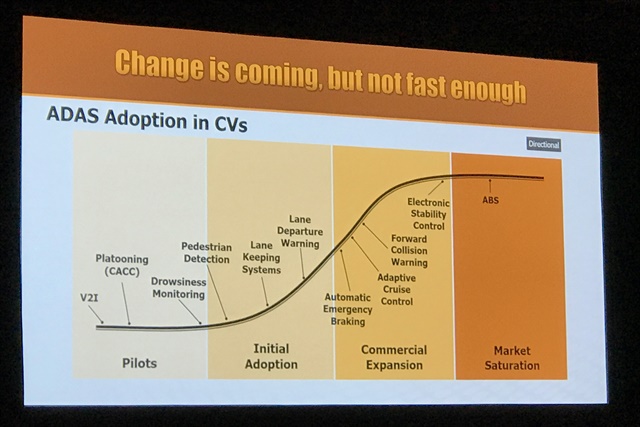
“We do have the answer.” While progress has been made in the last few years seeing adoption of forward collision warning and mitigation systems, he said, in other areas, such as lane keeping systems or drowsiness monitoring, “adoption is not there,” especially among smaller fleets.
And a lot of that comes down to the question of payback, or return on investment. While large fleets tend …Read the rest of this story
