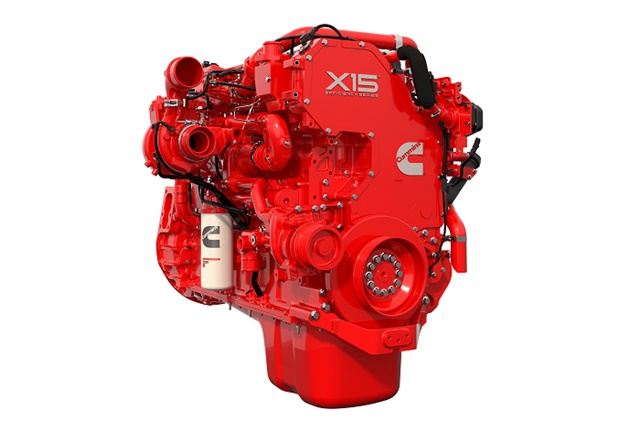
Cummins X15 Efficiency Wins TWNA Technical Achievement Award
Cummins X15 Efficiency diesel’s advanced combustion design merited the 2016 Technical Achievement Award. Photo: Cummins
“>
Cummins X15 Efficiency diesel’s advanced combustion design merited the 2016 Technical Achievement Award. Photo: Cummins
“>
The Cummins X15 Efficiency Series diesel has won the Truck Writers of North America’s 2016 Technical Achievement Award.
The award was presented during an awards luncheon at the American Trucking Associations Technology & Maintenance Council’s annual meeting in Nashville, Tenn.
Cummins redesigned its ISX15 to meet 2017 federal greenhouse gas and fuel economy requirements, and introduced two models called X15 Performance and X15 Efficiency. The Efficiency version employs an Atkinson Cycle in its valve action that adds fuel efficiency important to fleet managers, said John Baxter, a freelance technical writer, former mechanic and a member of the TWNA panel. That caught the attention of his colleagues in the voting.
“The engine won for its advanced combustion design that includes a little-used Atkinson Cycle, and other features,” explained Jim Park, chairman of the TWNA awards committee and Heavy Duty Trucking equipment editor. “It beat out four other finalists who had previously topped a pool of 15 candidates for the award. A panel of industry journalists from Canada and the U.S. debated and voted over a period of several weeks.”
The 14.9-liter diesel gains 3% in fuel efficiency over the preceding model, the ISX15, through improvements to air-handling, combustion efficiency, reduced parasitic losses and advanced electronics, Proctor said. Maintenance should cost 40% less than previous engines over five years, according to Cummins.
“The engine’s valve events are modified so that compression is slightly limited, allowing for greater-than-normal expansion during the power stroke that follows,” he explained. “That means that the gases expand to 20 times their volume at the pistons’ top center by the time they are released, as opposed to standard expansion factors in the range of 15-17 to 1. Allowing the burning gases more room to expand captures energy …Read the rest of this story
