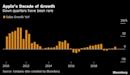
(Bloomberg) -- Apple Inc. reported quarterly revenue that grew 1%, but didn’t provide a forecast for the first time in more than a decade, sparking concern that performance will suffer later this year. The shares fell 2.6% in extended trading.Chief Executive Officer Tim Cook said Apple experienced a “very depressed” period in late March and early April, in the depths of the Covid-19 pandemic, but saw a “pickup” in the second half of this month. The company raised its dividend and expanded a share buyback plan by $50 billion.Fiscal second-quarter sales came in at $58.3 billion, compared with $58 billion a year earlier. That beat Wall Street estimates, according to data compiled by Bloomberg. IPhone revenue was $28.96 billion, down 7%, but also topping analysts’ expectations. Services sales jumped 17% to $13.35 billion, while the wearables and accessories business climbed 23% to $6.28 billion.“The last part of March and the first...
(Bloomberg) -- Amazon.com Inc. Chief Executive Officer Jeff Bezos normally uses the company’s earnings report to extol the virtues of Alexa or the benefits of Prime. On Thursday, he told investors to hold on tight as his company navigates “the hardest time we’ve ever faced.”The largest U.S. online retailer saw profit shrink and said it may incur a loss in the current quarter as it boosts spending to keep logistics operations running smoothly during the coronavirus pandemic.“Under normal circumstances, in this coming Q2, we’d expect to make some $4 billion or more in operating profit,” Bezos said Thursday in a statement reporting Amazon’s results. “But these aren’t normal circumstances. Instead, we expect to spend the entirety of that $4 billion, and perhaps a bit more, on Covid-related expenses getting products to customers and keeping employees safe.”Operating income could range from $1.5 billion to a loss of $1.5 billion in the quarter...
(Bloomberg) -- Visa Inc. Chief Executive Officer Al Kelly warned the firm will be challenged “for a number of quarters” even as declines in spending on its network began to moderate in April.As the U.S. government began sending out stimulus payments to millions of consumers this month, Visa saw an increase in spending on home improvement, automotive and some areas of health care. Still, spending on the firm’s cards in the U.S. has dropped 19% in April compared with the same period a year earlier, according to Chief Financial Officer Vasant Prabhu.To offset the slowdown in spending on its cards, Visa said expenses in the second half of the year would be flat compared with the same period a year ago. The company, which has vowed it won’t make any virus-related layoffs this year, said costs rose 4% to $1.93 billion in the first three months of the year, below the...
(Bloomberg) -- The Federal Reserve revamped its Main Street Lending Program in ways that will allow battered oil companies to qualify for the aid after industry allies lobbied the Trump administration for changes.Larger, more heavily indebted companies can now qualify and use the money to pay off prior loans under the changes the central bank announced Thursday.The move opens the door to more oil and gas producers, said Senator Kevin Cramer, a Republican from North Dakota, who had pressed the administration on the issue as energy companies struggle to survive an epic collapse in fuel demand and crude prices.“With the decrease in demand and oversupply due to the global oil price war creating a valley for these highly leveraged companies, this expansion will help them bridge the gap as we look to reopen America,” Cramer said in an emailed statement Thursday.Environmentalists blasted the shifts they said rewarded oil companies that took...
(Bloomberg) -- One of the biggest U.S. steelmakers is signaling how the coronavirus pandemic is set to inflict pain on blue-collar America.U.S. Steel Corp. expects to lay off about 2,700 employees as the virus forces the company to idle most of its blast furnaces. Even before lockdowns hit the economy, producers were facing slowing demand in the manufacturing sector.Now, U.S. Steel’s moves further illustrate how the virus is turning President Donald Trump’s much-touted “blue-collar boom” into a bust as he heads into November’s election. Economists see an historic economic contraction in the offing and millions of jobs at risk in coming months.Pittsburgh-based U.S. Steel said in a filing Thursday that it sent out notices of plans for layoffs to 6,500 employees, but that it expects the actual number affected to be about 2,700. As of Dec. 31, the company had 27,500 people on the rolls.“It’s all about minimizing or preserving cash...