Kenworth Truck Centres hosts grand opening for new Cambridge facility
Photo: Netradyne
">Photo: Netradyne
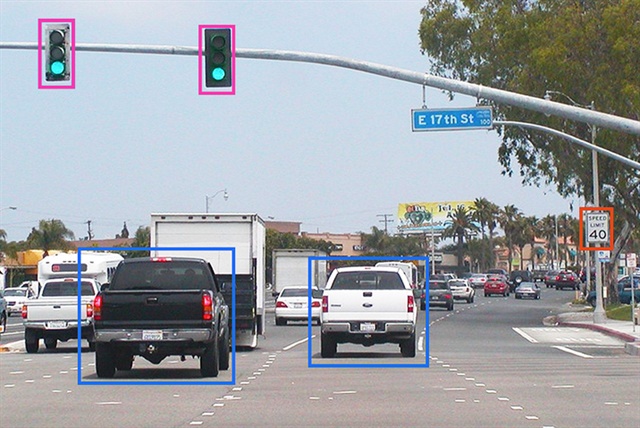
">Netradyne has added three new artificial intelligence deep-learning features to its Driveri platform, including Traffic Light Detection, Relative Speed Determination and Pedestrian Identification.
The Driveri platform is designed to detect and analyze on-vehicle video with artificial intelligence to help drivers and fleets improve performance and understand driving conditions.
The new features are said to provide fleet managers and drivers with greater driving situational visibility:
Traffic Light Detection – through the accurate detection and recognition of traffic lights, fleets gain valuable insight into their routes, capturing a more robust driving view in the absence of an inertial-based trigger
Relative Speed Determination – Driveri analyzes every minute of every driving hour – computing the vehicle's speed against the flow of traffic – providing visibility into potential unsafe speed variances based on road conditions
Pedestrian Identification – expanding on Netradyne's comprehensive deep learning portfolio, the platform can now detect proximity of pedestrians to the vehicle, improving risk analysis
The Fleet Safety Management Center lets fleet managers instantly access video events that have been transmitted based on preconfigured parameters. In addition, EventAccess gives fleet managers the ability to remotely access video events that are stored on the Driveri platform. EventAccess also provides fleets the ability to respond to immediate inquiries regarding claims and customer service requests.
Fleet Managers can query the Driveri dashboard and search video events by driver, vehicle, date, time and location. Results are displayed in an easy-to-view interface, allowing for quick responses and immediate inquiry resolution.
"Through the application of Deep-Learning, fleets are provided with a wider view into the driving environment, allowing for more complete context around the conditions that the fleet is operating under and ultimately making the fleet safer in those driving conditions,” said Avneesh Agrawal, Netradyne's co-founder and CEO.
Related: NetraDyne Builds Artificial Intelligence into Camera-Based Safety System
Follow @HDTrucking ...Read the rest of this story
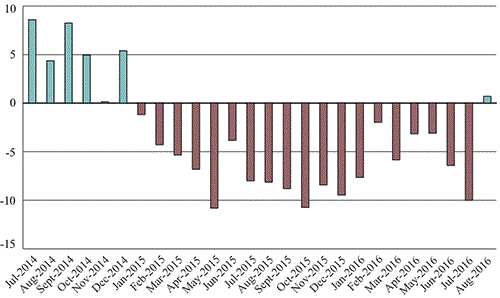
U.S.-NAFTA freight value percent change from previous year over the last 24 months. Graphic: U.S. DOT
" >U.S.-NAFTA freight value percent change from previous year over the last 24 months. Graphic: U.S. DOT
" width="400">The total value of U.S. freight moved between Canada and Mexico during August posted its first year-over-year increase since December 2014, according to new Transportation Department figures.
The resulting 0.7% increase from August 2015 also came as just two transportation modes, truck and air, carried more cross-border freight by value.
The value of commodities moving by truck and air increased 3.4% and 4.9%, respectively, while the value of freight carried by rail fell 0.3%. Pipeline declined 4.5% and vessel dropped 12.5%. The overall value totaled $93.1 billion.
Trucks carried 65.3% of the freight moved with North American Free Trade Agreement (NAFTA) partners Canada and Mexico. Trucking accounted for $31.2 billion of the $49.7 billion of imports, or 62.8%, and $29.6 billion of the $43.4 billion of exports, 68.3%.
Rail remained the second largest mode by value, moving 15.3% of all U.S.-NAFTA freight.
Much of the earlier year-over-year declines were due to the dramatic drop in the price of crude oil compared to two years ago.
U.S.-Canada Freight Value SlipsFrom August 2015 to August 2016, air, rail, and truck carried a higher value of U.S.-Canada freight than a year earlier. However, the total value of U.S.-Canada freight fell to $47.3 billion, down 1.4% from a year earlier, due to decreases in the value of goods moved by vessel and pipeline.
The top commodity category transported between the U.S. and Canada by all modes was vehicles and parts, of which $5.2 billion, or 55.1%, moved by truck and $4 billion, or 42.5%, moved by rail.
Trucks carried 59.6% of the value of the freight to and from Canada. Rail carried 16.5%, followed by pipeline, 9%; air, 4.7%; and vessel, 3.8%.
U.S.-Mexico Freight Value IncreasesIn August the value of U.S.-Mexico freight increased 3% from the same ...Read the rest of this story

At a time when many trucking companies are reporting lower third quarter profits, two report slight gains – but they remain the exception rather than the rule.
International Package Growth Drives UPS ProfitsUPS Inc. (NYSE:UPS) reported net income increased 1% to $1.27 billion, or $1.44 per share, up from $1.257 billion, or $1.39 per share, a year earlier, due in large part to higher profit from international operations. Earnings per share were 1 cent better than analysts' expectations.
Total reported revenue was $14.9 billion, up 4.9% over the same quarter last year for the Georgia-based fleet.
In the company's supply chain and freight segment, revenue increased 8.1%, to $2.6 billion, primarily due to the Coyote Logistics acquisition midway through the third quarter last year.
According to the company, weak market conditions in its air freight forwarding and less-than truckload markets weighed on top-line growth, as operating profit declined 5.9% to $206 million from a year earlier.
UPS Freight LTL revenue per hundredweight increased 3.7% over the same period last year, however, “total tonnage remains challenged by current market conditions," noted the company. UPS Freight revenue fell 5.3% to $701 million.
U.S. domestic package revenue increased 4.8% over the third quarter of 2015, to $9.3 billion, but the unit's operating profit slid 0.5% to $1.25 billion.
International package operating profit jumped 14% to $576 million, a record for any third quarter in company history.
UPS reaffirmed it expects adjusted earnings for 2016 to be between $5.70 to $5.90 per share.
ODFL Profit Edges 1.4% HigherProfits increased by a slightly greater margin at Old Dominion Freight Line Inc. (NASDAQ: ODFL), as the mainly LTL fleet reported a 1.4% uptick, hitting $85.6 million.
Earnings per share in the most recent quarter were $1.03, 6 cents better than a consensus estimate from analysts, and up from 99 cents a year earlier.
Revenue increased just 0.4% ...Read the rest of this story