US government lauds handling of Volvo recall

Image courtesy of FinditParts
">Image courtesy of FinditParts
">FinditParts has launched an expedited shipping program that guarantees second-day delivery on select parts called FinditParts Express.
FinditParts has partnered with UPS to ensure that select parts are received by customers in two days. Effective Nov. 1, more than 50,000 of the company's fastest-moving parts in its online parts catalog will be eligible for guaranteed two-day delivery to most U.S. shipping zones.
Some of these parts will qualify for free shipping and same-day shipping depending on the recipient's proximity to a FinditParts distribution center. The company has added nine regional shipping warehouses throughout the U.S. to improve its distribution coverage for two-day shipping.
“We looked geographically at where our customers were and where the concentration of business was in deciding where to put the warehouses,” said David Seewack, founder and CEO of FinditParts. “We wanted to strategically place inventory in distribution centers where we would be able to get the greatest coverage in the U.S. within two days.”
New distribution centers will be located in Arizona, California, Connecticut, Georgia, Illinois, Minnesota, New York, Oregon and Texas.
Under its previous method of operation, a customer who ordered a variety of parts might get them in multiple shipments from multiple locations. With the FinditParts Express program, customers who select parts in the program will get one shipment of their complete order.
The program was designed to address FinditParts most commonly ordered parts to make the items available more quickly. Parts that are not part of the Express program can also be ordered for two-day delivery, but customers will have to pay for that convenience.
Related: Commentary: Online Parts Sales Growing
Follow @HDTrucking on Twitter
...Read the rest of this storyread more
...Read the rest of this story
A federal appellate court has upheld the Federal Motor Carrier Safety Administration's electronic logging device mandate, which now remains on track to go into effect starting on Dec. 18, 2017.
The U.S. Court of Appeals for the Seventh Circuit rejected the argument of the Owner Operator Independent Drivers Association, which had sued to throw out the rule on the grounds that it would violate drivers' rights to privacy under the Fourth Amendment.
In denying OOIDA's petition for judicial review, the court stated that it found that the ELD rule is “not arbitrary or capricious, nor does it violate the Fourth Amendment.”
Related: OOIDA Fires Back on ELD Rule Ahead of September Court Hearing
Follow @HDTrucking on Twitter
...Read the rest of this storySource: EIA
" >Source: EIA
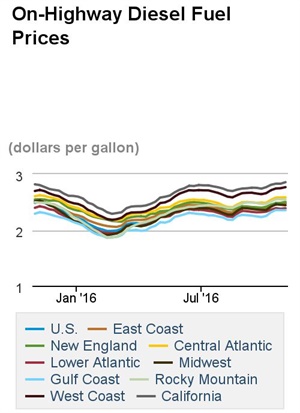
" width="285" height="392">Diesel fuel prices in the U.S. have plateaued again, changing by less than a cent over the past three weeks, according to the latest numbers from the Energy Department.
The average price of on-highway diesel fuel was up 0.01 cents last week, increasing to $2.479 per gallon at the pump. The average price is nearly equal to where it was in the same week of 2015 and is cheaper by only 0.06 cents.
Prices were up in most regions of the U.S. with the largest increase occurring on the West Coast at 1.9 cents per gallon. Some areas saw a decrease in prices with the largest drop being a 0.9-cent decrease in the Rocky Mountain region.
The price of regular gasoline was down last week, falling 1.3 cents and settling at 2.23 cents per gallon. Compared to prices in the same week of last year, gasoline is 0.06 cents more expensive.
The largest decrease in prices by region was in the Midwest where prices fell 3.2 cents for the week. Prices were up in some areas with the West Coast posting a 1.7-cent increase for the week.
Crude oil prices were at the lowest levels in a month as several non-OPEC member countries declined to adjust production levels to lower global demand, according to a MarketWatch report.
Rumors have abounded about a tentative agreement between members OPEC to freeze production levels and address a supply glut that has kept oil prices at low levels for most of 2016. However, with the prospect of a deal becoming uncertain and non-OPEC countries refusing to participate, prices may hover around $50 per barrel for the foreseeable future.
Related: Ploger Transportation Pushes 10 Mpg With a Far-From-Typical Powertrain Spec
Follow @HDTrucking on Twitter
...Read the rest of this story
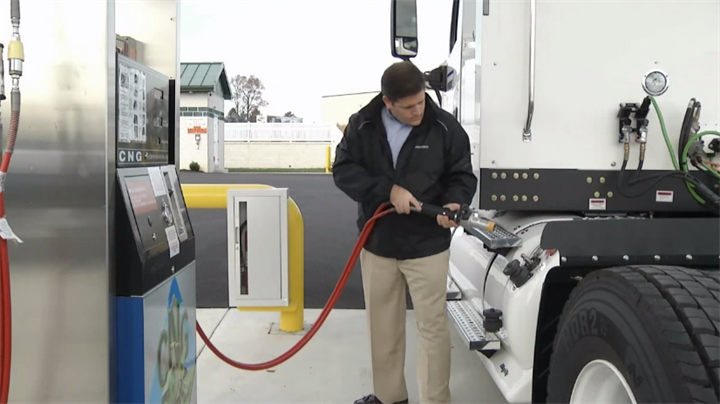
U.S. and Canadian natural gas Class 8 truck sales declined over a three-month period from June to August, according to the latest quarterly report from ACT Research.
Compared to the same three-month period in 2015, sales are down 29%. They are also down 25% year-to-date. On the buying side, natural gas vehicle purchases are mostly dominated by transit bus and refuse truck operators.
Lower amounts of freight and excess capacity have caused all vehicle sales, regardless of the type of fuel used, to be subdued. That has added to the built-in difficulties of the natural gas vehicle market, according to ACT.
“Regardless of the fuel used, heavy trucks are all competing for the same freight, which has failed to increase for at least the last five quarters,” said Steve Tam, ACT vice president.
“Coincidentally, many truckers increased their fleet sizes just as freight growth was slowing, setting up the current situation of excess capacity that is keeping the brakes on new truck sales, irrespective of fuel type," he added.
Related: Alternative Fuels in the Age of Cheap Oil
Follow @HDTrucking on Twitter
...Read the rest of this story