Ritchie Bros' announce last call for 2016

Leave it to Volvo Trucks to come up with a unique and startling way to illustrate the powertrain possibilities of automated manual transmissions (AMTs) – specifically in terms of helping a fully-loaded tractor-trailer maintain speed while saving fuel.
read more
...Read the rest of this storyread more
...Read the rest of this story
Overall U.S. economic growth increased more in the third quarter of the year than first projected, according to a new Commerce Department report, and will likely pave the way for an interest rate hike in December.
The gross domestic product (GDP) expanded at a 3.2% annual rate, its highest level in two years and better than a consensus estimate from analysts. This is higher than the 2.9% rate estimated a month ago and far greater than second quarter annual rate of 1.4%.
The increase in the GDP in the third quarter primarily reflected positive contributions from personal spending, exports, private inventory investment, and federal government spending, according to the department. They were partly offset by negative contributions from residential fixed investment and state and local government spending. Imports, which are a subtraction in the calculation of GDP, increased, but a measure of corporate profits increased for the third straight quarter.
“Looking ahead, advance October international trade data suggest that a large gain in food exports that accounted for much of the third quarter export increase is unwinding in the fourth quarter, while early data also suggests that the add from inventories in third quarter will not be repeated,” said Nathan Janzen, senior economist at RBC Economics. “Nonetheless, indicators of growth in final domestic demand have been stronger.”
He noted household spending continues to be supported by improving labor markets and low interest rates. Indications that investment in the oil and gas sector is bottoming out, and three consecutive, though modest, monthly gains in non-defense capital goods shipments through October, point to a modest near-term strengthening in business investment.
“Today's report does not alter our view that GDP growth remained at a modestly above-potential rate in the fourth quarter, with a stronger gain in final sales to domestic buyers providing further evidence of a strengthening ...Read the rest of this story
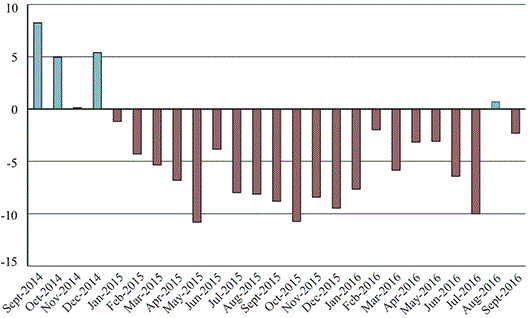
U.S.-NAFTA freight value percent change from previous year over the last 24 months. Graphic: U.S. DOT
U.S.-NAFTA freight value percent change from previous year over the last 24 months. Graphic: U.S. DOT
The value of freight movements between the U.S. and its two next door neighbors moved back into negative territory following the first year-over-year increase since late 2014.
New U.S. Transportation Department figures show only the transportation modes of rail and air carried more U.S. freight by value with North American Free Trade Agreement (NAFTA) partners Canada and Mexico in September compared the same time a year earlier as total freight on all modes decreased 2.3% to $91.1 billion.
The total value of cross-border freight has declined from the same month of the previous year in 20 of the past 21 months beginning in January 2015 with only an increase of 0.7% this past August.
The value of commodities moving by rail and air increased 8% and 3.4% respectively, while the value of freight carried on other modes decreased: truck, 3.8%; pipeline, 5.2% and vessel, 6.8%.
Despite this drop, trucks carried 64.7% of U.S.-NAFTA freight and continued to be the most heavily utilized mode for moving goods to and from both U.S.-NAFTA partners. Trucks accounted for $30.1 billion of the $48.8 billion of imports, or 61.7%, and $28.9 billion of the $42.4 billion of exports, or 68.1%.
Rail remained the second largest mode by value, moving 15.9% of all U.S.-NAFTA freight. The surface transportation modes of truck, rail and pipeline carried 85.5% of the total value of U.S.-NAFTA freight flows.
Canada Freight Value Falls 4.4%The value of U.S.-Canada freight flows fell 4.4% to $46.2 billion in September compared to the same time in 2015 mainly due to decreases in the value of goods moved by vessel and pipeline. All modes of transportation except rail carried a lower value of U.S.-Canada freight than a year earlier.
The top commodity category transported between ...Read the rest of this story