Morrison Express Expands Cross-Border Services in El Paso

Morrison Express Expands Cross-Border Services in El Paso

Logistics, transportation and supply chain management provider Morrison Express is expanding its offering in El Paso, Texas, providing improved cross-border capabilities and logistics.

“We have developed a streamlined shipping and communication process which has delivered an improved and expedited experience for our clients," said Mona Lopez, Morrison Express El Paso operations manager. “As an example, loads reach our facility and cross the border with on-site, bilingual staff who handle the inbound process at origin while communicating in Chinese and see shipments through to pre-inspection by customs in Mexico in Spanish.”

Morrison serves a manufacturing base in Juarez and other cities, moving products like lightweight automotive materials and skins, tablet and technology components, synthetic rubber, and specialized polymers.

The company said manufacturers that have employed American and Mexican back-shoring programs allow suppliers in North America and Asia to cross the border for light assembly or manufacturing using Morrison's Free Trade Zone operations, transportation, logistics and customs experience.

Morrison Express also offers Return Merchandise Authorization to manufacturers that are diagnosing issues, performing testing and quality control —while using certified OEM processes—and returning materials from U.S. retailers across the border and back to plants in Mexico.

"For large electronics manufacturers, Morrison Express offers clients an expedited 2-3 day express service from Korea, Taiwan, China, and Hong Kong via LAX trans-load and cross dock to feed full containers into our El Paso facility," said Eduardo Vargas, Morrison Express director of logistics and customer solutions. “An FTZ operation grants clients numerous benefits including duty deferment until export, unlimited storage time, electronic admission, and the ability to manipulate cargo stateside.”

For more information on Morrison Express, click here.

Follow @HDTrucking on Twitter

...Read the rest of this story
OPEC Deal Sends Diesel, Crude Oil Prices Upward

<img width="150" src="http://www.automotive-fleet.com/fc_images/news/m-diesel-prices-18-1.jpg" border="0" alt="

Source: EIA

" >

Source: EIA

" width="285" height="388">

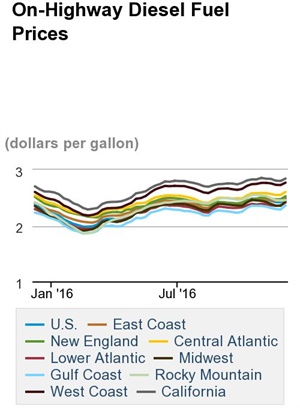
On the heels of a major agreement between oil producing countries to cut oil production, diesel fuel prices saw a significant increase last week, according to the latest numbers from the Energy Department.

The average price of on-highway diesel fuel increased 6 cents last week, hitting $2.48 per gallon at the pump. The price is now 10 cents more expensive than it was in the same week of 2015.

Prices were up in all regions of the U.S. with the largest increase hitting the Midwest with a 7.5-cent jump for the week. The smallest change was in the Rocky Mountain region where prices increased 0.7 cents.

Gasoline prices were also up last week with the average price increasing 5.4 cents to $2.208 per gallon at the pump. The price is now 15.5 cents more expensive than it was in the same week a year ago.

The largest increase in prices occurred in the Lower Atlantic region with an 8-cent increase for the week. The largest decrease in prices was in the Rocky Mountain region, where prices fell 2.6 cents.

Crude oil prices have risen to the highest levels since summer of 2015 as a deal between OPEC members to reduce oil production has increased the market value of oil, according to a MarketWatch report.

Rumors of a deal to cut or freeze oil production have been around for a few month, but until last week's agreement, crude oil prices had remained at low levels due to weaker global demand.

Now, with a cut in production, coupled with the onset of winter in the Northern Hemisphere and other smaller factors, prices seem to be poised for a rebound.

Follow @HDTrucking on Twitter

...Read the rest of this story
November Class 8 Truck Orders Indicate Stabilized Market

There was a significant and expected increase in Class 8 truck order activity during the month of November, according to preliminary numbers from FTR.

Net orders are projected to hit 19,300 units for the month, representing a 41% increase in order activity compared to October. Backlogs are also expected to increase for the first time in 10 months.

“Class 8 orders came in right as expected in November. It is good news that the market has stabilized and is following seasonal trends,” said Don Ake, vice president of commercial vehicles at FTR. “Backlogs should increase in November and December as production dips, however, this order level should allow production to bounce back some in Q1.”

Class 8 order activity for the past 12 months annualizes to 191,000 units, according to FTR.

“The downturn in the Class 8 market was in response to weak manufacturing and lackluster freight growth in 2016,” said Ake. “It appears business inventories have finally dropped and manufacturing is regaining strength. This trend is important for the Class 8 market to regain footing early in 2017.”

Related: Class 8 Orders Were Hurt by Cancellations

Follow @HDTrucking on Twitter

...Read the rest of this story