Echo Global Logistics Earns #3 Spot on Annual Built In Chicago List of Top Digital Companies, Reflecting Firm’s Consistent Employee Growth and Acquisition Strategy

EPA said its new proposed rule to further reduce diesel NOx emissions by 2024 was spurred by several state and city petitions from around the country. Photo: Jim Park
">EPA said its new proposed rule to further reduce diesel NOx emissions by 2024 was spurred by several state and city petitions from around the country. Photo: Jim Park
">If you thought the EPA 2010 diesel exhaust emissions rules were the last you'd ever hear about reducing the nitrous oxide levels coming out of your trucks' exhaust stacks, take a deep breath of clean air and think again.
Earlier this week, the U.S. Environmental Protection Agency announced that, in response to petitions filed by several states, including New York, Connecticut, Washington, Rhode Island, Massachusetts and Vermont, as well as cities with persistent smog problems such as Los Angeles and San Jose, Calif., it would begin work on a new proposed rule aimed at setting lower standards for NOx diesel emissions from heavy-duty diesel engines beginning in model year 2024.
EPA said the initiative is in keeping with its Clean Air Act mandates, which require it to revise standards occasionally to ensure it is doing everything possible to protect public health. The agency noted it has been 16 years since it last revised its NOx standards for heavy-duty diesel engines.
Industry response to the announcement centered on the Truck and Engine Manufacturers Association (EMA), which announced it would cooperate with EPA and the California Air Resources Board to determine if new regulations are warranted and can be implemented in a fashion that keeps costs and exhaust complexity at a minimum for North American fleets and other end users.
“Currently, we don't know the answer to those questions and we need data to help us understand what improvements are possible,” said Jed Mandel, EMA president. “We are willing to cooperate and work in conjunction with anyone in the industry to address these issues.
"We do think there is some room for improvement on the current regulations," he continued. "And ...Read the rest of this story
Image:Modagrafics
">Image:Modagrafics
">Fleet graphics provider Modagrafics has announced signing a sales agent agreement with Blackberry to market the Blackberry Radar asset tracking system to fleet owners.
Blackberry Radar is an asset tracking system for for-hire trucking companies and private fleet operators. It monitors location, critical events and the internal environmental conditions of trailers. The system can help fleet managers optimize trailer usage, improve on-time delivery and generate more revenue per trailer.
“Our focus with Blackberry Radar is to improve the bottom line for fleet owners,” said Derek Kuhn, senior vice president of IoT, Blackberry. “Blackberry Radar provides unparalleled data and analytics tools for fleet managers to locate, optimize, and maintain their trailer fleet. Working with Modagrafics, Radar can disrupt and improve the out-of-home advertising market.”
The Radar tracking device is self-contained and is designed to send fleet managers and dispatchers instant event-driven alerts and regular information updates. The sensors provide indications when cargo is loaded or unloaded, if the trailer is in motion or idle, and when the doors are open or closed. It also monitors trailer conditions, such as temperature, humidity, and barometric pressure. It can handle temperature fluctuations between -40 degrees Fahrenheit and 185 degrees Fahrenheit.
The Blackberry system is designed to share data with a fleet's existing transportation management system. Installation and setup can take as little as 10 minutes per vehicle and each device has a battery life of over three years.
“By combining Modagrafics' marketing and branding products with the Blackberry Radar solution, our customers will not only be able to improve traditional fleet efficiency, but they will have the ability to more effectively manage their brand presence, optimize their out-of-home marketing budget, and increase customer impressions,” said Paul Pirkle, president and CEO of Modagrafics.
For more information, click here.
Related: BlackBerry Offers Asset Tracking for Trucking
Follow
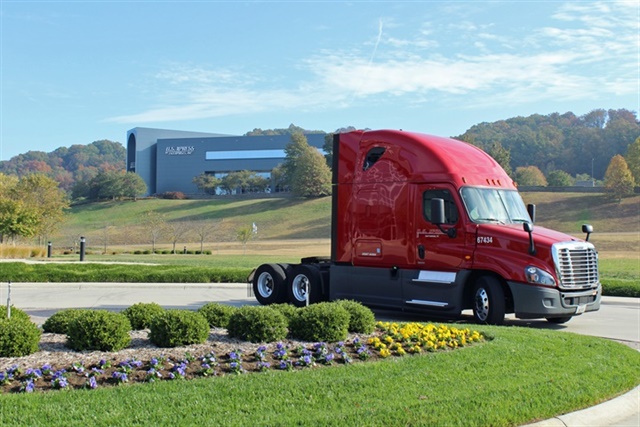
Out of 7,000 U.S. Xpress tractors running on the road today, only 16 “legacy” units are still equipped with manual transmissions. Photo: Jack Roberts
">Out of 7,000 U.S. Xpress tractors running on the road today, only 16 “legacy” units are still equipped with manual transmissions. Photo: Jack Roberts
">Automated manual transmissions rule the roost at U.S. Xpress today. During an event in early November to the fleet's headquarters in Chattanooga, Tennessee, senior vice president of maintenance Gerald “Gerry” Mead noted that out of some 7,000 U.S. Xpress trucks running today, he's down to just 16 “legacy” models still equipped with manual transmissions.
“Our last tractor buy was 100% AMTs,” Mead explained. “And at this point, we just can't see a valid reason to spec a manual transmission – or even an application that would absolutely demand one.”
Mead noted that early versions of the latest-generation of AMTs suffered through some relatively minor teething problems (usually centered on the shifter). Overall, however, he said the integration into U.S. Xpress' fleet has been mostly painless, with the shift toward nearly 100% AMT specs happening far faster than he imagined it would a few years back.
U.S. Xpress specs its AMTs with some unique (and secret) algorithms to meet the fleet's performance and efficiency requirements. While the units have delivered in a big way on fuel economy, they've paid off in other ways as well.
“The drivers love them, so they help with recruiting and retention,” Mead said. “And our maintenance costs are way down. Everyone talks about no longer replacing clutches and greater brake life. And we're seeing those things, too. But we're also seeing reduced overall maintenance costs and greater overall vehicle durability because AMTs don't shake, rattle and vibrate the truck as much when they get going. And reduced vibration is always a good thing from a maintenance point of view.”
Mead noted that manual transmissions are increasingly becoming the “brains” of a truck, coordinating and controlling almost every driving and ...Read the rest of this story