J.B. Hunt Transport Services, Inc. Reports Revenues, Net Earnings and Earnings Per Share for Both the Fourth Quarter and Year Ended December 31, 2016
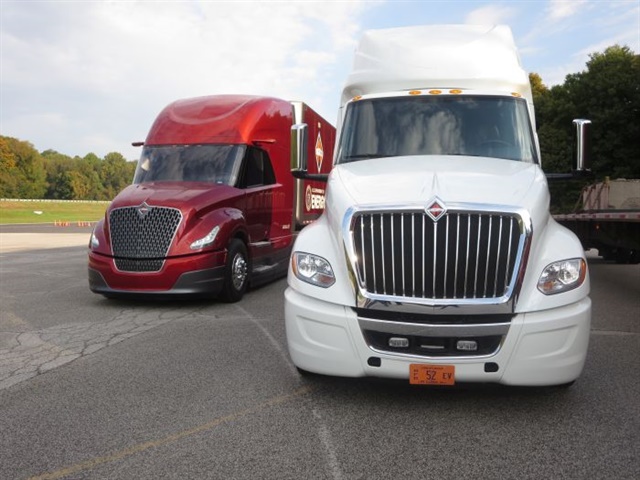
Manufacturers are taking cues from their EPA SuperTruck work to meet the new regs. Navistar's version (left) thus influenced its International LT625 tractor. Photos: Tom Berg
">Manufacturers are taking cues from their EPA SuperTruck work to meet the new regs. Navistar's version (left) thus influenced its International LT625 tractor. Photos: Tom Berg
">What will it cost? That's what truck operators mainly want to know as the federal Phase 2 greenhouse gas and fuel economy standards take hold. Jointly published late last summer by the Environmental Protection Agency and the National Highway Traffic Safety Administration, the 1,700-page set of regulations took effect Dec. 27, and will require reduction of carbon dioxide emissions and greater fuel efficiency for various types of trucks, tractors and trailers, over a 10-year span.
The short answer about cost is hundreds to thousands of dollars per vehicle for each of three model years over the next decade — 2021, 2024 and 2027 — when they will meet increasingly stricter standards. Trailers come sooner, in January 2018. Paybacks at each stage will come in one to four years, according to the agencies' estimates. “We like an 18-month return on investment,” says Glen Kedzie, an American Trucking Associations vice president and the group's energy and environmental affairs counsel. “This is the longest regulation for implementation ever imposed on our industry. It's going to be going on for a decade.”
Yet ATA is “cautiously optimistic” about the Phase 2 regulations, he says. They seek to lower CO2 emissions through reduction of fuel burned, which is a win for both regulators and truck operators. “They considered our concerns, and this is the only regulation that gives us something back,” he says. “In previous regulations, we just wrote the checks and that was it. We're not 100% on board, but we're saying the framework is there to be successful if we don't have any surprises on maintenance, downtime, and cost.”
In the history of diesel pollution-control regulations, which started in earnest in ...Read the rest of this story
Rolf Lockwood
" >Rolf Lockwood
" width="185" height="245">Trucking engenders passion, and I see it in the engineers you depend on, who seem able to beat just about any challenge that comes along. They slide the big lever into gear and they go. I'm especially impressed by those who design engines.
I admire their ingenuity and their inventiveness greatly. There are good ones and bad ones, I suppose, and we've all known engines that weren't exactly impressive. But collectively, the engineers who deliver your horses are a good bunch. And some of them are simply brilliant.
That's a good thing, given the Environmental Protection Agency's continuing insistence that diesel engines get cleaner and cleaner and then cleaner again. And now, for your benefit, more fuel-efficient as well. (The EPA should have started there, in my opinion, but that's a different column.)
Not to say we should have been free to pollute, but you don't have to be a tree-hugger to realize that something had to be done.
My first taste of that need was in 1972 when I lived in London, England, for a couple of years. With thousands of diesel taxis, buses, and trucks running around the city, not to mention a zillion cars and a lot of household and industrial smokestacks burning coal, the air was truly awful.
And how about California? Every year through the 1980s and early 1990s I used to go to Anaheim, just south of Los Angeles, for a truck show. But the air was so bad — literally brown — that it was several years before I realized there should be mountains visible immediately to the east. I just couldn't see them through the haze until one unusually clear day. I was astonished.
London and southern California were worst cases, sure, but they showed us just how bad things could get if we didn't ...Read the rest of this story

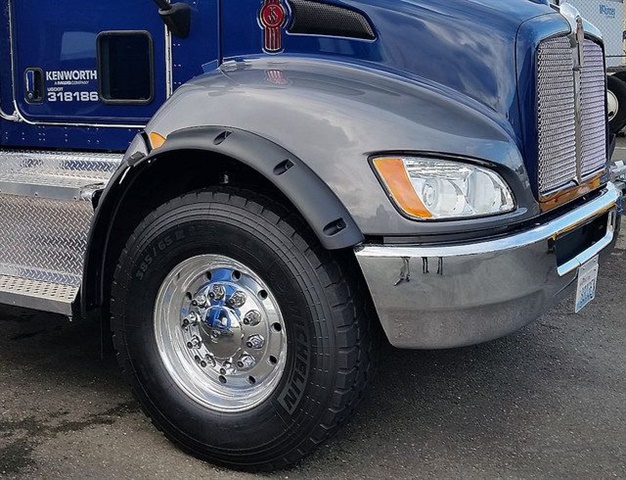
Kenworth is offering wide base tires for applications requiring up to 20,000-pound front axle ratings for the company's T370 truck model.
Available in 385/65R22.5 sizes, from Bridgestone, Goodyear, and Michelin, the tires were previously available only on all-wheel drive T370 steer axles with ratings up to 16,000 pounds.
The Kenworth T370 is also now available with 4.9-inch fender extensions to reduce road spray from the wide base tires.
“These tires can now be ordered for new T370s with our heaviest non-drive front axles – rated at 16,000, 18,000 and 20,000 pounds,” said Kurt Swihart, Kenworth marketing director. “This provides a larger ‘footprint' in vocational applications where off-road conditions, such as mud, can making driving difficult. The tires also comply with standards in certain states and Canada, which require larger tires to carry heavier weights.”
Follow @HDTrucking on Twitter
...Read the rest of this storyread more
...Read the rest of this story