Volvo halts production of 16-liter D16 engine

LAS VEGAS -- The outlook for the U.S. economy is expansion at a pace around trend through 2019, according to Bill Strauss, senior economist and economic advisor, Federal Reserve Bank of Chicago.
Speaking at Heavy Duty Aftermarket Dialogue ahead of Heavy Duty Aftermarket Week, he said he also expects:
Employment to rise moderately with the unemployment rate remaining very lowThe slack in the economy to disappear, which will lead to a gradually rising inflation rateAn increase in manufacturing output at a rate below trend in 2017 and 2018Strauss began his presentation by reviewing what he said at HDAD in 2016. He said he was close on three of his four conclusions. But the fourth, manufacturing output, which he previously had expected to grow at a rate slightly below trend in 2016, actually saw no growth. He attributed this to the value of the U.S. dollar, which caused exports to suffer because the cost of U.S. manufactured goods was higher in foreign markets.
Going forward, he said, “I do not know the impact the new administration will have on the economy. There are lots of uncertainties.” He added that the Federal Reserve does not make assumptions when setting its policies but rather relies on data, so the Fed will have to wait to see what changes are made by the new administration before making any moves of its own.
He did say that a group made up of 50 blue chip companies has not altered its outlook on the economy, predicting 2017 to be a little better than 2016 but not substantially better. “However, there is upside risk that economic growth numbers could be higher,” Strauss said.
According to Strauss, the Federal Open Market Committee expects GDP to grow at around trend over the next three years. He is expecting final numbers for 2016 ...Read the rest of this story
LAS VEGAS. While “no one knows what the new administration will mean for the economy and growth,” the Federal Reserve Bank of Chicago is sticking with its pre-presidential-election view that the economy will grow a bit better in 2017, though that growth won't be substantial.
“We haven't altered our forecast materially, but we do see an upside risk in economic growth,” said Chicago Fed sr. economist and economic advisor Bill Strauss. “There's a better chance of it being stronger than of it being weaker.”
read more
...Read the rest of this storyLAS VEGAS. At just over 40 lbs., the Quantum 99 alloy aluminum wheel for heavy-duty truck applications is 20z% stronger than the company's previous aluminum wheel while weighing 5 lbs. or 11% less, according to Accuride Corp.
read more
...Read the rest of this storySource: EIA
" >Source: EIA
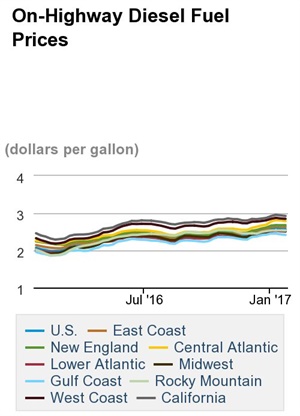
" width="250" height="347">Diesel prices in the U.S. were down for the second week in a row, taking back some of the gains from the start of he year, according to the latest numbers from the Energy Department.
The average price of on-highway diesel fuel fell by 1.6 cents last week, settling at $2.569 per gallon at the pump. That price is still much higher than it was at this point last year, gaining nearly 50 cents compared to 2016.
The drop in average fuel prices was driven mostly by a 2.9-cent decrease in the Midwest, topping all other major regions in the U.S. New England was nearly flat over the same period, losing 0.1 cents for the week.
The average price of regular gasoline was down even more last week, dropping 3.2 cents to $2.326 per gallon. The price of gasoline is currently 47 cents more expensive than it was in the same week a year ago.
By region, the largest decrease in prices occurred in the Midwest, where prices fell by 6.4 cents per gallon. The smallest drop was on the West Coast, where gas prices fell by an average 0.7 cents.
Fuel prices seem to be mirroring the crude oil market, as the price of a barrel of crude oil was down in trading to start the week. Oil prices were trending upward to start the year in anticipation of a deal between OPEC countries to freeze or cut oil production. However, the deal has also reignited U.S. crude oil production, which has subdued any gains, according to a MarketWatch report.
OPEC originally agreed to cut oil production to meet lower global demand and drive up crude oil prices. However, the resulting increase in prices made the U.S. oil industry, particularly the shale oil portion, profitable enough to ramp up ...Read the rest of this story

SAF-Holland USA says it will close its two plants in Michigan and shift their component manufacturing to three of its remaining factories, which are closer to customers. As part of the restructuring, the Muskegon facility will retain the company's Americas headquarters and engineering operations, and absorb sales and administrative functions from Holland.
Production will transition to locations in Dumas, Arkansas, Cincinnati, Ohio, and Wylie, Texas, the company announced last week. It will invest about $3 million at those facilities, and will build "a new state-of-the-art engineering and technology center" in Muskegon. Two other U.S. plants are not affected.
All production now in the U.S. will stay here, Steffen Schewerda, president, Americas, for SAF-Holland, told HDT on Jan. 23.
Meanwhile, production will be adjusted to lower demand for components as a part of "market swings," he said. For the coming year, "the forecast is a little bit down in the truck business and a little bit down in the trailer business. Nothing abnormal.
"For me, it's a matter of the external and internal supply chain and where is my customer base," he continued. "Logistics is a huge part of costs." For example, moving some production to Cincinnati will better serve the Kenworth plant at Chillicothe, in southern Ohio.
Ending of Michigan production will affect 230 jobs, of which 180 to 190 will go to Cincinnati, Dumas and Wylie. Michigan workers who are willing to move might get at least some of those jobs, Schewerda said. Sixty to 70 administrative workers from Holland will be shifted to Muskegon, about 30 miles away.
The Muskegon and Holland plants now make auxiliary-axle suspensions, fifth wheels, couplings and drawbars.
The transition, which is expected to be implemented over 18 months, will lead to one-time restructuring costs of as much as $10 million ...Read the rest of this story